Showing posts with label DBT. Show all posts

Wednesday, January 09, 2013

Vodoo continued: my final Statement on USB cables


This article here is the final sequel to "Hot Vodoo: Audio differences between USB cables - yes, they do exist" and "More USB cables - more differences". So before you read this one go ahead and scroll through the other two.

Almost one year has passed since my last article concerning USB cables and their sonic signatures was published here. Truth is that I ran out of steam: I didn´t want to do it since I was afraid that I had been measuring the effects of ground loops only. But before I start with the embarassing truth I´ll tell you about the stir those two USB articles created. The articles I refer to (linked above) were written almost a year ago and since then they have been popping up constantly in several online forums. I´ve received visits from Russians, Germans, Americans, Norwegians, Japanese or Chinese citizens to name but a few. Sometimes the participants of these forums made fun of me, sometimes they tried to find out how I was doing things, sometimes I was accused of lying or imagining things and on some occasions people actually tried to help me. It fascinates me to this day that 99 % of all those people didn´t comment here on my blog but only in their respective habitat, forums I´ve never heard of before. Since I´m the most gleefully cunning person I occasionally registered there just to take part in their discussions... and boy, it was delightful to witness how fast participants there transformed from being bullies into polite, elaborate people upon myself unexpectedly taking part in those discussions. Without me it was 'chic' to mock me - so why did people stop when I suddenly entered? I love mockery, especially when it´s about me (I tend to be too self-centered sometimes). This wasn´t restricted to one country, no, it was a trait exhibited by people coming from all around the world. For all those who were doubting me throughout the last year I assume this article will be a field day which is perfectly alright - yet it saddens me that people generally seem to ignore transparency and truthfulness. But let´s start, eh?

USB cables revisited: only the Belkin and the Audioquest were used
In the last article I compared five different USB cables, for the article you are now reading I used only two of them: the Belkin which performed the best & the Audioquest which performed the worst. Since the measurment differences between those two were the strongest I assumed that they´d be the most likely candidates for also showing differences today. Likewise, I used my Creative Labs Soundblaster X-Fi HD USB again... BTW, that was the most peculiar thing... because in those forums I mentionend above I was attacked for measuring cheap hardware 'on my kitchen table'. Well, of course I did, that was the whole point. What good would my test have been if I would measure with expensive boutique hardware (which I don´t own, thank you very much)? I wanted to show results with everyday hardware, something people would actually buy. That way my results would (hopefully) be more comprehensible. Furthermore, assuming that something more expensive is behaving in a superior way is audiophile bullshit. One word about the 'kitchen table' comment... I will ignore it since it reveals opinions much too conservative for my taste. Just something to think about. Back to topic: I had to use the X-Fi HD USB and my ASUS Xonar Essence ST again since I wanted to compare possible differences between one year ago and today. My testing methodology may have changed / improved during the last year, yet I still have to make sure to repeat testing circumstances exactly as before to obtain reliable results.

Creative Labs Soundblaster X-Fi HD USB was used again
For that reason my testing chain then and now consists of the X-Fi HD USB connected via the Audioquest King Cobra RCA cable to the Xonar Essence ST. The last time both soundcards were powered by my desktop PC and since that obviously created the problematic grounding loop I now took a slightly different approach. This time I used my nine year old laptop, an FSC Amilo 1425 which was used to power my X-Fi HD. Naturally this laptop is able to run on batteries, it completely avoids grounding loops that way. Everything else was the same though: the Creative still was connected to the ASUS with exactly the same RCA cable. The laptop uses Windows XP as its OS so I had to utilize the Kernel Streaming plugin for foobar2000 to avoid potentially harmful resampling (one year ago: WASAPI direct connection on Windows 7). Another difference to the older test is that I decided to show you the results of ten test runs (five for every USB cable). I also did five test runs for the last test but I sadly failed to disclose their results. So, let´s have a look at the facts, shall we?

For comparison: Old results, one year ago, both interfaces run from the same PC

Belkin USB cable, two different PCs, one running on batteries,
five different test runs which have been averaged for this table

Audioquest Forest USB cable, two different PCs, one running on batteries,
five different test runs which have been averaged for this table
Shit! You now can see that one year ago I indeed measured the effects of a ground loop caused by using the same PC for both interfaces. With one interface running on batteries and by that removing the ground loop I also removed the measurment differences between the two USB cables, the lower resistance of the Audioquest is not important anymore. Yes, the X-Fi HD USB now measures EXACTLY the same with two different USB cables. Which probably means that 1. differences between USB cables don´t exist or 2. that I indeed can´t measure them with my limited hardware or 3. that I need more and different measurments. In any way, two things are now crystal clear: the X-Fi HD USB is a gorgeous performer on its line-out while the Xonar Essence ST boasts an equally impressive line-in. With measurment results as fantastic as these it´s hard to imagine that more expensive soundcards can do much better; you also have to keep in mind that both cards are relatively cheap and are far away from being hardware for demanding professionals. Just take the noise levels: they have improved by roughly 12 dB - Creative was indeed telling the truth by claiming a noisefloor as low as -114 dB for the X-Fi HD. Back to the USB cables: the only differences I was able to find were so small that they are truly insiginificant:

X-Fi HD USB, Belkin USB cable
X-Fi HD USB, Audioquest Forest USB cable
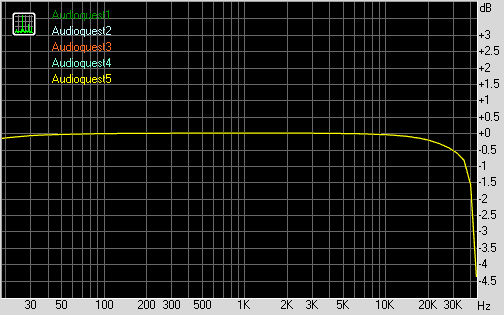
Click on the upper of those two pictures, that way you can scroll between them using your mouse wheel - only then you´ll see that the X-Fi HD USB has a very, very slightly improved high frequency performance with the Audioquest. That´s it. You could now say "Hey, there is a difference!" Erm... no, there isn´t. It is way too tiny to be of significance. Maybe distortions are able to reveal something else?

X-Fi HD USB, THD & Noise, Belkin USB cable
X-Fi HD USB, THD & Noise, Audioquest USB cable
Again, click on one of those two pictures and scroll between them with your mouse wheel and you´ll see that nothing changes - again. If at all, only the noisefloor seems to reveal a slight tendency in favor of the Belkin so I won´t bore you with additional non-existing differences between two pictures. Today I´ve learned two things: ground loops are evil & USB cable differences cannot be measured when using my approach. Phew, now I´m embarrased: I wrote two articles that were basically describing the effects of a ground loop! Stupid, stupid, stupid. But wait, has the sound changed? That´s where it gets interesting because it hasn´t. The X-Fi HD USB still sounds its best with the Audioquest Forest USB and the worst with the Belkin. Let me point out that the sonic differences are indeed small, I assume that they won´t be audible to 90 % of all people. But I started this article with an emphasis on being honest and truthful (which I always am - and which is painful here) and therefore I´ll tell you that I had doubts about my ability to hear things; I was afraid I might have encountered a prime example of a placebo. So I did what I usually detest, namely a Double Blind Testthe results of which you can see below:

foo_abx 1.3.4 report
foobar2000 v1.2
2013/01/09 02:54:00
File A: RAM-Disk:Audioquest.wav
File B: RAM-Disk:Belkin.wav
02:54:00 : Test started.
02:55:31 : 01/01  50.0%
02:56:05 : 02/02  25.0%
02:56:27 : 03/03  12.5%
02:57:05 : 04/04  6.3%
02:57:18 : 05/05  3.1%
02:57:28 : 05/06  10.9%
02:57:45 : 06/07  6.3%
02:58:01 : 06/08  14.5%
02:58:19 : 07/09  9.0%
02:58:33 : 08/10  5.5%
02:58:48 : 08/11  11.3%
02:58:59 : 09/12  7.3%
02:59:17 : 10/13  4.6%
03:00:01 : 11/14  2.9%
03:00:17 : 12/15  1.8%
03:00:35 : 13/16  1.1%
03:00:51 : 14/17  0.6%
03:00:54 : Test finished.
 ----------
Total: 14/17 (0.6%)
I had occasional problems making out differences. It took me 17 trials during roughly seven minutes to find out if I was imagining things - but now I´m at least confident that my ears (and brain) are still fully functional. I´m no so-called 'Golden Ear', those are a myth. Audiophiles often claim that they are able to hear more than, say, skeptical people relying purely on measurments - which isn´t true. The only thing that´s valid to state is that there are people out there who have trained themselves to hear differently compared to others. I only hear this because I know what to listen for, nothing more. I´m also proud of my (perhaps imaginary) ability of not falling for typical placebo effects. "How can Marlene be so arrogant and full of herself?" you ask... maybe you´re right, look what being conceited brought me: grounding loops! All kidding aside, the situation of most of the time knowing what to listen for really isn´t the easiest thing to live with. I sometimes wish to have the gift of blissful ignorance because everytime I hear an album I immediately spot errors or defects & I cannot enjoy the music until they are gone. This might sound contrived to you but it prompts me to ignore bad sounding albums, even if the music is engaging. Imagine the time I could save by not being obsessed with these things. Enough with the cocky self pitying and back to topic!

Measures extremely well on its line-out: Creative Labs Soundblaster X-Fi HD USB

I´m afraid there isn´t that much to conclude. I still hear the effects of different USB cables, yet I´m unable to measure them; the centuries old dilemma of audiophiles. It all leads to you and the decisions you make, dear reader. Are you a believer or a skeptic? I hate to exploit this common prejudice but I started measuring USB cables through external soundcards as a means of diminishing troubles between those two groups - I thoroughly failed. The only thing I did was creating a lot of hot air. Shame on me. I did however learn a few things: more expensive cables have less resistance causing ground loops to leak through more easily, that I cannot measure everything, that ground loops hamper effective resolution and that the X-Fi HD USB is a great performer on its line-out. But where is the benefit for you?


Wednesday, June 27, 2012

Sound quality differences with optical outputs - why?


For years I haven´t been bothered with digital S/PDIF connections. I basically stopped using them in 2001 when I got rid of my MD deck. This deck had been connected using its RCA digital input, only because everyone was saying that these gave superior sounding results. I never actually checked out if this was true with the result that I ignored optical Toslink in-/outputs back then. But my recent encounters with the Sony MZ-R 30 and the Sony MZ-R 900 forced me to use them again - they are the only way with which I can achieve digital copies with these MD recorders. Thankfully many of my vintage portable CD players are equipped with an optical TOSLINK interface, sometimes I also bought them for this reason. With an optical cable I can connect my PCDPs to an MD recorder to create a digital copy even including trackmarks automatically set by the MiniDisc recorder.

Optical mini-Toslink on the Sony D-335

During the last few weeks I recorded roughly twelve MiniDiscs. Some were recorded with the respective CDs played back by my Sony D-465 or the Sony D-335, some were recorded with the Creative Soundblaster X-Fi HD USB as their the digital source. To my surprise the CDs copied with those two CD players sounded different to what I´m used to, it was apparent that the sound signature had been changed somehow. The ones made with my Creative sounded pristine instead. To use an analogy: recordings from my CD players sounded like a decent analogue copy while the ones from the Creative sounded like the originals. But how can this be true? In both cases I used an optical cable that transferred its data digitally, effectively creating a second original (ignoring the lossy ATRAC compression). All the digital outputs I´ve used so far are bit-perfect meaning they won´t change the digital signal in any way. I´ve confirmed this with one of my CDs from TELARC, a rare example of a DTS-recording they released some 15 years ago. Our Sony STR-DB 830 QS is able to recognize the digital signal as DTS-encoded, it doesn´t matter which device is doing the playback. So why do I hear differences between digital signals? It just doesn´t make sense.

My optical fiber cable (copyright: Philips)

The cable you can see above is the one I´ve used for all my tests involving MD recorders and my Creative. Build quality is good... the gold plated "connectors" don´t make sense of course; the signal is pure light and cannot be influenced by the conductivity of certain metals. People seem to expect it though... what the heck, it looks nice doesn´t it? Back to the question of why I´m hearing differences. The S/PDIF protocol necessary for digital Toslink transfer has several disadvantages. The most significant is that the receiver of the signal doesn´t control it, the sender does. Because of that it must synchronize its internal clock (necessary for D/A converting) to the one contained inside the signal itself which is generated by the device transmitting it. Now in case of jitter (you knew that I would mention this, didn´t you?) introduced by an unstable or polluted clock the receiver (D/A converter or MiniDisc) won´t have a stable clock reference, in effect making jitter audible upon conversion to analogue signals. Research into this subject has been going on for years, for example from members of the AES. This influence can be reduced of course by reclocking the incoming signal. Both my MiniDisc recorders do exactly that: they reclock the signal with their built-in samplerate converter, effectively creating their own clock reference. Another impermeable wall for jitter is the MiniDisc writing process itself because it is another reclocking step. All of this should in theory eliminate jitter completely. Would it be able to survive it would result in distortions not unlike those found in intermodulation distortion and in a compromised stability and clarity of the stereo image. How are my MD recorders doing this reclocking? They probably use a phase-locked loop circuit (PLL) which you can imagine as a huge flywheel averaging out speed variations. Depending on the quality and implementation of the PLL jitter reduction is more or less successful, according to an article from Soundonsound it cannot ever be eliminated completely though. Attention: even with jitter the transferred signal will always be the same, it still contains the same 0 and 1, albeit at different places (sort of).

Jitter test signal on MZ-R 900, played back by Creative Soundblaster X-Fi HD USB

Jitter test signal on MZ-R 900, played back by Sony D-465

Look at the two pictures above by clicking on one of them, then scroll through them with your mousewheel. They were created employing the Sony MZ-R 900, its analogue output recorded with my E-MU 0202 USB. I set the MD recorder into record-pause mode in order for it to serve as a D/A converter only without the result being distorted by the ATRAC encoding. In both cases I used exactly the same signal, it´s the jitter test I usually use for my vintage portable CD players. In case of the Creative it was played back by foobar2000, utilizing the WASAPI interface of the soundcard - without resampling of course. Exactly the same file (this time burned on a CD-R) was then played back by the D-465. Level matching was unnecessary since both results have the same gain. On the pictures you can see that the spread of the signal is wider with the Creative. With the signal played back by the D-465 however there are additional sidebands absent with the Creative. The example below also exhibits a noisefloor higher for roughly 1-2 dB. While I assume these tiny differences to be insignificant, they (or something else) do have an audible effect on music. Recorded from the D-465 music has an unsharp and compact image, sounding a bit bloated and less crisp. Piano for instance sounds a bit distorted while strings loose their gloss. All of this was restored to normal when the Creative was used as a digital source for recording. I even did a DBT, not only for you but also for myself to make perfectly sure that I wasn´t hallucinating these differences:

foo_abx 1.3.4 report
foobar2000 v1.1.13
2012/06/25 20:54:42
File A: D:\Coast Guard Rescue Creative.wav
File B: D:\Coast Guard Rescue D-465.wav
20:54:42 : Test started.
20:56:15 : 01/01 50.0%
20:57:00 : 02/02 25.0%
20:57:29 : 03/03 12.5%
20:57:48 : 04/04 6.3%
20:58:08 : 05/05 3.1%
20:58:26 : 06/06 1.6%
20:59:45 : 06/07 6.3%
21:00:00 : 07/08 3.5%
21:00:06 : 08/09 2.0%
21:00:41 : 09/10 1.1%
21:01:01 : 10/11 0.6%
21:01:08 : Test finished.
----------
Total: 10/11 (0.6%)

For this DBT I recorded the same track ("Coast Guard Rescue", The Perfect Storm) twice, again with the D-465 and the Creative. Level matching was unnecessary as both had the same level, they needed precise alignment of course in order for the DBT to be successful. By this example you can see that different digital sources might have an impact on sound, even when they are bit-perfect. I´ve subsequently tested several other players and their digital outputs: all my portables appear to be susceptibe to something that distorts the digital sound while still being able to transfer a bit-perfect digital signal. There was only one portable player coming closer to the clarity of the Creative transferred signal, the DE-J 725. It didn´t sound bloated but flat and uninvolving (strangeley mirroring its analogue signature). The player almost sounding like an exact clone of the Creative was my Pioneer DV-610 AV which is nothing more than a simple DVD player. Are the reasons for this jitter? Or is it something else? I´d like to know if you, dear reader, have made similar experiences. Maybe my portables do have an unstable clock source or their signal gets distorted by other factors unknown to me yet. In either case the Creative once again proves itself to be a very reliable device of high quality. Additionally a clean digital signal from the source seems to be vital for perfect sound. To all the doubters out there: a bit-perfect realtime signal doesn´t mean that it´s free from some kind of distortion! You might now think that everything is a bliss - you are mistaken there. Recording to MD with the Creative is quite tiresome, trackmarks are not transmitted and therefore I have to set them myself after recording which essentially means that I have to divide a single, 60-minutes track into several pieces. But I´m obviously not a person that loves convenience that much (Exhibit: using MD recorders) so my desire for quality usually gets the upper hand and in the end I´m rewarded with perfect sound quality from MiniDisc. Before I forget: my reviews for the MZ-R 30 and the MZ-R 900 have been done with recordings from the Creative.


Last update: 10.01.2013

Sunday, June 24, 2012

The Devil is an MD Recorder: Sony MZ-R 900 Review


You might ask: "Has she gone mad now?" No, she hasn´t. But an MD Recorder can be devilish good, that´s for sure. While the recorder I wanna talk about does not come from Spain like me in the movie "The Devil is a Woman" (pictured above) it still is able to embody the typical passion spanish Latin Lovers are known for. Well, I´m not a woman known for clichés and as much as my movie partner Cesar Romero actually was born in the U.S.A I never have been in Spain... nevermind. I´d really like to write about the Sony MZ-R 900 instead which is another MD recorder. In my last article I reviewed the Sony MZ-R 30 while also explaining the several ATRAC revisions Sony did over the 19 years the MD lasted. I also tested the Wide Bit Stream capability of my Sony MZ-R 30 and much to my surprise it was able to process digital data with a bitdepth of 24 Bit through its optical line-in. There was one obstacle though: its combined A/D/D/A converter works only at a bitdepth of 16 Bit; the 24 Bit ATRAC-processing was therefore useless. But a few days ago I was lucky and bought the Sony MZ-R 900 for very little money and that particular unit behaves a bit differently. When released in 2000 it cost 350,- Euros which makes it more expensive than my MZ-R 30 (300,- €) from three years prior. During these three years a lot happened with portable MD recorders... they became incredible tiny and loaded with features.

Sony MZ-R 900 compared to a cigarette

It´s exactly as big as an MD case (except height) which poses more problems than you might think: due to its small size and light weight it will move by itself when for example the recorder is lying on a table and one pulls on the headphone cable / FiiO E6 only slightly. It feels fragile even though its build quality is astonishing nonetheless. The precision Sony assembled it with is wonderful to look at, touching the housing feels lovely. The drive however... from my MZ-R 30 I cannot hear a thing when it records or plays a MiniDisc but the MZ-R 900 is loud as hell in comparison. According to the Manual this is normal behaviour but it still betrays its manufacturing quality in my opinion. This tiny recorder contains so many new features compared to the MZ-R 30... to write them all down here would be too much. I suggest you read about them on MZ-R 900' MD Community page should you be interested in them. Features are lovely, problems are not: our Kenwood exhibits some difficulty playing MDs recorded by the MZ-R 900. It will skip in the middle of one track to the next, it will even skip entire tracks. A few seconds prior one can hear its drive working hard to maintain the reading process. I guess the DM-5090 is starting to break down because the MZ-R 30 doesn´t have any problems whatsoever with these discs. Another thing: the headphone shares its output with the line out so you have to configure which one to use in the menu of the recorder. This wouldn´t be so unnerving if the recorder would actually remember this setting - the moment you change a disc or remove power it has "forgotten" everything. From what I´ve read the successor to the MZ-R 900 (MZ-R 901) rectifies this - a wise decision, Sony!

Sony MZ-R 900 in/ outputs

The MZ-R 900 is equipped with an ATRAC 4.5 IC, an improved version of the ATRAC encoder compared to the one built into my MZ-R 30. Through higher computational accuracy Sony managed to improve distortions by roughly 3 dB while also including a feature called "Adaptive High Band Control". The latter would ideally be responsible for an extended frequency response into higher frequencies. Just like the MZ-R 30 it also has a combined A/D/D/A converter, again from Asahi Kasei. This time it´s an AK4562, according to its manufacturer capable of recording and playback of 20 Bit signals. You shouldn´t hold up your hopes too much though: the tiny MD recorder and its converter IC are manufactured with portable use in mind and Asahi Kasei rates the D/A-part of the converter having an S/R of only -93 dB. This is not even barely good enough for pure 16 Bit performance with the result that I won´t expect too much from this unit when it comes to measurments.

Sony MZ-R 900 measurments (used as a D/A converter only through its analogue output)

ATRAC 4.5 measurments with the Kenwood DM-5090 (only through its optical output)


The measurments through its analogue output reveal nothing interesting for it behaves similar to many of my vintage portable CD players. But the chart above also reveals - just as I expected - that the D/A-converter isn´t really 20 Bit, it performs at 16 Bit at best (if I ignore the missing 3.8 dB). I have to add a little explanation: its true resolution probably reaches 20 Bits - useless though when it´s swallowed by noise resulting in a far less impressive usable resolution. For the ATRAC chart I used a testsignal recording digitally made with the MZ-R 900 that was subsequently played back by the Kenwood (it´s the only MD recorder I own that sports a digital output. Its digital signal was recorded using my Creatives' optical input. THD + Noise indeed have improved for 2 dB, IMD + Noise are better as well while the Noise level is 1 dB higher. Well done Sony... (small) step by (small) step you managed to improve the codec all those years ago (irony intended). Now I just need an ATRAC 4.5 Typ-R (according to tests it´s much better) capable MD recorder and everything will be perfect. As I mentionend during my last review I had a hard time hearing differences between the original and the ATRAC encoded version - but since then I encountered some forum posts stating that there are indeed signals able to "trip" the ATRAC ICs. I might perform some tests with these signals myself in case I should be able to purchase a unit equipped with 4.5 Typ-R.


Sony MZ-R 900 detail

The MZ-R 900 sounds very well indeed. True to the title of this review it shows explosive dynamics which on occasion tend to get too harsh and forwarding, sometimes they feel contrived and aggressive. In general it prefers high frequencies instead of presenting a completely balanced soundscape while base and mids are slightly underrepresented. This leads to a sound that can be described as euphonically charming, not the truth but tasty nonetheless. Because of its well articulated treble it presents details with analytical precision; even then the highest frequencies are diminished leading to a sound that´s drier and edgier than my references. I believe all of this to be caused by its mediocre jitter peformance; high frequency jitter brightens up the sound, low frequency jitter muddies lower frequencies. To me both results are evident here. The staging is another thing: it´s not as wide and layered as it should be, dimensions are reduced a bit. Performers mixed to the center for example tend to be too distant, on the other hand everything else surrounding these performers is encapsulated in its own 'stage bubble', including reverberation. The virtual room doesn´t sound like the original, members of an orchestra seem to change their places, reverb tails don´t seem to be as long as they are on the reference. In short: it replaces the original Ambiance with its own, highly characteristic one. Timing is another thing... while high frequency agility is excellent, mids and bass are slightly slower and miss punch and snap. All of this combined creates a dynamically powerful, slightly edgy yet charming sounding machine. It certainly is superior than other MD recorders, even superior than many of my portable CD players.
One word about its headphone output: usually I don´t talk about these, in this case I´ll make an exception because it sounds so well. The sound coming out of the MZ-R 900 when the FiiO amplifies my Sennheiser HD-448 does not change from the sound of its own amplifier. I´d use it all the time... if it wouldn´t be so weak. It simply isn´t strong enough to yield enough gain with my 32 Ohms HD-448 - a shame really.

Sonic Balance:
Dynamics:
Resolution:
Stage / Ambiance:
Character:


Sony MZ-R 900 side
Sony MZ-R 900 with one of those famed white ES MiniDiscs

Concluding my review I´d like to say that I have mixed feelings about this little recorder. The finishing quality is wonderful but it´s too small for the purpose of residing on my desktop. Yeah, I´m stupid here, I know. I´m well aware that it is a portable MD recorder and that its size makes it very convenient to carry it around. But for that purpose its headphone output isn´t strong enough to power low impedance headphones convincingly. And while the sound oozes charme and explosive dynamics it can be too edgy and aggressive at times. I think that I will indeed search for a third machine to buy, maybe one that also is NetMD equipped, I don´t know. Stay tuned!

Sony MZ-R 900
Last update: 24.07.2012

Monday, January 23, 2012

Wahoo: Portable CD players shootout!


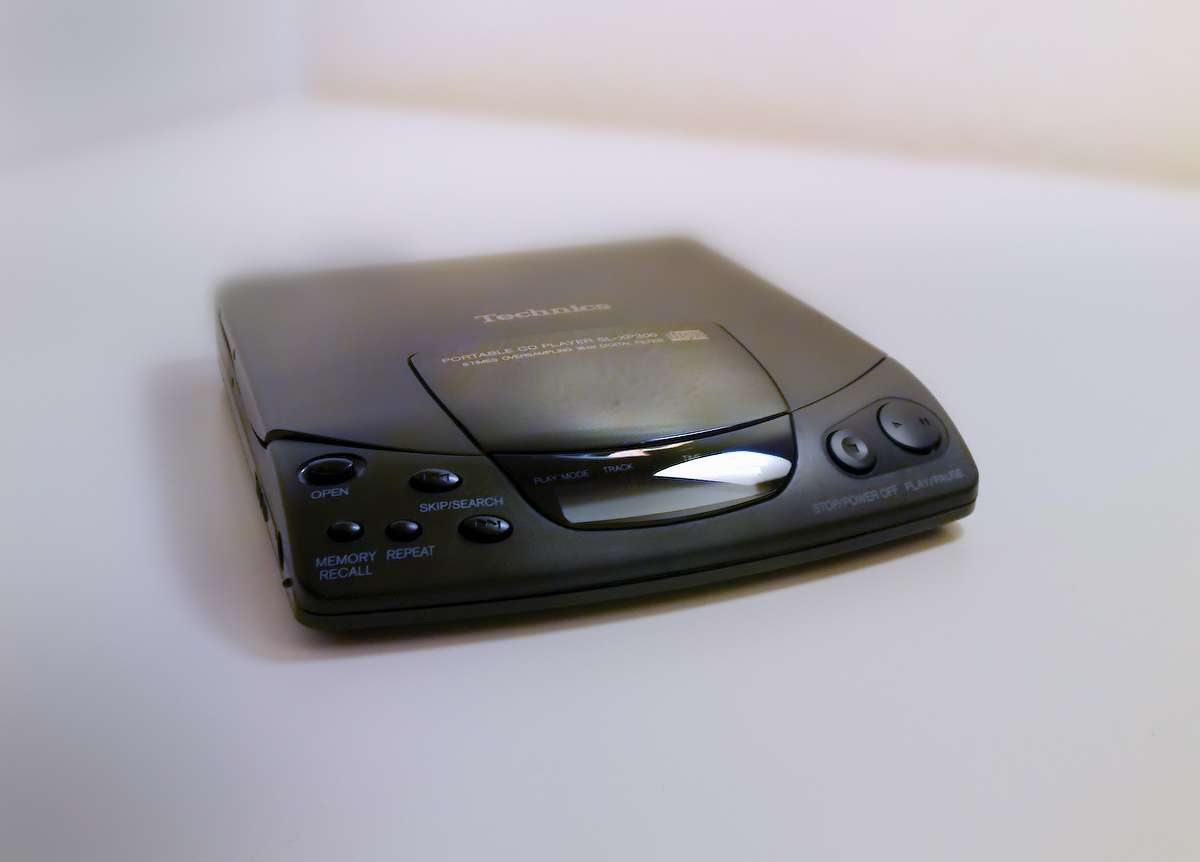
Half a year ago I became interested in owning my first CD player again, a Technics SL-XP 300. I´ve described everything in a post made for soundtrackforum.net so I´ll spare you the details. But my interest continued and I also discovered that many people collect vintage portable CD players. Somehow I´ve started doing the same and right now I own the aforementionend Technics SL-XP 300, a Technics SL-VP 50, a Sony D-220, a Sony D-465 and also a Sony MZ-R 30 (a portable MD recorder) with a continued interest in purchasing used PCDPs (I´d like to own either the Sony D-90 or the Sony D-99 and the Technics SL-XP 700). But today I´ll review the first four PCDPs, focusing solely on the sound quality of their line-outs. I´m ignoring their headphone outputs because they are mostly crap, not very loud and change the sound of an attached headphone. BTW, I´m recommending to you to do the same as their line-outs sound much better. You could amplify these line-outs with a FIIO E6 (NwAVGuy has written a lovely review about it) and subsequently you would get much better sound.

Why am I fascinated in these little CD players? Well, I don´t really know... it´s probably because I love that they are so small compared to fully sized CD players and still sound gorgeous. Judging from their sound they easily beat much more modern, fully portable mp3 players like the iPod. They suck of course in everything else: they are comparatively bulky, prone to skipping, cannot play mp3, etc. But on with the tour: two of the four players I´m gonna review today are not very famous, the other two are recommended regularly. Especially the last one, the Sony D-465, got a very good review by Duncan from Head-Fi.org in this thread: Personal CD players through the Ages. I will show that this review isn´t particularly close to the truth and I´ll also show how important level-mateched listening tests are - as stated in my article "Why Comparisons between Components usually suck".

And in order to proof my findings that CD players aren´t that much different in sound I´ll also provide fully legal samples which contain several examples of their recorded outputs. I´ll also introduce a slightly odd method of showing how I perceive sonic differences with frequency response and staging, instead of describing them with text I´ll turn to pictures instead. Furthermore, I measured them as good as I could with RMAA (the E-MU 0202 USB was extremely helpful).I won´t need to tell you that every recording (either music or test signals) was done with the same cable (Audioquest King Cobra), the same soundcard (E-MU 0202 USB) and exactly the same configuration. I increased the volume afterwards so that every test signal and every musical piece had exactly the same volume as the original files. Please note: I compared their outputs with several pieces of music and the results to the digitally ripped originals from which the CD I used for the players was derived. I didn´t use some fancy, expensive and dubious reference player no one can own - I turned to the originals instead. So my comparison is extremely hard and unfair to these players because several factors are in favor of the digital originals: they havn´t been converted to analogue and back to digital again and they didn´t have to go through an analogue RCA-cable. For the audiophile readers: please be aware that the E-MU 0202 USB is an excellent recording device, especially when used with 24/192 as in my tests, therefore there is no need to doubt the quality of these recordings. To offer the possibility of blind testing I downsampled my recordings to 96 kHz while I upsampled the digital original to 96 kHz, both times with the Weiss Saracon. So every file in my archive has the same bit-depth, samplerate and volume. For comparison how a fully sized CD player from those years sounds I also included samples derived from a Sony CDP 470.

I used the following albums for my listening tests: the first track "Banning back Home" from John Williams' score to Hook because it sounds very good; the player must be able to present the correct combination of timing, crispness, warmth, dynamic and staging. The second track ("Swim") is from Madonna's Ray of Light from 1998 - it was mastered too loud and therefore shows a lot of clipped peaks. The players have to play these more than 0 dBfs peaks without showing distortions of their own. This track also shows a wonderful, round and tight bass which the players have to show with the correct timing. The third track is the Presto from Mozart´s Symphony No. 1, recorded in 1990 by Jack Renner for TELARC. Besides being a fabulous interpretation the player has to show impeccable timing between the players, the most realistic staging (the recording was done with just two microphones) and also a certain amount of crispness: with mediocre components the recording sounds either dull without microdynamics or overly crisp with too much gloss on the strings. The fourth and last track is "Flying Ballet" from Supergirl, composed and conducted by Jerry Goldsmith in 1984 with engineering done by Eric Tomlinson. True to Tomlinson´s style of engineering the recording shows extremely crisp high frequencies and a warm bass - the timing isn´t an issue here, more important is its crispness: the strings and the brass sound extremely brilliant but they shouldn´t sound biting or harsh. The staging is important too because this recording can easily sound flat on the wrong players.

Recordings used for the listening tests
_________________________________________________________________________________


Sony D-220

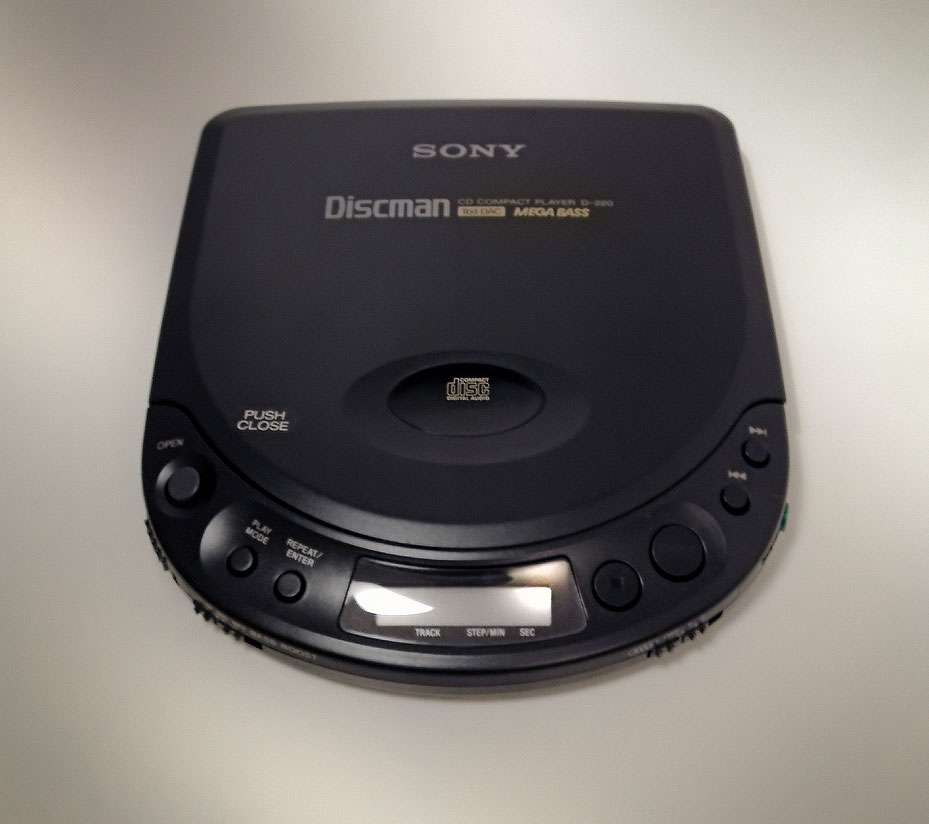
This player was released in 1993 and it´s one of the more cheaper portable CD players Sony offered around that time. Despite the low price the build quality is good (apart from the plasticky drive), the sound is more than ok and it´s fast and durable. And I think that it also looks nice:

The Sony D-220 from above

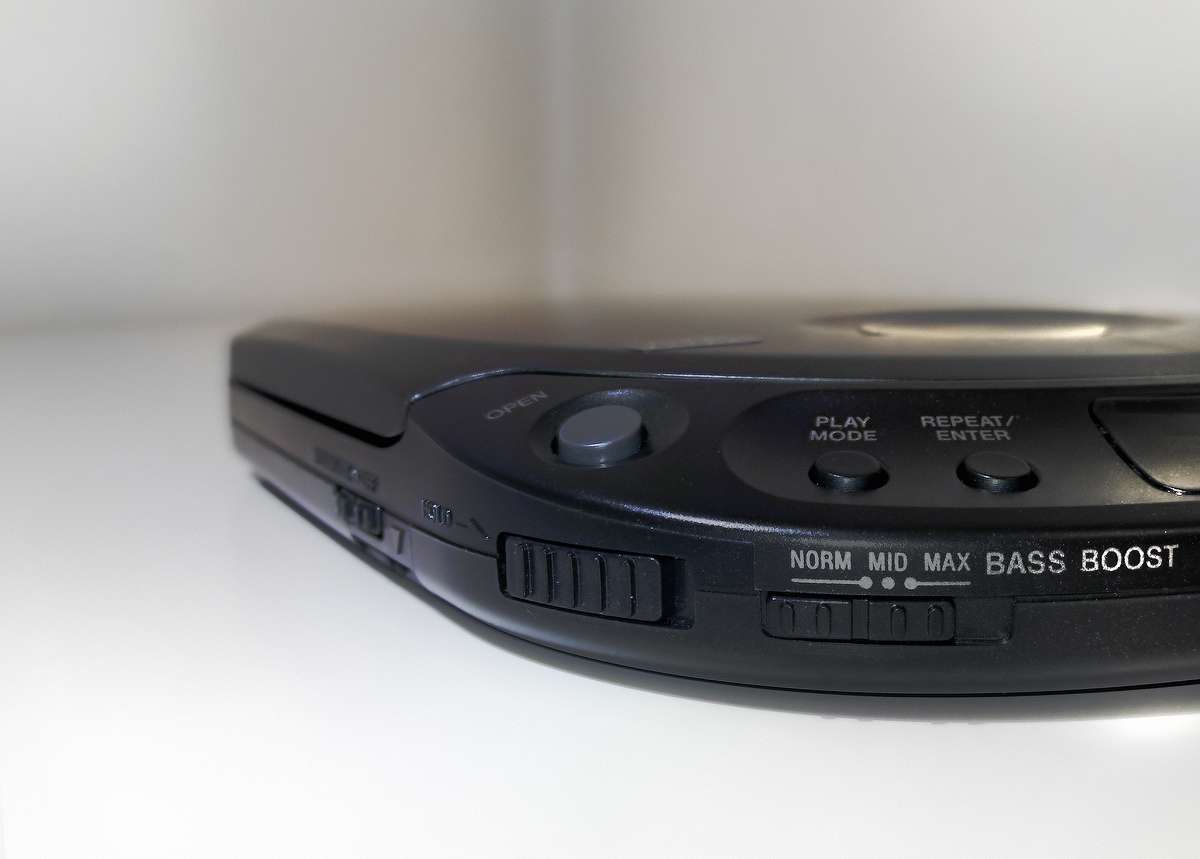
Closeup of the D-220

D-220 Measurments

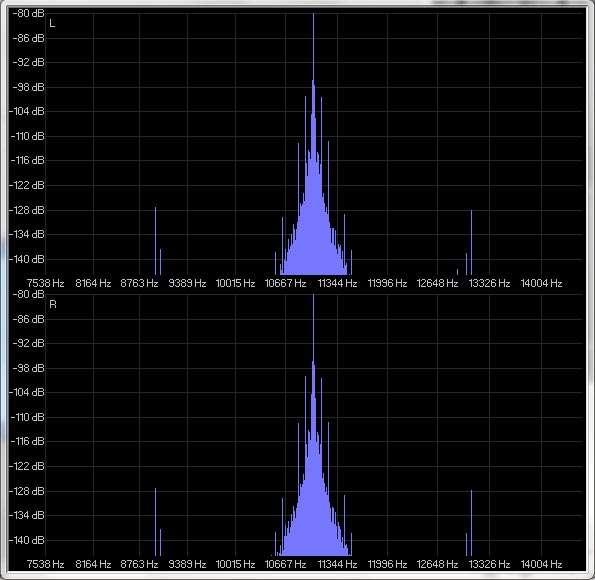
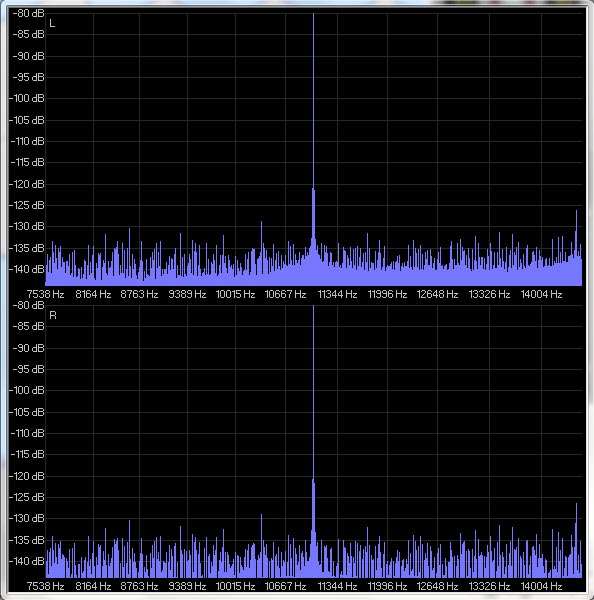
Jitter Performance of the Sony D-220

As you can see it looks and measures nice apart from the slightly odd jitter performance. What about the sound? Well, it sounds as nice as it looks: with the track "Swim" upper bass is a bit hollow or pronounced, highs are smooth, the staging with Supergirl is impressive. However, it sounds a bit slow on Swim and Mozart´s Presto, the timing isn´t particularly good, especially the bass seems to "follow" the rest. With this player I´m always wondering about monaural signals (like voices, solo instruments, etc.): they are standing very clear and elevated and have a beautiful articulation. Voices are sounding like they are standing right in front of you while the rest of the stage is very close to the stage of the digital original (even though it´s not very stable and a bit flatter). It also adds a glowing sheen of additional colour to every audio material, it sounds more beautiful then the original. In general, the lower frequencies seem to be blown up on all examples in combination with a slightly unstable spatial impression at those frequency areas. Compared to the original the Presto sounds a bit muffled and less fast while Supergirl sound a bit too cozy. Still, I´d say that this player does sound relatively good and although it doesn´t present the original sound its warm, pleasant and coloured sonic signature will probably make many people happy (including me).
_________________________________________________________________________________


Technics SL-XP 300

This player was released in 1991 and is the only one of this quartet that´s using true 18 bit multi-bit converters (all others are using 1-Bit converters). The drive is different too: it contains many parts made out of metal and includes a true glass laser lens (the Sonys use much more plastic in their drives in combination with a plastic lens). The drive can play everything, from overly long CDs to CD-Rs and is a prime example of reliability. Which sadly cannot be said about the rest: from my experience I know that parts used on the circuit board tend to age faster then usual when exposed to old age or heat. But any of this doesn´t matter because as my first player it still has a place in my heart.

Technics SL-XP 300, playing DG ReComposed Vol. II
(connected to my HD-448 for the picture only)

Technics SL-XP 300: still a beauty IMO

I know... this photo isn´t much different... have I told you yet that I love it? ;)

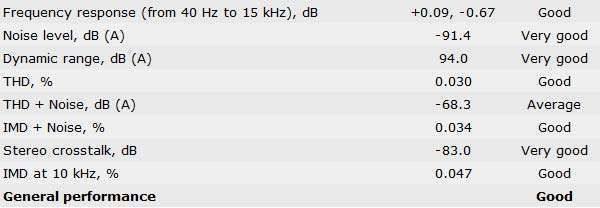
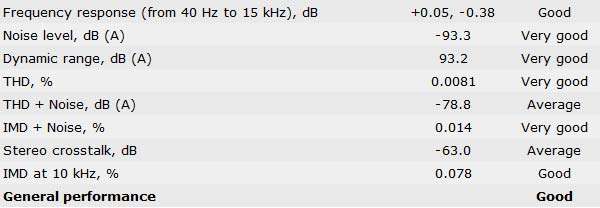
Technics SL-XP 300 measurments

Technics SL-XP 300 Jitter performance

Measurments are ok but not mind boggling. Jitter is low enough, it won´t be discernible (below -110 dB) although it does show a bit more than usual high frequency jitter. Still, this is a portable player - I think it measures well, especially regarding its age of 21 years. What about the sound? Yes... I´m afraid it isn´t as good as I remembered it for all those years. The sound I remember was like this: dynamic, a bit too loose, pleasant with a nice golden sheen. After listening with my HD-600 though I became aware that it doesn´t do anything wrong really, it just sounds a bit too friendly. My impression is that every track I tested it with sounded a bit weak on the mids without really deep bass while having a tiny bit too much gloss on high frequencies (could be wrong about that because of the perceived recessed mids). The decreased mids are also the reason for missing sonic colour, the dynamic spark is missing. Staging is a bit flat and distant but otherwise correct while (despite diminished frequency ends) the dynamic seems to be a bit too explosive. Overall the sound is pleasant, smooth, friendly and sadly not very truthful.

_________________________________________________________________________________


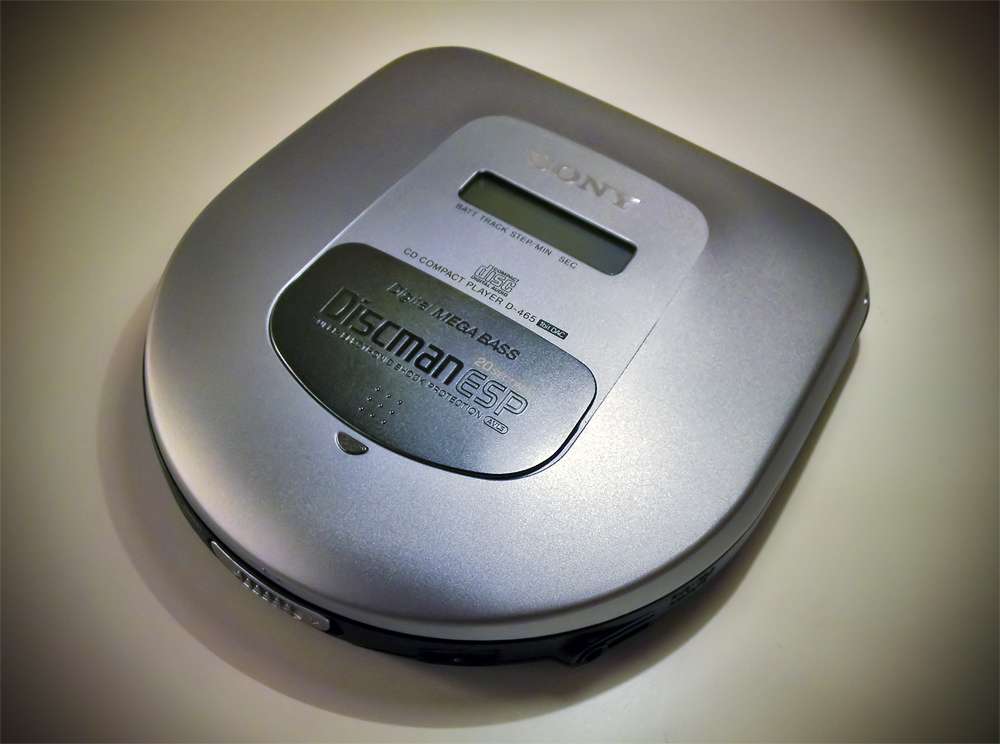
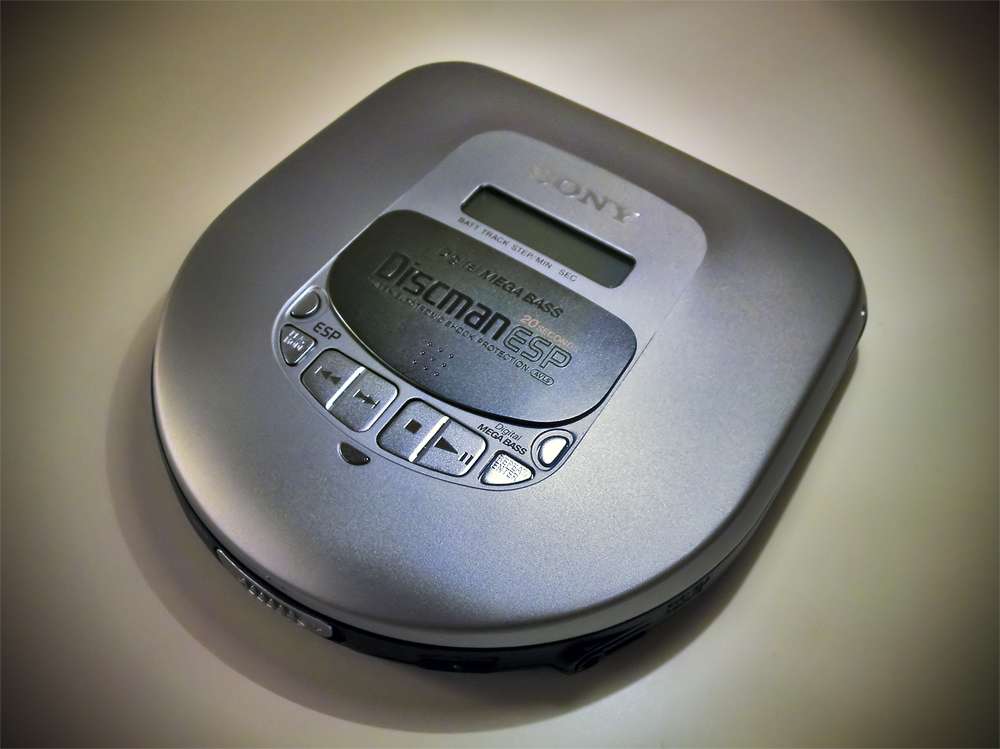
Sony D-465

The build quality on this one is a bit better then usual - it has a metal lid and offers the best "Hold"-function one can imagine: you simply cover its buttons by moving a metal slider. This also is the only one of the bunch to offer Electronic Shock Protection (ESP) so it won´t skip when you go around with or decide to do some sports with it. It even offers a digital output via Toslink so it can be connected to a digital amp or a digital recorder. Compared to the former two it is relatively bulky and not very beautiful. Sadly the true build quality is awful: after I finished my tests the drive broke apart (the clamp holding the CD in place deattached itself which seems to be quite common with this drive, the adhesive for the clamp isn´t very durable). Therefore I´ve purchased a used replacement drive but I haven´t built it in yet. I expected more from this player after the glowing review at Head-Fi.

Sony D-465

Sony D-465: slider opened

Closeup of the D-465

The D-465 with its leather case

Sony D-465 measurments

Jitter performance of the Sony D-465

Yikes! Jitter is bad even though it measures extremely well on everything else. The sound... well, it´s not very good. It´s in fact the worst sounding player of my quartet: deep bass is flaccid on Swim and Supergirl, upper bass is boomy on every track, mids sound pinched and unpleasant (Madonna sounds thinner, the Mozart recording looses its appeal), voices are too forward and much too crisp. Highs in general are rather tinny while the stage impression seems constricted and flat (not counting the forward voices). Example: the very balanced recording of Mozart's Presto gets too thin and too brittle. The only track that sounded ok with all the added, aggressive & artificial colour was Madonna's Swim: because of the slight loudness-y sound it seemed to be more dynamic, engaging and impressive. But then Supergirl came and the impressive dynamic turned into zippy, sharp and piercing high frequencies. This player is a huge disappointment, its reputation is far from being deserved. For me this one is a personal flop.
_________________________________________________________________________________


Technics SL-VP 50

Two words: huge and bulky. This "portable" player is enormous! Not many people know it, probably because it also can play Video-CDs (yes, it has a video-output) and the one test I´ve read (from german magazine STEREOPLAY) wasn´t very favourable - one reason for this probably was that they didn´t do level-matched testing. I´m also guessing that not many people can take a player serious if it can play visual media too. Technics probably assumed that because of its size it wouldn´t be used much on the go so they equipped it with an infrared remote in order to be used at home. Build quality is impressive, it has the same drive as my Technics SL-XP 300 (only updated a bit) and even the lid is made out of metal. Inside one can find two mainboards: one for audio and one for video (this explains the size and the weight). Today everything would fit on one tiny mainboard but this player was released in 1995 when video decoding via hardware wasn´t as efficient as it is today. Back then it also was a very expensive piece of hardware: it did cost a whopping 450,- Euros when it was released to the market. I only payed 22,- Euros for it (incl. shipping) - and this was for a brand-new and unused exemplar! The person who offered it on eBay sold roughly 20 brand-new pieces of this player and thank God I was one of the lucky ones.

The Technics SL-VP 50

From the left

Technics SL-VP 50: rear closeup - and what a fat ass that is!

Yes, the Technics SL-VP 50 is huge!

Measurments of the Technics SL-VP 50

Technics SL-VP 50 jitter performance

Just as with the XP-300 the measurments are ok but not awesome though the jitter performance is excellent. As is the sound: of all reviewed players this is the one that sounds the closest to the digital original. Precision is good, staging is a bit too compact but apart from this it´s a virtually identical clone of the original, the overall frequency response is a bit light on deepest bass and highest high frequencies. The overall timing is a bit slower but consistent over every frequency band. Yes, the only major thing I´d critisize is that it sounds a bit boring. It sounds as if being bored just so slightly by any kind of music (if it would be alive) and it also sounds a bit inflexible or static. But it never lies, it doesn´t sound thin or constricted, there is plenty of space around instruments in the orchestral recordings. On Swim the punch is diminished and the Presto from Mozart sounds a tiny bit too muffled but Banning Back Home from Hook almost sounds like the original. This is an impressive little (big) portable player!
_________________________________________________________________________________


Sound "pictures"

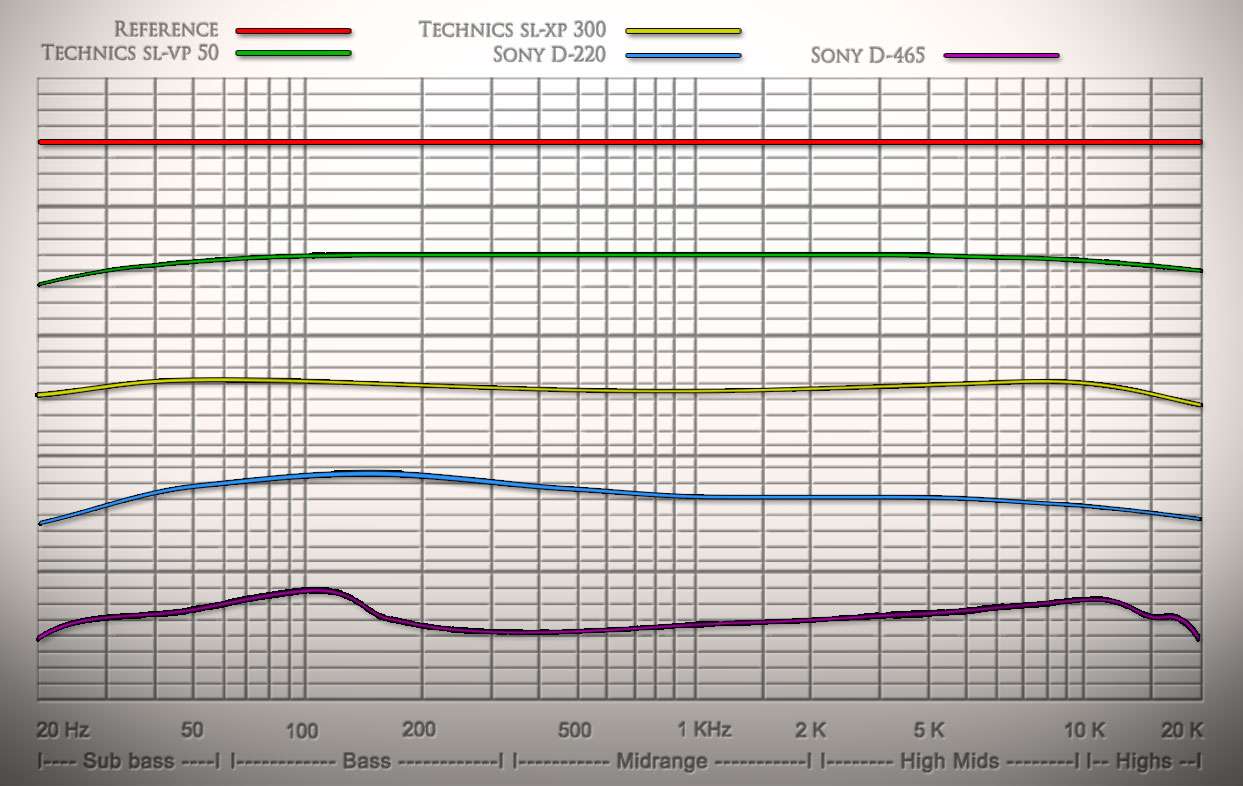
And now, as I promised above, I´m gonna show you some pictures, pictures of how I perceive the sound of these players to be. Two categories will be mentionend: perceived frequency response and perceived staging or room impression. The expression "perceived" is important here as you will be seeing plots that don´t have anything to do with the reality, it´s just what I hear. But words are an imprecise instrument for explaining sound when pictures can do so much better. So I try to explain the perceived sound with the usual frequency plots but manipulated them to show what I hear instead (not what I measured!). The stage impression will be visualized by a photograph of an orchestra in front of a stylized human head. The orchestra is then morphed into an appropiate form to describe what I´m hearing. I´d like to show you the perceived timing too but I haven´t found a simple, visual expression for it yet.

The perceived differences between the players, visualized with frequency plots

The reference stage impression: the perceived virtual orchestra
sounds wide with appropriate depth

Sony D-220: slightly forward monaural signals
and a tiny bit flatter

Technics SL-XP 300: flatter and more distant sounding

Sony D-465: constricted perceived stage impression
with very forward voices and overall flat room

Technics SL-VP 50: just a bit more compact

I hope that you, dear reader, find those pictures as amusing as I did while creating them. And didn´t I make the loveliest pictures of these portable CD players? Anyway, the result of my little article is that the Technics SL-VP 50 is the winner when all differences regarding voltage outputs are removed and the players all have the same amplitude. Under these circumstances the Sony D-465 is a most disappointing looser. Oh, I forgot: all players were at their best because I cleaned their drives (including the several laser lenses) and cleaned every flat cable inside them and also every plug of the RCA connection I used (on the players, the soundcard and the cable). I think my results are even more impressive because the SL-VP 50 had to fight against the original file - that it managed to sound so very close to it was a surprise even to me. BTW, I mentioned a fully sized CD player from Sony, you probably ask yourself "Where did that one go?" Well, it had the most horrible sound of them all, it did everything wrong and sounded flat and uninvolving so I wasn´t in the mood of displaying its results here. But you can listen to it yourself with the files I´m now gonna provide to you. Attention, illegal file downloaders: this archive isn´t for you! You won´t find not one full track in it, only fully legal 30-seconds-excerpts of the tracks I mentionend during my review. To anyone else: you´ll find the mentionend examples and also my RMAA-measurments, just click on the properly named HTML-files and you´re gonna see all the plots and fitting decriptions. For the DBT lovers out there: most of the tracks are properly aligned so you can play them with foobar2000 and find out if you can hear a difference (Mozart cannot be used since I made some editing mistakes there). To everyone else expecting huge differences in sound: don´t be disappointed; while my descriptions are accurate you probably won´t hear anything when you give those files a first listen. There are two reasons for it: 1. you have to be experienced to hear those differences and 2. the differences between HiFi components are not that big once amplitude differences are removed (as is shown by comparing them to the original files).


P.S.: Do I have a personal favourite? Yes, I do. It is the Sony D-220 because its sound is very pleasant, with a colourful timbre and I can listen to it for hours. It´s also relatively small, not very heavy and can be moved around with ease. The winner of this test, the Technics SL-VP 50, may be the best but it´s bulky and not played in. Then, because it´s so good and precious to me, I don´t want to stress it much. I´d like to keep it in pristine condition for many years and therefore I use the more readily (for cheap money) available Sony D-220. It may not be the most truthful player out there but sometimes even I love a player that lies so enjoyable. And there goes my pseudo-objectivism... :)

Related Posts Plugin for WordPress, Blogger...

The Socials