
 |
| Sony MZ-R 90 |
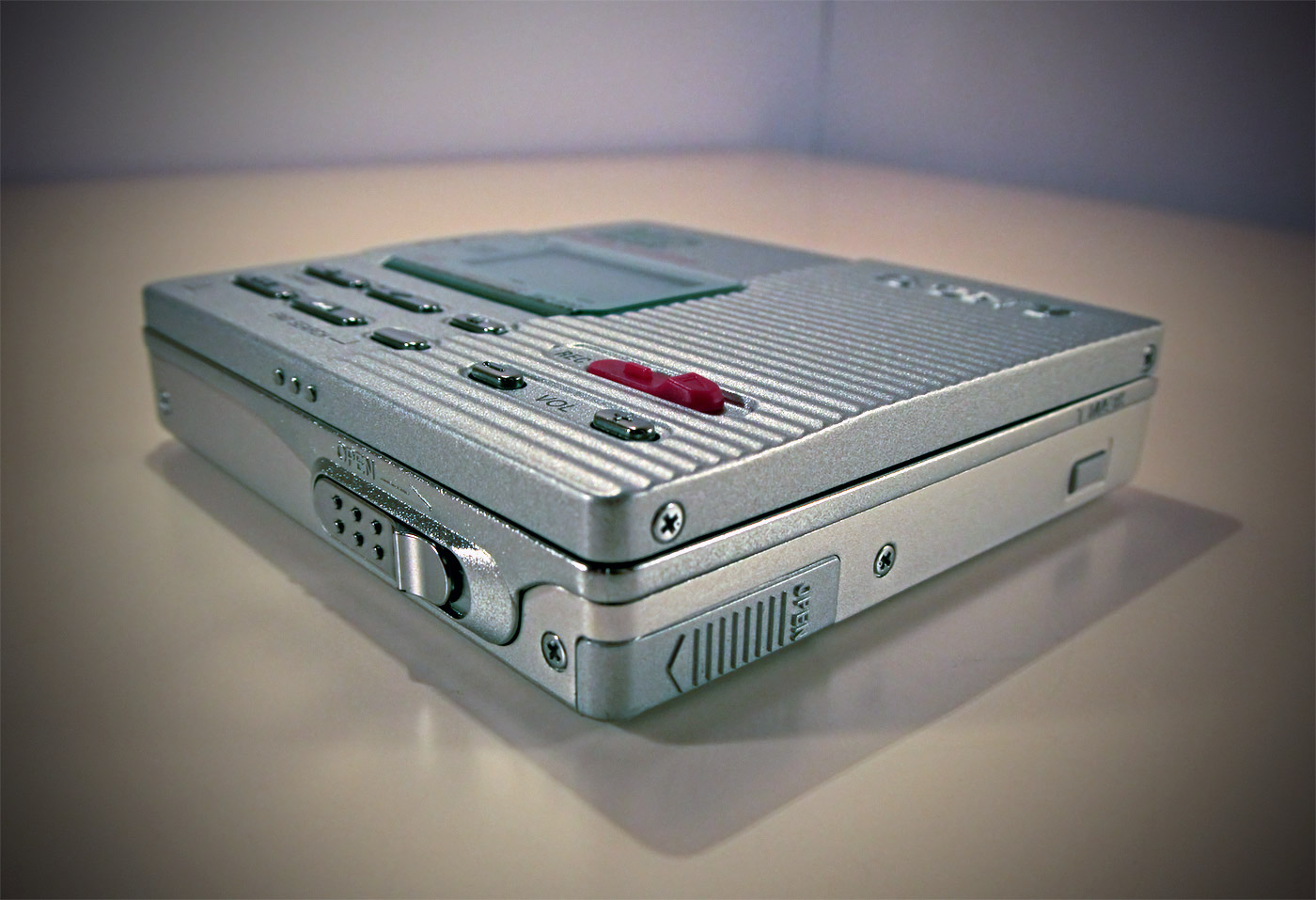
This will be my last review of a personal MD recorder for the time being. I´ve received several complaints from personal friends of mine that I concentrate too much on ancient or obsolete technology. Since I also want to talk about other stuff ('snake oil' for example) I´ve finally decided that I have bought enough used MiniDisc recorders and that it´s time for different things. The next article will be about ATRAC, it´ll also contain a guide to hack the firmware of two MD recorders - that´ll be it. On with the review now, shall we? Just like the MZ-R 37 I bought this one not because I wanted it but because I was bored. I placed a bid, being confident that I wouldn´t be successful only to find out later that I´d won the auction. At first I became quite aggravated with myself for buying an MD recorder I never wanted to own in the first place but after it arrived I felt very lucky indeed... boy, this thing is a beauty! Released in 1999 it sports a fantastic manufacturing quality: everything fits perfectly, its shell feels extremely sturdy and is delightful to touch.
 |
| Sony MZ-R 90 close-up |
But once it starts to play or to record a MiniDisc the impression of high quality is diminished quite a bit: the drive is extremely loud, it literally seems to be 'grinding' along while the disc is spinning. It´s so loud that I can hear this unnerving noise easily during soft passages when playing music over my Sennheiser HD-448. Furthermore, the drive mechanism behaves extremely sluggish: in an effort to conserve battery power Sony chose to implement an aggressive power saving strategy which occasionally results in a waiting time as long as five seconds - and that´s only for a track change. The successor MZ-R 900 is a lot faster but still not as fast as the MZ-R 55. The MZ-R 90/91 also is the first recorder to lack a seperate line-out - it has been combined with the headphone output and can be configured via the menu. It´s a bit smaller than the MZ-R 55 and does seem to have a higher level of integration for some ICs. The ATRAC IC is a CXD-2660GA which uses version 4.0 or 4.5 (measurments are inconclusive) of Sony's proprietary codec, it also seems to combine several ICs into one. Apart from that some things (the DAC for example) have been left unchanged, they are the same on the MZ-R 55, MZ-R 37 and the MZ-R 90/91. The drive and its laser have been completely redesigned compared to the two former models - both are much smaller and also much slower. When I first listened to it I immediately noticed that it sounds much crisper than the aformentionend units, in fact its crispness appears to be a bit too much. I suspected jitter so let´s have a look at my measurments:
 |
| Sony MZ-R 90/91 measurments, line-out activated |
 |
| Sony MZ-R 90/91 measurments, headphone output activated |
 |
| Sony MZ-R 90/91 jitter |
 |
| ATRAC measurments, 24 bit input: ATRAC 4.0 or 4.5? Dynamic Range & IMD are like ATRAC 4.5, THD is like ATRAC 4.0 |
My suspicions were wrong because as you can see jitter isn´t the culprit here; while it might be audible I think that it isn´t the main problem of the MZ-R 90. Much more serious are high frequency distortions over the analogue output, not even the MZ-R 37 distorts that much. Total harmonic distortions are 10 dB higher, intermodulation distortions are four times as high. BTW, measurments don´t change, no matter how the output is configured which means that the line-out function is nothing more than setting the volume to max and switching of AVLS and MegaBass (the MZ-R 900 has a real line-out setting, changing voltage levels). Another word about the jitter performance: isn´t it amazing that it differs so much from the measurments I did for the MZ-R 55 and MZ-R 37? All three use exactly the same DAC (AK4517) so in laymans' terms they all should have the same performance. Instead, these differences prove that the overall PCB layout is much more important than the DAC-IC itself.
 |
| Sony MZ-R 90 |
I´ve already told you that it sounds very crisp. On some recordings this is nice but on others it adds an aggressiveness not very suitable for well rendered sound quality. While it doesn´t distort as much as the Sansa Clip+ it nevertheless shares some of its sonic traits: dynamics are a tad too explosive and contrived, stage congested, the sound sometimes lacks warmth. Apart from that its sound is ok; stage is much flatter than the reference but equally wide, leaving enough space between instruments. Overall articulation is ok, albeit a bit artificial, the resolution walks a fine line between slightly exaggerated brightness and edginess. Despite its brighter-than-necessary sound the details are rendered too casually, high frequency definition on occasion dissolves into noise. Timing is ok but nothing to be mad about; it´s slower over the whole frequency band which results in missing snap and punch, the aggressiveness doesn´t help. I have to say that I´m disappointed by its sound; for some recordings it might be helpful but for most available releases it´ll be too much because it sounds too forward. Mediocre, predecessor and successor both are the superior units.
Sonic Balance:

Dynamics:
Resolution:

Stage / Ambiance:
Character:
 |
| Sony MZ-R 90: perfect built quality |
 |
| Sony MZ-R 90 close-up |


