Showing posts with label md recorder. Show all posts

Wednesday, September 04, 2013

Spectacular sounding MiniDisc tweaking - FOR FREE!


Introduction

The following Article concerns itself with a piece of software called an Equalizer. Removing certain frequencies with this EQ enables the ATRAC codec necessary for any MiniDisc recorder to encode any piece of music in a superior way. Substantial proof will be offered by means of measurements as well as musical examples.
A warning: if you are lazy or if PC-based audio is a complete mystery to you this article isn´t for you. You also won´t be happy if you think that an equalizer is one of the devil's minions (an opinion clearly not based upon facts). Furthermore, the significant sound improvements described here require you to spend some time with your music, it means work. If you can´t afford the necessary time, you probably aren´t interested in good audio quality coming from MiniDisc at all. Or are you? ;)

Basics of lossy encoding

Lossy (or perceptual) codecs were developed for only one thing: making audio smaller without you, dear constant reader, noticing it. Using a datarate of, say, 128 kBit/s you´ll receive a file the size of only 5 megabytes (before: 50 megabytes). Every lossy codec available on the market performs this 'shrinking', it doesn´t matter if it´s ATRACMP3AACOGG or WMA. How do these codecs achieve this? They 'erase' or 'alter' parts of any musical material, getting rid off things our ear cannot perceive anyway. Erasing certain parts of any object reduces its size which is most convenient for portable players not having terabytes of available space; they can store more music that way. In the article that follows I will compare ATRAC (necessary for MiniDisc) to MP3. Both codecs are equally old (20 years), yet MP3 is still in development. ATRAC however was declared dead in 2004 with the introduction of Hi-MD, since then it hasn´t been improved. ATRAC is effectively one of the worst codecs around, it doesn´t help that its datarate is comparably high (292 kBit/s). It could have been more effective if Sony would have decided to fuck their desire for power constraints (a superior ATRAC IC would have drained battery power faster). Well, we have to work with what we´ve got and how we are able to improve it. Anyway, the following chapters will show you the most important basic instrument any perceptual (lossy) codec employs to fool your ear... or more precisely, your brain (Fig. I):

Fig. I: Equal-loudness contour, logarithmic scale (copyright: Wikipedia)
On the left of Fig. I you can see the Sound Pressure Level, measured in dB. The line below presents several frequency points of the entire frequency range our ear can hear (20 Hz to 20,000 Hz), measured in Hz. Now take the highest frequency at 16,000 Hz; it would need a level of roughly 25 dB to be perceived as loud as the 4,000 Hz tone. The key thing you have to understand is the difference between actual levels and perceived levels. Our ear itself listens with almost perfect precision, but our brain decides what part of the received audio material is kept. Our brain has been 'tuned' over the course of several millenia to recognize the human voice with immaculate precision, the area from 2,000 to 4,000 Hz is the most important frequency band  with the highest sensitivity. So listening sensitivity of the ear/brain combination sucks at low and - especially - at high frequencies. Those frequencies weren´t necessary for survival, so they have been 'dropped' as a result. Which means that we have to make signals at those areas much louder. But it also means that we´re unable to hear grave errors at low and high frequencies - and that´s where perceptual (lossy) codecs come in:

Fig. II: Multitone signal, -6 dB, .WAV, 24/44.1 (linear scale, Hanning)
Above (Fig. II) you can see a multitone signal (.WAV) in 24 bit and 44.1 kHz which consists of more than 100 seperate sines. Frequency response ranges from 0 to 22.050 Hz. There aren´t any errors to witness (the thickened bases of the several sines are caused by imperfections of the Hanning windows function used to display the results). Compare that to the same signal, encoded with MP3:

Fig. III: Multitone signal, -6 dB, MP3 (Lame, 256 kBit/s), 24/44.1 (linear scale, Hanning)
It´s evident that something has been added by the MP3 compression (Fig. III). This something is simple quantization noise, inherent to every digital system. In this case it´s at roughly -90 dB (original .WAV file: -144 dB). This amount of noise also reveals how lossy codecs work. It is always said (even I did so above) that they 'remove' or 'erase' parts of the music with surgical precision. Well, it isn´t true, they don´t really 'remove' anything (ignore the cut-off at 19 kHz for a sec'). What any lossy codec does instead is decreasing bit-depth dynamically, taking into account complexity, gain and composition of the signal. Example: a clarinet, formerly having a resolution of 24 bits now has a resolution of perhaps only 6 bits. The remaining 18 bits resolution are non-existent anymore which - BINGO - creates quantization noise. Effectively, the quality of any lossy compression is partly determined by how well it is able to hide this noise. MP3 is very good at this, a wonder given the fact that this codec is over 20 years old. You can also see that the quantization noise floor is shaped according to the Equal-Loudness contour (Fig. I). It is fairly low at 4,000 Hz (I failed to point this out with my red line) and rises slightly towards higher frequencies.

Disadvantages of ATRAC compared to MP3

Fig. IV: Multitone signal, -6 dB, ATRAC 4.0, 24/44.1 (linear scale, Hanning)
ATRAC (in this case 4.0; DSP Type-R doesn´t differ) performs much worse. Quantization noise is stronger (70 dB, Fig. IV, MP3: -90 dB)... WideBitStream my ass! ATRAC has a datarate of 292 kBit/s to its disposal, the MP3 example has even less (256 kBit/s), yet it yields superior performance. But it should be clear by now that ATRAC also follows the Equal-Loudness contour (Fig. I), just like every other lossy codec. However, ATRAC & MP3 do a bit more: they completely remove high frequencies. MP3 did it in my example at 19 kHz, ATRAC at 17.5 kHz. They get rid of those frequencies because A) we don´t hear them well and B) because their encoding hurts the rest of the frequency spectrum. How can the presence of high frequencies distort frequencies below them? Because both codecs use a constant bit-rate, they cannot adapt this bit-rate (and therefore possible quality) to changing complexity patterns. MP3 is of course able to encode with variable bit-rate (VBR). But I used constant bit-rate only (CBR) to create fair comparison conditions. ATRAC is forced to encode everything with 292 kBit/s, no matter what. Should a certain signal require a higher bit-rate, pity, ATRAC simply can´t do it and has to take away more information at other areas, informations it might want to keep instead.

Advantages of ATRAC compared to MP3

Fig. V: 1 kHz sine, MP3 (Lame, 256 kBit/s), 24/44.1 (logarithmic scale, Hanning)
Fig. VI: 1 kHz sine, ATRAC 4.0, 24/44.1 (logarithmic scale, Hanning)
The situation reverses with less complex signals. Fig. V and Fig. VI exhibit that ATRAC performs superior to MP3 with simple signals. Quantization noise is more evenly distributed, resolution of 20 bits is retained. Which means: the less complex a signal is, the better can it be encoded by a lossy codec; apparently, this is even more valid for ATRAC. But it has another advantage: its time/frequency resolution, expressed in block length. Perceptual codecs need to decide between long mode and short mode. The latter enables any lossy codec to encode transients (very short & loud signals, for example the attack of a piano or handclapping). For short mode, MP3 uses a window size of 192 samples (or 4.3 ms). Now if a signal is shorter than that it is ignored, it ceases to exist because it's effectively 'invisible'. In comparison ATRAC has not one but two short modes. For lower frequencies it´s 130 samples (2.9 ms), for higher frequencies 65 samples (or 1.45 ms). In general, ATRAC is better suited to encode very loud and short transients, helping dynamics and precision.

Sonic differences between ATRAC & MP3

Ask 'normal' people (not audiophiles) how they perceive the sound of MP3 and you´ll most likely receive the answer that it sounds slightly warmer to them, that is, if they can hear any difference at all. Yet your basic audiophile will call its sound 'cold' and 'digital' when in reality nothing could be further from the truth (their reasoning: it must sound that way because it uses lossy compression). Listen, all you audiophiles out there: MP3 encoded music sounds a tiny bit warmer compared to the original. The reason is not that it removes any frequency content above 16 kHz (also stated by audiophiles), the one and only true reason is that it fails at encoding short transients responsible for dynamics, attack and precision. When ATRAC still was used regularly it too was described as sounding 'cold' (for example in German STEREOPLAY magazine 15 years ago). Again, this isn´t true. At least not for ATRAC 4.0 and ATRAC 4.5. Both sound significantly more pleasant and warmer than the original (ATRAC DSP Type-R changed the situation somewhat). Responsible for this mellow signature isn´t a too short window size. These shortcomings are caused by the ATRAC codec attempting to encode signals up to 20 kHz. All those years ago, magazines and audiophiles alike (the german STEREO magazine paramount among them) constantly pressed Sony to improve rendering of high frequencies. They believed that if you could retain frequencies from 16 to 22.05 kHz it would yield true audiophile sound. Bullshit! ATRAC would have profited extremely if they wouldn´t have listened to audiophiles, I will show you how.

Tweaking ATRAC
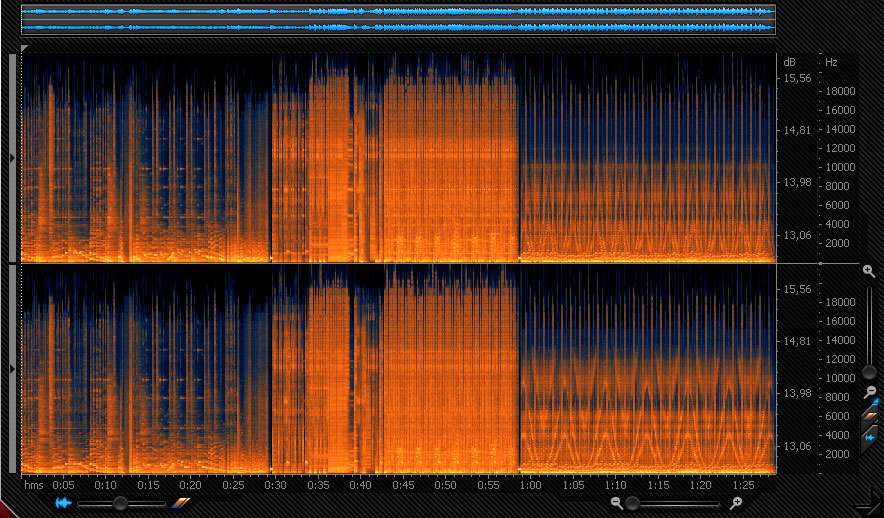
Fig. VII: ATRAC standard encoding (24/44.1, linear scale)
By trying to encode signals up to 22,050 Hz (see Fig. VII) ATRAC is losing precious available bits better reserved for lower, more readily audible frequency bands. This creates an overall pleasant sound signature by producing soft compression artifacts. Of course, this sound is far away from the truth. The final critical band ATRAC encodes is the frequency area from 15,500 to 22,050 Hz, if it wouldn´t be present anymore, ATRAC would have more bits to spare for lower frequency bands (0 to 15,500 Hz). Remember: the less complex the music is (a.k.a. less frequency bands), the better will it be encoded by ATRAC. For that reason we will erase frequencies beyond 15,500 Hz with an equalizer so that ATRAC 4.0 or higher doesn´t need to concern itself with these frequencies anymore! Will this sound muffled? No, it won´t since ATRAC encodes transient responses with utter precision (compared to MP3 which always sounds slightly blanketed depending on the material). Getting rid of frequencies beyond 15,500 Hz improves quantization noise as a result:

Fig. VIII: Multitone signal, -6 dB, ATRAC 4.0, STANDARD ENCODING, 24/44.1 (linear scale, Hanning)
Fig. IX: Multitone signal, -6 dB, ATRAC 4.0, 15.5 kHz CUTOFF, 24/44.1 (linear scale, Hanning)
Look at Fig. IX and compare it to Fig. VIII by clicking on one of them with the left mouse button and scrolling through both of them. Quantization noise floor has been lowered by roughly 5 dB - and only because frequencies beyond 15,500 Hz have been removed. Stunning result, isn´t it?

Fig. X: RMAA frequency response, ATRAC 4.0 STANDARD ENCODING, four passes
Fig. XI: RMAA frequency response, ATRAC 4.0, 15.5 kHz CUTOFF, four passes
Even RMAA recognizes the effect. Fig. X & XI depict that the hole around 4,000 Hz, typical for any ATRAC version, has almost disappeared along with the odd response at subsonic frequencies (20 Hz). Increasing levels from 10,000 to 15,000 Hz on Fig. XI are caused by my equalizer setting (see below at 'Equalizing ATRAC (costly option)').

Equalizing ATRAC (free option)

I told you that this tweak is free, I therefore searched, found and measured a suitable equalizer. This was difficult, not many free equalizers around are able to process with high quality. I will however also tell you about costly alternatives, namely SoundForge and iZotope Ozone. SoundForge is the VST-host while Ozone is the equalizer I work with in that case. I will talk about them because they are yield slightly superior quality. Never, I repeat, NEVER use built-in equalizers (SoundForge, WaveLab, Adobe Audition, foobar2000, Winamp). I´ve measured them and they create so many errors that it´s shocking. Anyway, to achieve the tweak without paying any money while still retaining high quality you´ll need these things:
- foobar2000 (get it here)
- a VST-wrapper (get it here)
- the equalizer EngineersFilter from RS-MET (get it here)
or
- Audacity (get it here)
- the equalizer EngineersFilter from RS-Met 

Fig. XII: RS-MET EngineersFilter setting for ATRAC Cutoff
Fig. XII reveals my configuration for the cutoff filter. The EngineersFilter offers several other filtering methods but I decided to keep it simple in order for less tech-savy people to use it as well. Regarding installation/setup of foobar2000, its VST-Wrapper and the EngineersFilter I cannot help you however, you need to figure that out for yourself, the same goes for Audacity. Other recommendations are: keep the signal at 32 bit floating-point, regardless if you´re working with foobar2000, SoundForge or any other digital audio editor. As you know, the MiniDisc is capable of working with high resolution material so if you´re recording from a PC just keep it at that high resolution. If you don´t want to use a PC I´d recommend a CD-RW (which can be erased and rewritten). In that case, decrease bit-depth to 16 bit without using noise-shaped dither (the shaped and dithered quantization noise would otherwise confuse ATRAC again) and burn the results to CD-RW.

Equalizing ATRAC (costly option)

Fig. XIII: iZotope Ozone 4.0 settings for ATRAC cutoff
Fig. XIV: iZotope Ozone 4.0 general setup (-> click 'Option')
First of all you´ll need a digital audio editor like SoundForge, WaveLabAdobe Audition or Audacity. With these you´ll be able to load iZotope Ozone (in my case, version 4.0) which you will configure to the specifications pictured in Figs. XIII & XIV. The 1.5 dB amplification of frequencies at 20,000 kHz is optional and used by me to fool my ear into not recognizing that certain frequencies are alltogether absent. Why would you even use the iZotope Ozone EQ? Because it´s in my experience the best equalizer on the market, it doesn´t create phase distortions nor other distortions or errors and generally performs perfectly. Have a look:

Fig. XV: iZotope Ozone, phase response
Fig. XVI: EngineersFilter, phase response
The phase response sadly is very underrepresented when it comes to sonic differences between DSPs or units playing audio material. In this case it´s evident that iZotope Ozone has superior phase performance (Fig. XV) compared to the EngineersFilter (Fig. XVI), yet it is debatable if this is audible at all. Let´s be fair: the EngineersFilter EQ performs admirably compared to all the other free EQs I´ve tested. Impulses play a role too:

Fig. XVII: iZotope Ozone, impulse response
Fig. XVIII: EngineersFilter, impulse response
Fig. XVII depicts a perfectly symmetrical impulse response for iZotope Ozone. A high steepness of the cutoff filter produces better frequency resolution at the expense of perfect impulse response. The same is true for the EngineersFilter, although here the impulse response (Fig. XVIII) is modeled after the first CD players with analogue anti-aliasing filtering. In the end you have to decide, I´ve written it years ago that the effects of impulses are overrated. BTW, the settings I´ve described yield the following measurable results:

Fig. XIX: frequency response, ATRAC 4.0, 15.5 kHz cutoff (logarithmic scale)
Fig. XX: frequency response detail, ATRAC 4.0, 15.5 kHz cutoff
As you can see on both examples above which were created by RMAA I´ve achieved the desired effect - without frequency deviations created by crappy equalizers and, almost (for the EngineersFilter) without phase distortions. The graph depicting the zoomed-in frequency response (Fig. XX) reveals a not too steep cutoff, yet it´s precise enough to get rid of frequencies beyond 15.5 kHz. The result of my procedure is evidenced by Fig. XXI: the picture shows a spectogram derived from an ATRAC encoded/decoded recording (compare to Fig. VII). The precise 15.5 kHz cutoff is clearly visible.

Fig. XXI: ATRAC encoding with 15.5 kHz cutoff (24/44.1, linear scale)

The sound

When I first heard the results I couldn´t believe my ears, the sound had improved by such a margin that I was wondering how I had been able to listen to it before. Precision, attack, stability and holographic impression of the stage were sounding so much better now... But listen for yourself. The following files were recorded digitally with the Sony MZ-R 55 featuring A) the standard full-frequency and B) the 15.5 kHz cutoff discovered by me. In both cases, the original files were at 24/44.1. After recording I played them back using the Kenwood DM-5090 (also digitally) and recorded its output with the optical input of my Creative Labs Soundblaster X-Fi HD USB. After that I merged three 30-seconds examples and uploaded them to soundcloud. INSTEAD OF LISTENING TO THEM ONLINE, DOWNLOAD THEM! Reason: both are ATRAC-encoded/decoded PCM-files, encoded again with MP3 by soundcloud (at 128 kBit/s). Should you just press 'play' you´d only hear a transcoded file, revealing compression artifacts clouding possible differences. Downloading them however you´ll be able to listen to the pure, ATRAC-encoded/decoded, Kenwood-derived, digital files in pristine 24 bit quality without further influence from soundcloud. You would even be able, should you desire, to perform a DBT listening test; these two examples were edited with sample precision.


Three ATRAC 4.0 encoded samples, standard encoding


Three ATRAC 4.0 encoded samples, encoded using my 15.5 kHz cutoff filter

Epilogue

And? What do you say? I feel that the result speaks for itself. I admit that this tweak requires some effort but I think that it´s worth it. I now can use ATRAC 4.0 again! Oh yes, I almost forgot... why didn´t I use a more recent ATRAC version? While the effects will be superior using ATRAC 4.5 or higher, the ATRAC 4.0 equipped recorders I own (MZ-R 30, MZ-R 50, MZ-R 35, MZ-R 37, MZ-R 55) have high quality drives, producing MiniDiscs running without flaw on any other MD recorder / player. Later units (MZ-R 900, MZ-R 909) featuring superior ATRAC ICs fail to do this. With the exception of the Sony MZ-N 510 they all record with unreliable results. I also admit that it isn´t very convenient to use MiniDisc these days. The reason to use them, for me at least, isn´t their sound. Every other lossy codec employed today around the world is superior. I´m sorry, but it´s a fact. Still, I love those little discs. The players/recorders are of high build quality, sound well enough (in some cases more than well) and you get the joy of bringing some amount of 'slowness' into your musical life by occupying yourself with media you can actually touch. Let´s face it, I´m an idiot. An idiot... just like people still listening to vinyl. Like them I believe in an ancient and deceased format. But have I mentionend yet, that it´s pure joy? Oh, I did? Never mind! Anyway, with my tweak you´re able to prolong the lifetime of MiniDisc before it´s completely replaced by superior codecs and playback devices. And while you´re at it, use it in combination with the FiiO E07K, it´ll sound even better this way. Use this chance well and enjoy the results!


Last update: 06.09.2013

Thursday, July 18, 2013

The legendary Sony MZ-R 50 - A review


Willkommen zurück to my blog, dear Constant Reader!

Three months have passed since I last wrote something and while I´ve had several reasons not to write any articles - most of them are explained in the edited blurb now several months old - I still very much desired to return to the one subject that (at the moment) interests me most: MD recorders. As you may remember, I stated in this feature that I won´t tackle MD-related topics anymore for reasons that also were stated in the article mentionend above. Well, this one here bears witness to the fact that I´ve decided to fuck that. I WANT to review MD recorders; they may be obsolete, clunky and not very good yet they ooze charm and force me to concern myself with media I can take into my hand. No one said it better than SileEeles on the MiniDisc Community forum"I think the main reason I got into MiniDiscs again was because I missed having that physical media. I mean I have CD's boxed up for one reason or another (mostly that they are all on the computer) but I just find that I'm a notourious track skipper on the computer. I don't think I've fully listened to an album for ages, and since I've had my portable player hooked up I've been through quite a lot, and I love it." 

Sony MZ-R 50 from above

I´ll leave it at that. During the last months I´ve also had some ideas how to format my reviews. Articles published before the one you´re reading never felt very organized to me; I´ve therefore decided to equip each paragraph with thematically fitting headlines ('overview', 'sound', 'measurements', etc.). That way it´ll be easier for you to visually skip to the section that interests you the most. I´ve also concluded that it would be prudent to move the section containing measurments to the end of every post; it won´t fit into the middle anymore because I´ve chosen to incorporate more detailed and diverse measurments than ever before. Doing that I hope to gain a new level of transparency for you and myself, dear Reader, so let´s see how it works out. What are you saying, shall we start now? Yes, I think we might.

OVERVIEW

The Sony MZ-R 50 was released in October 1997, a period when MD recorders still had a long way to go entering the conscious mind of the general public (and for some this never happened at all). Judging from the units offered for sale on eBay it sold decently just like its predecessor, the Sony MZ-R 30. When the MZ-R 50 was released to the market it cost a whopping 700,- Deutschmarks (€ 350,-); quite a lot of money for a portable audio player 16 years ago and also more expensive than its predecessor. It seems that the price Sony charged was justified 'cause it soon became apparent that the MZ-R 50 was a very reliable machine hard to destroy. It went on to become something like an insiders' tip for journalists working in the field, emerging as the go-to-recorder for interviews or events when used with an attached microphone. Even after all those years many people remember it fondly and consider it to be the pinnacle of MiniDisc engineering in terms of usability and robustness... though I of course managed to break it the day it arrived.

Sony MZ-R 50: 16 years old and in marvellous condition

I purchased it more than a year ago from an extremely nice lady who sold it through eBay small ads. As you can see on the photographs its condition was close to perfect, she obviously treated this machine with respect, something that never fails to surprise me and always feels delightful. When I receive a used electronic item I usually take it apart to clean it as well as I can in order to restore it to its best working order (I hope). In case of the MZ-R 50 disassembly and cleaning were easy enough, though in hindsight I should have skipped both since it was in lovely condition from the inside anyway. Re-assembling however proved to be my downfall: upon reinserting the mainboard I broke the switch responsible for detecting if the shutter door is closed or open. I was devastated 'cause I had just spent € 40,- for a used recorder I was anxious to listen to, a portable in lovely condition now turned to rubbish by my own hands. I didn´t throw it away though, I kept it as a reminder to treat every future electronical device I might purchase with utmost care. But my bad conscience remained, as a matter of fact it was fueled further by an envelope arriving three weeks later: the nice lady I purchased this unit from had found additional parts when tidying up and sent them to me. You know, some people really do know how to make others happy and all they need to do is carrying something out that isn´t requested of them. Extraordinary. Anyway, among those parts was the fully functional original Li-ion battery!

Sony MZ-R 50 macro picture - beautiful, isn´t it?

Do you know how rare this is? This is the only rechargable battery I´ve encountered still working as advertised. And it wasn´t even part of the original ad, it was sent to me without additional charge (though I insisted on paying the postage for the envelope). If the lady I purchased this from reads this: you´re one of the reasons why I´m hopeful that not all of humanity is a bunch of fucked up idiots. Anyway, I very much desired to repair it - which happened in March 2013 when I acquired a horribly looking and supposedly defective MZ-R 50 on eBay. I didn´t care that it was in such an awful condition, I figured the part most susceptible to wear would be the drive and that the mainboard would be less likely to bust. The battered MZ-R 50 declinated to be salvaged for its mainboard to my amazement still worked perfectly (contrary to what the seller claimed), even though it looked and felt as if a car had run over it. Hmm, the purported indestructibility apparently isn´t a myth at all. So I cannibalized its mainboard and transplanted it into my broken unit. After re-assembling the unit I inserted an MD and... bingo, my MZ-R 50 recognized the closed lid again. Phew, operation successful, patient thriving again. The only thing left to do was calibrating the mainboard to the drive, thanks to Sony's convenient automated calibrating feature this happened swiftly and with perfect results.

Sony MZ-R 50, in- and outputs
After telling you this story let´s return to the features of the MZ-R 50... though I´m afraid there isn´t left much to tell seeing that it´s virtually unchanged from the MZ-R 30. The two major differences are that the more recent recorder is 30 % smaller and that it features a 40-second shock protection buffer instead of a 10-second buffer. Inside, both the MZ-R 50 & MZ-R 30 are almost completely alike. Apart from the optical pick-up and the drive mechanism both feature the same WideBitStream capable ATRAC chip (CXD2652AR), A/D-D/A-converter (AK4515VQ), headphone amplifier (LA4800V, also feeds the line-out), gain control IC for changing the volume on the HP-out (DS1802), system control IC (CXP819P60MR), RF amp (CXA2523R)... yadda, yadda, yadda.
Build quality is marvellous and has been improved over the MZ-R 30; buttons work with tight precision, fit very well without jiggling, the aluminum shell feels superior when touching it. In my opinion the MZ-R 50 also looks better than the MZ-R 30, its casing sports a colour best described as 'silverwhite' that doesn´t look as 'dirty' as the dark silver of the former model. The glossy ornamental belt surrounding the outer edges only adds to its exclusivity and doesn´t look tacky. This unit simply feels and looks superior to the MZ-R 30 in every regard. Battery life is not as good, the smaller Li-ion battery keeps a smaller charge and is drained after roughly six to seven hours (MZ-R 30: eight to nine hours). Skipping from one track to the next is incredibly fast, it takes half a second at max. Almost as fast is writing to the TOC, this takes no more than one and a half second... compare that to recorders that came later (MZ-R 90 for example) which seem to take forever.

Sony MZ-R 50: perfect finish

SOUND

Before you start reading this paragraph I suggest you take a look at the post 'Marlene's testing methodology', otherwise you won´t know how I´m able to judge the sound (I don´t do it like everyone else).

Despite most parts being equal sound quality has been improved considerably. The MZ-R 50 gets rid of the biggest sonic problem of its predecessor: resolution and detail. High frequency intelligibility, definition and differentiation has been enhanced by quite a margin, the MZ-R 50 is able to render it convincingly without turning treble details into noise. 
Dynamics are still too soft, this might have been an intentional decision on Sonys' side (this is at least what the Stereoplay magazine wrote in their review). Bass punches sound too weak, transients in general miss impact and bite. The weak bass however is likely to be responsible for how tight and intelligeble it sounds. Timing is ok but nothing to write home about, it doesn´t reach the speed and snap of the original files I compared it too. Generally speaking, mids and especially treble appear to be faster than low frequencies; combine the friendly handling of transients with this high frequency agility and you´re getting an airy yet pleasant sounding audio player.
Another thing that changed big time - not much for the better - is the staging. The MZ-R 30 sounded confused, you weren´t able to make out size and position of instruments, reverbaration felt chaotic, dimensions of the virtual soundstage were lost. The MZ-R 50 improves on that somewhat by creating three seemingly seperated soundstage 'areas': left, center, right. Instead of presenting the stage as it sounds on the original, (aka one singular virtual stage with perfectly naturally integrated instruments and reverb) it takes it apart into something drier and clustered with players having changed their positions. Width is on par with the reference, depth is not (flatter). On the other hand the virtual soundstage is extremely stable; players might have changed positions but at least they stay there no matter what.
Should you plan on using the headphone output I can safely say that you have to ignore it - it sounds like shit. Employ an additional headphone amp and feed it with the line-out, you´ll be rewarded with a sound featuring less distortions and frequency deviations.
I have listened to this player a lot during the last months and despite its sonic shortcomings I came to admire its sound. It might not present the truth but sometimes an airy and pleasant performance can be very soothing, especially if you use a headphone like the HD-448 which borders on sounding too mellow. The highly detailed, yet unintrusive treble balances out the sound signature of the Sennheiser nicely.

Sonic Balance:
Dynamics:
Resolution:
Stage / Ambiance:
Character:

CONCLUSION

The Sony MZ-R 50 is generally regarded as a classic portable audio player, a reputation that it deserves for several reasons. First, it truly is ridiculously reliable and robust. I managed to destroy it but only because I took it apart. An almost broken unit I purchased on eBay turned out to be fully functional even though it looked like it had been through hell and back. There is a reason that this recorder was used by journalists in the field, it´s small enough to be easily portable, it´s big enough to be handled blindly and it´s sturdy enough to not mind a bump or two. Admittedly, the latter would be a shame 'cause with its perfectly executed finish dents would be a disgrace to its beauty. The sound of the MZ-R 50 is not perfect but it nonetheless shows enough character to be enjoyed by listeners seeking a somewhat pleasant and sparkingly airy sound lacking any ounce of edginess. With audio beauty lies in the eyes of the beholder and in my eyes this little thing is achingly beautiful. In conversations with friends I call my MD recorders my "little precious diamonds", the MZ-R 50 summarizes my feelings splendidly because it surely is an example of a gem almost devoid of impurities. Recommended.

FANCY GRAPHS (MEASUREMENTS)

Line-out

Sony MZ-R 50, line-out, 50 kOhm load (Xonar Essence STX)

Sony MZ-R 50, frequency response, line-out
The chart above doesn´t show anything out of the ordinary, I´d even go ahead and say that it measures well considering it´s a portable device. Distortions are - except for THD + Noise - absent, I was especially surprised how low intermodulation distortions are. This is a first for a portable MD recorder. Not that it makes a difference; the ATRAC codec will add lots of IMD itself. On the graph directly above you can see one possible reason for its slightly bass light sound: deep frequencies decrease for 2 dB at 20 Hz. I don´t know about its audiblity, many skeptics are saying that deviations such as these are not audible. Equally inaudible is the residual high frequency ripple caused by the aliasing filter. Not pictured here is the shaped quantization noise beyond 20 kHz which is so loud that it might pose a problem to susceptible amps and loudspeakers.

Sony MZ-R 50, intermodulation distortion + noise, line-out
Sony MZ-R 50, total harmonic distortions + noise, line-out
The intermodulation distortion graph reveals a very clean sine at 7.000 Hz, whatever you plan on playing back, the MZ-R 50 will only add noise. The same goes for the second graph containing the total harmonic distortions + noise where again it is evident that noise is this units' biggest problem. Even-order harmonic distortion at 2.000 Hz is at -90 dB which is certainly inaudible, odd-order distortion is at an even lower -100 dB. Beyond that: nothing... except noise of course.

Headphone out

Sony MZ-R 50, several loads, headphone out
Sony MZ-R 50, frequency response, several loads, headphone out
Headphone output impedance doesn´t seem to be too high (I cannot measure it yet which means I have to guess; sorry), frequency response is the same for all headphones. The Koss PortaPro doesn´t show its characteristic 100 Hz bass-bump caused by an impedance rising higher around that particular frequency band. The 16-Ohm Sony MDR-W08 also leaves the response unchanged. The high frequency drop-off however could be audible on all headphones. The comparison chart above reveals that low-impedance headphones force the amp of the MZ-R 50 into severe distortions:

Sony MZ-R 50, intermodulation distortions + noise, several loads, headphone out
Sony MZ-R 50, total harmonic distortions + noise, several loads, headphone out
Intermodulation distortions are extremely high with every low-impedance headphone, reaching -45 dB around 120 Hz. Equally bad are total harmonic distortions + noise, especially with the two headphones rated at 16 Ohms (NoName Sony & Sony MDR-W08). Using headphones with 32 Ohms (HD-448) or more (PortaPro, 60 Ohms) distortions are lowered somewhat by roughly 15 dB, but even-order harmonics still show a prominent peak at 2.000 Hz. This headphone output isn´t very good, it seems to be engineered for headphones rated for at least 50 Ohms and it shouldn´t be used as an engineering reference for other portable players if you ask me.

Sony MZ-R 50, jitter, digital input, 16/44.1
From listening to the high frequency detail and agility for several months I fully assumed that the MZ-R 50 would show a lot of high frequency jitter, hence my surprise that it´s completely absent. Well, spotting this hasn´t been in vain because it reminded me again that our ears/brain aren´t the best measurment instruments. Yes, there is some slight amount of low frequency jitter, yet I think it´s safe to say that it doesn´t jitter at all... or it´s at least faint enough to be inaudible.


Thursday, November 22, 2012

To hack or not to hack: Sony MZ-R 700 & MZ-R 900

Sony MZ-R 700, ATRAC 4.5
This is finally it: my last MiniDisc article for the time being. I really have enough units already, I love them dearly. No need to buy more. Anyway, today I´m gonna talk about hacking the firmware of certain MiniDisc recorders. Those devices (and many other) contain a microprocessor that can be programmed to include or exclude certain functions. You can use the same IC for several different units without the need to manufacture two seperate ICs or in other words: the higher the model stands in the line the more functions are enabled. Companies do this to save costs on manufacturing, also do get more revenue. More money equals more features, even if entry levels units would be able to do the same - that would render the flagship models moot of course. Take my Pioneer BDP-140: it shares many features with the higher and more expensive model, the BDP-440. On my entry level player however fewer functions are enabled, it lacks DVD-Audio playback for example. Would you know how to tweak the firmware of the BDP-140 you could in theory add the missing features: my less expensive unit would then have the features of the more expensive unit. This also applies to several MD recorders of mine, by hacking the firmware you can add several features normally reserved for the top-of-the-line models.

Sony MZ-R 900, ATRAC 4.5
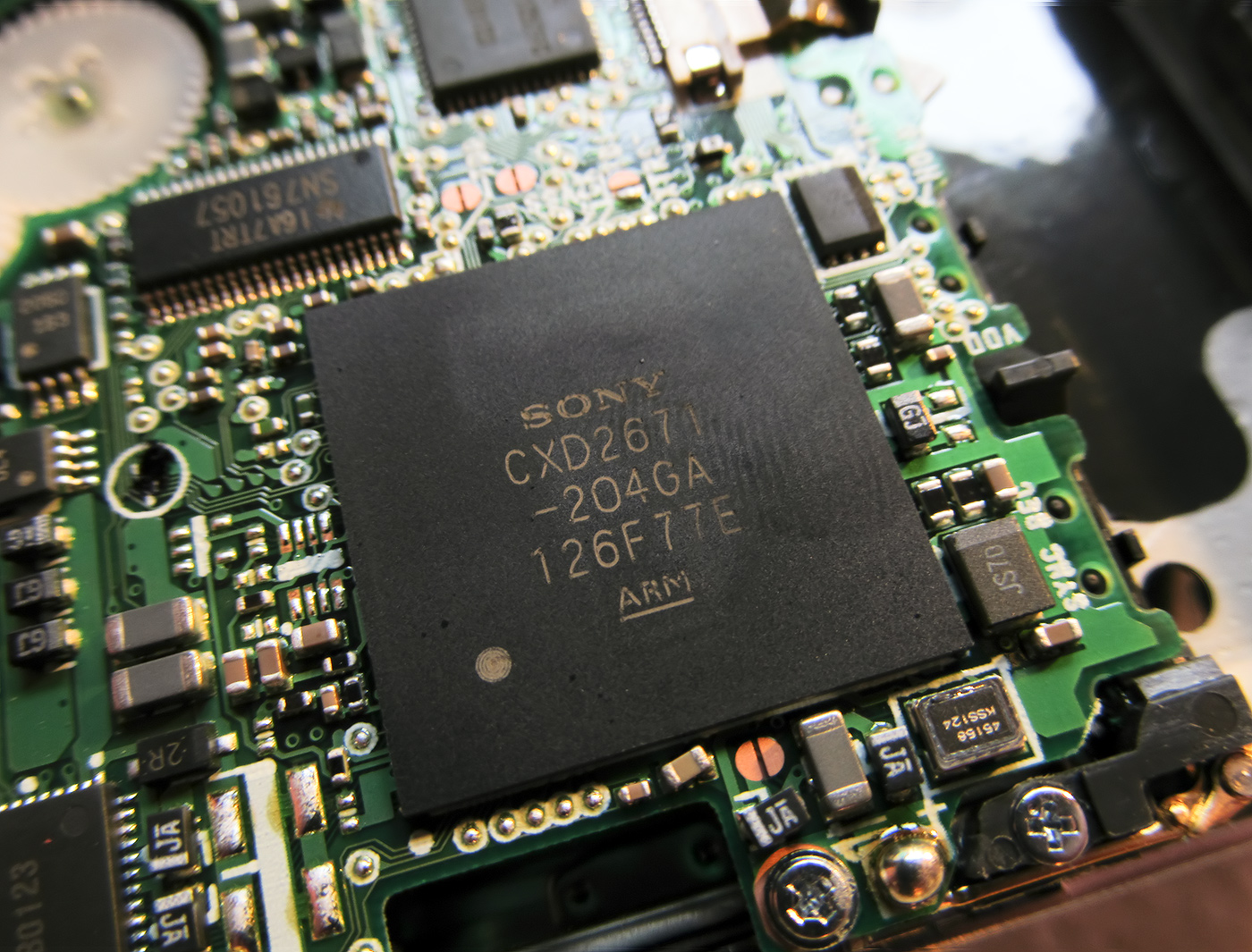
The two units you can see above are a Sony MZ-R 700 and two Sony MZ-R 900. The former was a gift to me from one of our mates, he didn´t need it anymore and upon hearing about my passion for MD he decided to give it to me for free. That made me really happy because I love new gadgets to play around with and I also wanted to try hacking its firmware. The MZ-R 700 was released in January 2001 together with the entry level model from the same production line, the MZ-R 500. The flagship MZ-R 900 had been released six months prior and according to many people all over certain boards it wasn´t as technically advanced as the later models. Being the top model it was of course much more feature heavy but it supposedly still lacked the newest ATRAC chip. The MZ-R 700 & MZ-R 500 were equipped with ATRAC 4.5 DSP Type-R configured to use the worse ATRAC 4.5 simply because the top model was using it: the cheaper models weren´t allowed an encoding engine more sophisticated than the one from the top model. Another proof was that the successor of the MZ-R 500 - the MZ-R 501 - was using ATRAC 4.5 DSP Type-R (proudly advertising it) yet both were using the exact same ATRAC IC, the CXD2671-204GA (MZ-R 700: CXD2671-203GA -> same IC, different hardware revision).

ATRAC IC, Sony MZ-R 900
Knowing that fact many people subsequently hacked the MZ-R 500 / 700 into not only having more features but also to use the more advanced ATRAC instructions. This could be done safely since MZ-R 500 / 700 / 501 were basically the same models with different shells and finish. But all the while people left the MZ-R 900 alone, using only the older ATRAC configuration. As it turns out the MZ-R 900 also used the very same ATRAC IC that turned the lower models into such pristine recorders. Look at the picture directly above: it shows the ATRAC IC on the PCB of my silver MZ-R 900 (the fingerprint is not mine and now gone), the CXD2671-204GA. Today I also opened up my blue MZ-R 900 and guess what: I found the same chip again. That means that both of my MZ-R 900 are able to use the more advanced ATRAC DSP Type-R. So I decided to hack their firmware based on this guide here on sharoma.com.

Before we start to hack away a short disclaimer: I´m not responsible for any damage that might happen should you make something wrong. Firmware hacking can be an extremely powerful tool but it can also destroy your recorder completely! If your unit is dead after hacking its firmware don´t blame me, you are doing this on your own responsibility!

According to the Service Manual of the MZ-R 900 a less advanced hardware revision is in use, yet on the PCB itself the 204GA has been printed onto it (on both of my models)
Read this guide at least once before you actually start doing something. I also recommend reading the hints below it and to look at the pictures showing how the display looks. You finished reading? Then let´s start: first of all you have to enter the service mode on your unit. You have to remove any disc, you also have to make sure that it is sufficiently powered. I would add a fully charged battery as well as connecting it to the power supply. I also would unplug the remote as we will apply the hack by using the buttons on the unit itself.

  1. To prepare for service mode switch the HOLD mode on.
  2. Then hold down the VOL- button (just like the Shift key on your keyboard), then press the following combination quickly: » » « « » « » « then press PAUSE twice. Release the VOL- button. Should you have been successful the display of your recorder is now flashing its firmware version, my two MZ-R 900 were displaying V1.300 00 2.
  3. Press VOL+ VOL- VOL-Keisu 800 should be displayed ("Keisu" on the left, "800" on the right)
  4. Press PLAY and then VOL+ five times
  5. Press PLAY seven times. On the right you should now see 867 and on the left three rolling numbers and three steady values. Ignore the first.
  6. Using the VOL+- keys change the value on the left to S67, then press PAUSE to save.
  7. Press PLAY to go to the next register 868 (on the right), change the value on the left to S01, press PAUSE again to save.
  8. Exit Service Mode by removing all the power from the unit.
You don´t need to hurry once you have enabled the Service Mode. Take your time, it´ll be much less unnerving. Also, you can always go back to the starting point (where it flashes the firmware) by pressing STOP repeatedly. Remember: pressing PAUSE always stores the value you have just changed. If you don´t press PAUSE nothing will be saved. After changing the values and leaving Service Mode you should enter it again to make sure you really have changed the two values. Should you have done something wrong or if you want to reset the changes here are the original values: for 867 it´s S00, for 868 it´s S20. Shouldn´t you trust my instructions please refer to the site where I took them from: www.sharoma.com/minidisc/hacking.htm.

Step 3 looks like this on the Display
Step 5 & 6 should look like this (the XXX indicates the rolling numbers)
Step 7 should look like this (XXX indicates rolling numbers)
Congratulations! If you have done it correctly you now have enabled ATRAC DSP Type-R on the Sony MZ-R 500, MZ-R 700 and MZ-R 900. I won´t tell you how to add more features to your unit, most of them are pointless anyway in my opinion. I was only interested in changing the ATRAC code... imagine: by hacking a firmware you can have better sound quality. I have not yet found any flaws, my three units still function perfectly. What? You want to know if changing some values really had an effect on ATRAC encoding quality? How lucky you are today, of course I anticipated this and therefore I´m going to present measurments to you (enlarge the pictures and scroll through them, that way you can see differences more easily)!

ATRAC 4.5 Total Harmonic Distortions from MZ-R 900 before hacking
Typical ATRAC 4.5 DSP Typ-R (MZ-N 510): less distortions all around
ATRAC IC of the MZ-R 900 after hacking: DSP Type-R performance!
Naturally all other measurments are the same. The 'attention-shifting' effect I described before also happened here. Are you surprised? I was, I now haven´t got any ATRAC 4.5 device left. I don´t care, naturally I´m gonna use ATRAC 4.5 DSP Type-R exclusively in the future. But one thing is curious: why didn´t Sony activate the most advanced ATRAC codec in the first place if the MZ-R 900 was already equipped with it? When it was released it was the only portable ATRAC 4.5 around (the predecessor probably used ATRAC 4.0) and Sony could have easily skipped an ATRAC generation, going straigt from ATRAC 4.0 to ATRAC 4.5 DSP Type-R. Why they didn´t do so is a mystery to me. Anyway, now I´m going to enjoy some music in pristine quality. Tata!

Sony MZ-R 700: it uses ATRAC DSP Type-R now,...
... as does this one and finally...
... so does this one. Wonderful!
Related Posts Plugin for WordPress, Blogger...

The Socials