Showing posts with label Asus Xonar Essence ST. Show all posts

Wednesday, April 10, 2013

A new PC & lots of problems... (EDIT: 17.07.2013)... that are finally rendered moot


I´m sorry that it took me so long to write a new Article. The reason for an absence several months long is that I bought new parts for our PC which is also the reason why I won´t talk about audio stuff today... well, at least not directy. You see, my trusted ASUS Xonar Essence ST doesn´t work anymore and I´ve decided to sell it. It´s not broken, it functions extremely well - just not in combination with the new PC parts. But let´s start with the reason for the purchase of the new parts.

During the last months of the past year I´ve encountered several never before seen errors which even included three BSOD(I was shocked since I´d last seen a BSOD with Windows XP). Programs crashed or misbehaved, all without an obvious reason, something they never did in the months before. I always take care of our system, avoiding unnecessary installations, defragmenting with the best program, cleaning up the registry (by hand, mind you!) etc. so I wasn´t prepared for this. But the error codes of the BSODs pointed towards a problem with the RAM. So I thought "Allright, the RAM is broken. Happens a lot." As skeptical as I am I tested it with Memtest86+ which immediately confirmed that my RAM was broken. Another pass with the program however produced errors at a different address area, the same thing happened with a third pass. I therefore concluded that the RAM was ok but that the mainboard was faulty instead. To confirm this I opened the PC case while the PC was running and touched the RAM slightly from the top - this caused another BSOD immediately, the error code again pointing to the RAM. By know I knew of course that the mainboard instead of the RAM was broken and needed replacement soon. But where do you get a decent mainboard equipped with a Socket 775 for Intel Core processors at the end of the year 2012?

AMD Fusion - my new system architecture

Bingo, it´s impossible since this socket was phased out last year along with the matching CPUs. To purchase a used mainboard wasn´t an option for me so I started thinking about a completely new system, keeping only the case, the HDD and the power supply. After much deliberation I decided for an AMD-based system, to be precise, an APU (Accelerated Processing Unit) formerly called "Fusion". This APU combines a common CPU and a GPU (Graphic Processing Unit) into a package as small as a usual processor. This whole architecture is not unlike those found in recent smartphones where they are called SoC (System on Chip). Why didn´t I continue to use an Intel based design when I was so happy with it? For one I´ve always admired that AMD is kind of the underdog when it comes to processors, secondly because the Fusion architecture is better suited to my needs. But first things first. In 2011 AMD introduced their new "Bulldozer" CPU architecture which completely revamps the approach of combining several cores into one processor by using so-called "modules" (or "Clustered Multi Thread"). Utilizing this design a four core processor would basically use two modules with each module containing two integer clusters (cores) and just one floating point unit. This design aims at reducing power consumption while having a very fast processing speed at the same time.

The new parts for the PC
However, this new module architecture wasn´t well received when it hit the market in October 2011. Processing speed wasn´t on par with similarly priced Intel CPUs, power consumption was (much) higher as well. According to many reviews this design isn´t capable of high single-threaded processing power - yet. Curiously, these new CPUs were running fast as hell on Linux but slow on Windows. The latter doesn´t seem to be optimized that much to fully utilize the processing power of a CPU aimed at multithreaded calculations. Anyway, in 2012 this design was improved; now it´s called "Piledriver" and this update brought a slight increase of processing power as well as reduced power consumption. It is this altered design I finally decided on, in my case called "Trinity" (sadly, it doesn´t look like Carrie-Ann Moss). Up above I wrote that this APU is better suited to my needs than a comparable Intel design. For one, the AMD APUs include a very powerful GPU which enabled me to perform energy efficient video encoding (do you really think I only have audio as a hobby?) by using GPU acceleration. I also wanted to have a system as simple as possible without a graphic card, a system that was powerful nonetheless. Furthermore, Intel products are traditionally more expensive so purchasing a cheaper AMD solution seemed to be a more reasonable approach. You can see the new parts on the picture above, a detailed list along with a list of my old parts follows now:

New system

  • 2x G.Skill Ares RAM (DDR3 2133, 16 Gigabyte)
  • ASRock FM2A75 Pro4
  • AMD A8-5600K
  • Intel 330 SSD (128 Gigabyte)
  • Noctua NH-U9B SE2
  • Inline SATA-cable (shielded)

Old system

  • 2x GEiL Value (DDR2, 8 Gigabyte)
  • ASUS P5Q SE Plus
  • Intel Core2Quad 8400
  • Western Digital WD6400AARS (640 Gigabyte)
  • Noctua NH-U9B
  • Club3D HD4650 (passive Graphic card)
  • Silverstone CP04 SATA-cable (shielded)

The old system had a combined cost of roughly 500,- Euros while the new system cost roughly 410,- Euros. The difference doesn´t seem big - unless you consider that the new PC has twice as much RAM and also contains an SSD instead of a common magnetic HDD. The Intel processor alone cost 133,- Euros (AMD A8-5600K: 93,- Euros). The new system however is not without flaw as you will find out soon. When my boyfriend and I ordered the parts I didn´t expect an increase in speed when it comes to raw processing power; from all I´ve read the new AMD APU was supposedly calculating as slow as a turtle; an actual entry-level CPU. 70% of the reviews I´ve read either pointed out that a competing Intel processor would be faster and less power hungry or that the AMD design was faulty from the beginning. Only very few reviews mentioned that an Intel system would need a powerful graphic card to be able to compete fully with the AMD, they also didn´t forget that the AMD approach of mighty multi-threaded processing power actually is the more advanced design better suited for future applications. AMD plans to make the GPU part a full member of the processing ensemble by giving it tasks usually assigned to a classical CPU, in the future the APU itself is supposed to decide on the best use for either CPU or GPU. In the end I wanted to sample AMD technology myself, I wanted to play around with GPU acceleration AND save power at the same time.

CPU cooler, RAM, Fan and Power supply
When the system was finally assembled it didn´t take long for me to discover that processing power actually had increased so much that it was baffling; I expected a worse performance remembering all the bad reviews I´ve read. Example: I made the error of assembling the system and forgetting to change the HDD the system is supposed to boot from with the result that it booted using my old, Intel-based Windows installation. For experts this shouldn´t come as a surprise but I expected that Windows would not be able to manage a complete change of the system architecture. Imagine my surprise when instead my old installation started as if nothing had happened. Of course, many drivers had to be installed but Windows Update performed that part admirably. Which means: before I installed Windows again I used my old system a bit which was still running from my Western Digital HDD - the improvement in speed was noticeable even on easy tasks as for example surfing the net. Everything not only was faster, it also felt that way: responsiveness of the whole system had improved by a large margin. I don´t need to tell you that it turned into a blazingly fast machine after installing it anew on my Intel SSD, I´ve experienced speeds I´ve until then believed wouldn´t be possible.

WEI (Windows Experience Index) for the new system
You can see the results of the WEI above. For comparison here´s the performance of my old system: CPU Score 7.2, RAM Score 7.2, Graphics Score 4.3, Gaming Score 6.2, HDD Score 5.9. The CPU score didn´t increase as much as I expected it to, from how the system now feels when it comes to responsiveness I would have guessed a 7.4. But this shows that the WEI uses a logarithmic scale; more details are revealed when running theoretical benchmarks:

Passmark PerformanceTest 7.0 comparison of old system against the new one
The picture above shows that the CPU actually performs roughly 80% faster than the old system. Everything else is faster too though the most obvious increase in speed comes from the SSD of course. Nonetheless I was surprised that this supposedly slow AMD processor performs this well. What you cannot see however is that the floating point performance of this CPU is only marginally faster than before which is caused by the availability of only two floating point units. Equally invisible is the single threaded performance which seems to be worse compared to the old Intel when considering efficiency per clock cycle (the AMD is faster but only because it clocks at 3.6 Ghz instead of 2.66 Ghz of the Intel). Nonetheless this is very impressive wouldn´t you say? Real world examples like for instance video encoding are three times as fast as before - and I´ve not even used GPU acceleration yet. Audio processing is faster as well though that depends on the individual program and whether it uses the integer or floating point units of the APU. But what about power consumption? My old system desired roughly 70 Watts when idling and 225 Watts when CPU and Graphic card were fully utilized. Compare that to the 40 Watts for the new system (idle) and 170 Watts (CPU and GPU under full load). A comparable Intel system would perform superior but it´s needless to say that an Intel system would draw as much power as my AMD system should it have a seperate graphic card of equal processing power. I also succeeded in having a small, not very complex system:

Almost empty - yes, this is a fully working PC
Wait... it´s empty? But where is the ASUS Xonar Essence ST? Shouldn´t it occupy one of the PCI slots? Yes, dear reader, it should. Problem is that the ASRock mainboard I chose isn´t very good. While the whole system runs fast and extremely stable using this mainboard at stock configuration the situation changes when you configure it to use anything out of the ordinary. You might remember that the RAM I bought is DDR3-2133, the CPU however can only handle DDR3-1866 natively which means that when the RAM is running at its native speed the CPU "thinks" it´s overclocked. As a result the mainboard severely overvolts the northbridge integrated into the CPU as well as the CPU itself. Despite overvolting the system now runs unstable and produces errors; everything goes back to normal when the RAM is underclocked to 1866 Mhz. The AMD APU also offers the possibility of overclocking by featuring unlocked multipliers; but don´t you ever dare to overclock it because then the system will turn unstable soon. I don´t want to use an overclocked PC but it´s nevertheless nice to know what a system is able to achieve; my limit so far has been a maximum CPU clock of 4.1 Ghz (maximum stock turbo frequency: 3.9 Ghz) using voltages not too high. When I´m not overclocking the mainboard itself overclocks and underclocks at the same time: under load the CPU always is at 3.8 Ghz, even when using single threaded applications where it should clock at 3.9 Ghz. But the worst is that this mainboard is unable to run my beloved ASUS Xonar Essence ST.

It´s not that it´s impossible to use it, the line-out of the ASUS functions as it should, my biggest problem is that I cannot switch to its integrated headphone amplifier! Instead of firing up my Sennheiser HD-600 it continues to feed the line-out - and I´ve clearly heard the clicking relays that change the signal paths. As you can guess this makes this card impossible to use and also removes the biggest convenience the card offers: having an excellent on-board headphone amplifier. Since I´m most of the time using my headphones the card is now useless. Naturally I contacted ASRock and ASUS; the latter tried to convince me that their mainboards are guaranteed to work with this card (Hello? Aren´t PCI cards standardized?) which isn´t true anyway; there are enough examples existing where ASUS mainboards failed to work with the ASUS Xonar Essence ST. ASRock tried to help me as much as they could, my problem was redirected to their Taiwanese headquarters by the European division (based in the Netherlands) but in the end everything was in vain since they didn´t own my soundcard. I´m now left with two options: to sell my Xonar Essence ST or to buy a new mainboard. I elected the first option.
AMD and Noctua badges on the Lian-Li case
Why have I decided on selling the Xonar Essence ST? For one, this card is extremely picky when it comes to mainboards. A lot of people over the past four years have reported numerous difficulties suspiciously sounding like my own problem. So far I´ve been lucky using my old system and despite this card being a native PCI card it doesn´t seem to work well under certain circumstances. The Xonar Essence STX which is exactly the same card (missing only a special "anti-jitter"-circuit and featuring an added PCI to PCI-Express interpreter chip instead) has been reported not to produce my particular dilemma. The anti-jitter circuit I mentionend was probably employed by ASUS for the PCI card only because the PCI interface itself jitters a lot (parallel data transfer); the PCI-Express version doesn´t need this chip because the interface doesn´t jitter as much (serial data transfer). Another reason for purchasing the PCI-Express version is that I cannot be sure that my old card will run with another mainboard. As I´ve written above, despite ASUS assuring me that the Essence ST is guaranteed to run on their own mainboards the past has shown that this isn´t the case. Since acquiring the new parts ASRock also has rectified some errors the mainboard produced by releasing updated BIOSs - but not my problem. I also don´t want to take apart my smoothly running system to assemble it again with a new mainboard considering that I might run into new problems. So, anyone wanna buy my Xonar Essence ST? ;-)

Illuminated Enermax fan - ridiculous, isn´t it? Don´t worry, it´s for the picture only

Not being able to use my lovely soundcard hinders me to produce the reviews I have been planning for a while; four months ago I purchased a FiiO E07K and already performed several measurements and listening tests before I re-built my PC. Still, I want to do some additional measurments and for that purpose I need a fully functioning card having a perfect noise and very transparent recording performance. Using the onboard soundchip of my ASRock board is impossible since the in- and outputs are noisy, they also don´t sound very well and are far away from being sonically transparent. My Creative Soundblaster X-Fi HD USB would be able to produce relatively neutral measurments but it´s unsuited for recording, because of it´s not transparent and relatively noisy input. During the last year I also purchased several vintage portable CD players which I´d like to review too... but I´m unable to, I cannot measure them and I cannot record their output to judge their sound quality.

So now you know why I haven´t written any reviews lately. I´ve gained a fast and efficient new PC yet I´m unable to unleash it´s full potential because I´m deprived of my lovely Xonar Essence ST, the card being incompatible with my new mainboard (or the other way around, who knows). I haven´t yet sold my card to buy a new one, I´m too lazy to produce some nice looking photographs for eBay. Furthermore, I did have other things to do and so four months passed... gosh, that long. I´ll have to buy the Xonar Essence STX soon to be completely happy again. Stay tuned for any update, it might happen soon. It certainly won´t take another four months!


Just a little update: for two months now I´m the lucky owner of a brand-new ASUS Xonar Essence STX... which means that I now can start afresh with new measurments, listening tests and reviews. I would have risen out of my slumber sooner but other things I didn´t have the wisdom to foresee delayed my 'comeback'. In March I rediscovered my love for books! I always have been an avid reader but during the past two years I´ve rarely read any book at all. Seems to me that I have been starving because in just four months I´ve read roughly 25 books, many more than 1.000 pages long. The novel that caused my love for books to rekindle was 'Horns' by Joe Hill, a fantastic read that I can recommend warmly. But not only books occupied my time. For a month now I have been ill... don´t worry, it wasn´t anything life threatening though I still had to stay in hospital for four days (four days in Hell). But as I started on my path to recuperation two weeks ago I also began to realize that my desire to write articles had returned with full force as well. So here I am, editing an article I´ve written three months ago, with many more article well on the way. And since I´m here why not show you how well my new Xonar Essence STX measures?

ASUS Xonar Essence STX, Loopback, 24/44.1
ASUS Xonar Essence STX, Loopback, 24/48
ASUS Xonar Essence STX, Loopback, 24/96
ASUS Xonar Essence STX, Loopback, 24/192

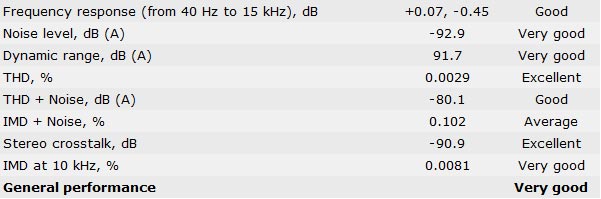
Looks good, wouldn´t you say? Oh, before I forget... please ignore that I used the commonly employed loopback method offered by RMAA, it´s just that I don´t have any hardware superior to the ASUS. Regarding the measurments I think that THD + Noise are a bit higher than I remember. But I may be wrong there. What I´m sure of is that I´ll repeat the measurments again (including jitter) when I have removed another soundcard I purchased recently, the Terratec Aureon 7.1 PCIe. I have not yet found a review for the Terratec - which means that I will review this interface myself. What? Why did I buy the Terratec? Well, I needed an optical input capable of receiving the samplerate of 88.200 Hz transmitted by the optical output of my Pioneer BDP-140. You´re probably guessing that I wished to copy my SACDs digitally... congratulations, your guess is correct! No, you don´t win anything, sorry. Anyway, I´ll write an article about copying SACDs without the Playstation 3 sometime in the near future, you will be able to read everything important then. I´ll also write an article reviewing the wonderful FiiO E07K 'Andes', I´ve owned it since January and have used it often. Other articles to be written will be about several vintage portable CD players, lossy codecs being able to process high definition audio material and... MD recorders. You´ve read correctly: I'm perfectly aware that I´ve stated back in November 2012 that I won´t write MD-related articles anymore because of technical obsolescence and friends bothering me with questions like "Who reads this crap?" Well, I do. I also happen to love MD, I can´t help it. I know it´s old-fashionend; I also have to confess I´m well aware that I´m no different from those vinyl crazy audiophile nincompoops believing in an ancient and essentially dead media format. But I don´t care; if you don´t want to read those articles just skip them.

But do you know what all of this means? Yeah Baby, I´m back!


Last update: 30.07.2013

Wednesday, January 09, 2013

Vodoo continued: my final Statement on USB cables


This article here is the final sequel to "Hot Vodoo: Audio differences between USB cables - yes, they do exist" and "More USB cables - more differences". So before you read this one go ahead and scroll through the other two.

Almost one year has passed since my last article concerning USB cables and their sonic signatures was published here. Truth is that I ran out of steam: I didn´t want to do it since I was afraid that I had been measuring the effects of ground loops only. But before I start with the embarassing truth I´ll tell you about the stir those two USB articles created. The articles I refer to (linked above) were written almost a year ago and since then they have been popping up constantly in several online forums. I´ve received visits from Russians, Germans, Americans, Norwegians, Japanese or Chinese citizens to name but a few. Sometimes the participants of these forums made fun of me, sometimes they tried to find out how I was doing things, sometimes I was accused of lying or imagining things and on some occasions people actually tried to help me. It fascinates me to this day that 99 % of all those people didn´t comment here on my blog but only in their respective habitat, forums I´ve never heard of before. Since I´m the most gleefully cunning person I occasionally registered there just to take part in their discussions... and boy, it was delightful to witness how fast participants there transformed from being bullies into polite, elaborate people upon myself unexpectedly taking part in those discussions. Without me it was 'chic' to mock me - so why did people stop when I suddenly entered? I love mockery, especially when it´s about me (I tend to be too self-centered sometimes). This wasn´t restricted to one country, no, it was a trait exhibited by people coming from all around the world. For all those who were doubting me throughout the last year I assume this article will be a field day which is perfectly alright - yet it saddens me that people generally seem to ignore transparency and truthfulness. But let´s start, eh?

USB cables revisited: only the Belkin and the Audioquest were used
In the last article I compared five different USB cables, for the article you are now reading I used only two of them: the Belkin which performed the best & the Audioquest which performed the worst. Since the measurment differences between those two were the strongest I assumed that they´d be the most likely candidates for also showing differences today. Likewise, I used my Creative Labs Soundblaster X-Fi HD USB again... BTW, that was the most peculiar thing... because in those forums I mentionend above I was attacked for measuring cheap hardware 'on my kitchen table'. Well, of course I did, that was the whole point. What good would my test have been if I would measure with expensive boutique hardware (which I don´t own, thank you very much)? I wanted to show results with everyday hardware, something people would actually buy. That way my results would (hopefully) be more comprehensible. Furthermore, assuming that something more expensive is behaving in a superior way is audiophile bullshit. One word about the 'kitchen table' comment... I will ignore it since it reveals opinions much too conservative for my taste. Just something to think about. Back to topic: I had to use the X-Fi HD USB and my ASUS Xonar Essence ST again since I wanted to compare possible differences between one year ago and today. My testing methodology may have changed / improved during the last year, yet I still have to make sure to repeat testing circumstances exactly as before to obtain reliable results.

Creative Labs Soundblaster X-Fi HD USB was used again
For that reason my testing chain then and now consists of the X-Fi HD USB connected via the Audioquest King Cobra RCA cable to the Xonar Essence ST. The last time both soundcards were powered by my desktop PC and since that obviously created the problematic grounding loop I now took a slightly different approach. This time I used my nine year old laptop, an FSC Amilo 1425 which was used to power my X-Fi HD. Naturally this laptop is able to run on batteries, it completely avoids grounding loops that way. Everything else was the same though: the Creative still was connected to the ASUS with exactly the same RCA cable. The laptop uses Windows XP as its OS so I had to utilize the Kernel Streaming plugin for foobar2000 to avoid potentially harmful resampling (one year ago: WASAPI direct connection on Windows 7). Another difference to the older test is that I decided to show you the results of ten test runs (five for every USB cable). I also did five test runs for the last test but I sadly failed to disclose their results. So, let´s have a look at the facts, shall we?

For comparison: Old results, one year ago, both interfaces run from the same PC

Belkin USB cable, two different PCs, one running on batteries,
five different test runs which have been averaged for this table

Audioquest Forest USB cable, two different PCs, one running on batteries,
five different test runs which have been averaged for this table
Shit! You now can see that one year ago I indeed measured the effects of a ground loop caused by using the same PC for both interfaces. With one interface running on batteries and by that removing the ground loop I also removed the measurment differences between the two USB cables, the lower resistance of the Audioquest is not important anymore. Yes, the X-Fi HD USB now measures EXACTLY the same with two different USB cables. Which probably means that 1. differences between USB cables don´t exist or 2. that I indeed can´t measure them with my limited hardware or 3. that I need more and different measurments. In any way, two things are now crystal clear: the X-Fi HD USB is a gorgeous performer on its line-out while the Xonar Essence ST boasts an equally impressive line-in. With measurment results as fantastic as these it´s hard to imagine that more expensive soundcards can do much better; you also have to keep in mind that both cards are relatively cheap and are far away from being hardware for demanding professionals. Just take the noise levels: they have improved by roughly 12 dB - Creative was indeed telling the truth by claiming a noisefloor as low as -114 dB for the X-Fi HD. Back to the USB cables: the only differences I was able to find were so small that they are truly insiginificant:

X-Fi HD USB, Belkin USB cable
X-Fi HD USB, Audioquest Forest USB cable
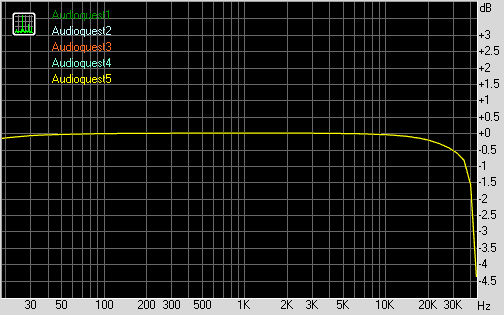
Click on the upper of those two pictures, that way you can scroll between them using your mouse wheel - only then you´ll see that the X-Fi HD USB has a very, very slightly improved high frequency performance with the Audioquest. That´s it. You could now say "Hey, there is a difference!" Erm... no, there isn´t. It is way too tiny to be of significance. Maybe distortions are able to reveal something else?

X-Fi HD USB, THD & Noise, Belkin USB cable
X-Fi HD USB, THD & Noise, Audioquest USB cable
Again, click on one of those two pictures and scroll between them with your mouse wheel and you´ll see that nothing changes - again. If at all, only the noisefloor seems to reveal a slight tendency in favor of the Belkin so I won´t bore you with additional non-existing differences between two pictures. Today I´ve learned two things: ground loops are evil & USB cable differences cannot be measured when using my approach. Phew, now I´m embarrased: I wrote two articles that were basically describing the effects of a ground loop! Stupid, stupid, stupid. But wait, has the sound changed? That´s where it gets interesting because it hasn´t. The X-Fi HD USB still sounds its best with the Audioquest Forest USB and the worst with the Belkin. Let me point out that the sonic differences are indeed small, I assume that they won´t be audible to 90 % of all people. But I started this article with an emphasis on being honest and truthful (which I always am - and which is painful here) and therefore I´ll tell you that I had doubts about my ability to hear things; I was afraid I might have encountered a prime example of a placebo. So I did what I usually detest, namely a Double Blind Testthe results of which you can see below:

foo_abx 1.3.4 report
foobar2000 v1.2
2013/01/09 02:54:00
File A: RAM-Disk:Audioquest.wav
File B: RAM-Disk:Belkin.wav
02:54:00 : Test started.
02:55:31 : 01/01  50.0%
02:56:05 : 02/02  25.0%
02:56:27 : 03/03  12.5%
02:57:05 : 04/04  6.3%
02:57:18 : 05/05  3.1%
02:57:28 : 05/06  10.9%
02:57:45 : 06/07  6.3%
02:58:01 : 06/08  14.5%
02:58:19 : 07/09  9.0%
02:58:33 : 08/10  5.5%
02:58:48 : 08/11  11.3%
02:58:59 : 09/12  7.3%
02:59:17 : 10/13  4.6%
03:00:01 : 11/14  2.9%
03:00:17 : 12/15  1.8%
03:00:35 : 13/16  1.1%
03:00:51 : 14/17  0.6%
03:00:54 : Test finished.
 ----------
Total: 14/17 (0.6%)
I had occasional problems making out differences. It took me 17 trials during roughly seven minutes to find out if I was imagining things - but now I´m at least confident that my ears (and brain) are still fully functional. I´m no so-called 'Golden Ear', those are a myth. Audiophiles often claim that they are able to hear more than, say, skeptical people relying purely on measurments - which isn´t true. The only thing that´s valid to state is that there are people out there who have trained themselves to hear differently compared to others. I only hear this because I know what to listen for, nothing more. I´m also proud of my (perhaps imaginary) ability of not falling for typical placebo effects. "How can Marlene be so arrogant and full of herself?" you ask... maybe you´re right, look what being conceited brought me: grounding loops! All kidding aside, the situation of most of the time knowing what to listen for really isn´t the easiest thing to live with. I sometimes wish to have the gift of blissful ignorance because everytime I hear an album I immediately spot errors or defects & I cannot enjoy the music until they are gone. This might sound contrived to you but it prompts me to ignore bad sounding albums, even if the music is engaging. Imagine the time I could save by not being obsessed with these things. Enough with the cocky self pitying and back to topic!

Measures extremely well on its line-out: Creative Labs Soundblaster X-Fi HD USB

I´m afraid there isn´t that much to conclude. I still hear the effects of different USB cables, yet I´m unable to measure them; the centuries old dilemma of audiophiles. It all leads to you and the decisions you make, dear reader. Are you a believer or a skeptic? I hate to exploit this common prejudice but I started measuring USB cables through external soundcards as a means of diminishing troubles between those two groups - I thoroughly failed. The only thing I did was creating a lot of hot air. Shame on me. I did however learn a few things: more expensive cables have less resistance causing ground loops to leak through more easily, that I cannot measure everything, that ground loops hamper effective resolution and that the X-Fi HD USB is a great performer on its line-out. But where is the benefit for you?


Saturday, June 02, 2012

Review: FiiO E6


EDIT 16.01.2013: I´ve received a FiiO E07K a few days ago and the experience I made with it prompted me to alter this article. I´ve therefore updated / changed it considerably.

I bought the FiiO E6 in November 2011 and since then this tiny, little headphone amp has made me extremely happy. I´ve always loved its pleasant sound. Some weeks ago I started to think about this and asked myself: "Why do I like its pleasant sound so much? Should it really be this pleasant? Is it really neutral?" Should you be a faithful follower of my blog you already know that I´ve been using it for almost every review I´ve written for this blog, I´ve used it for my portable CD players, I´ve used it for my Sansa Clip+, I´ve used it at home, I´ve used it when I was outside, I´ve occasionally even used it with my ASUS Xonar Essence ST. The FiiO was the only thing during those months that was able to make me truly happy without showing any flaws whatsoever. And that´s where I have been wrong because it sadly colours the sound, neutrality really isn´t an advantage it has. My original conclusion to this article was:
"By now it should be clear to you, dear reader, that you won´t necessarily need an ultra-expensive headphone amp in order to experience sonic bliss, the FiiO E6 will do just nicely with headphones ranging from 32 to 150 Ohms. You shouldn´t trust someone who describes the FiiO being inferior to other amps because of its low price. I cannot imply you to buy it, you have to make that decision yourself. Will you like the additional little box attached via another cable to your portable player? I myself don´t mind but what about you? I´m afraid you have to find that out on your own. You might be in for a sonic surprise, a surprise you maybe won´t like: bass you were expecting from your iPod may now be absent just because the problem of mismatching output impedances has disappeared. In my opinion however you should try it out anyway, $ 25 won´t really hurt and you might be eternally rewarded with something you´ve never experienced before with portable players: almost perfect neutrality, nice design and more gain than ever before."
To reach this conclusion I´ve beforehand spent precious time on explaining what a headphone amp is, gave examples why you won´t need a costly headphone amp, why the FiiO E6 would also work for a headphone as expensive as for example the Beyerdynamic T50P... blablabla. But everything changed with the arrival of the FiiO E07K: To review that headphone amp / USB DAC I wanted to find out how it would behave against a reference, something that appeared to be impossible for me before. When I wrote the original review for the E6 I couldn´t think of a method to reliably compare it to an ideal reference and I´ve always hated that I seemed unable to find out how it really sounds, if it colours the sound, if it introduces errors... when all of it could have been so easy.

FiiO E6

This feeling of being unsure about my rating for the E6 and the aforementionend original conclusion has been nagging me since publishing this article in June 2012. But now I´ve found a way to come close to an objective-as-possible review. My E-MU 0202 USB broke down during the last days of December 2012 which has robbed me of my basic ingredient for my testing methodology. It not only forced me to devise a new method for comparing units like portable CD players to my reference files, it also prompted me to alter my testing chain for such an occasion so that I could finally perform listening tests with headphone amps. The solution for latter cases was the Creative Soundblaster X-Fi HD USB: by recording its lovely output with my ASUS Xonar Essence ST I would create a new reference against which the FiiOs would have to be compared. Therefore my usual reference files for the FiiOs wouldn't be the sources for the testing material themselves, instead I´d use the playback from the X-Fi HD recorded with the Essence ST. After that I would insert one of the FiiOs into the signal chain between the Creative and the ASUS to record the same material again. Have a look:

Reference:

Creative Soundblaster X-Fi HD USB -> ASUS Xonar Essence ST = Reference files

Compared to:

Creative Soundblaster X-Fi HD USB -> FiiO E6/E07K -> ASUS Xonar Essence ST = FiiO results

Having done both steps I now would be able to compare the results from the FiiOs to my reference files. The sonic characteristic of the X-Fi HD USB embedded in the reference files would ideally be completely retained by the FiiOs and in case they´d colour the signal it would be incorporated as well. There are some obstacles which again might colour the results: the line-in of my Essence ST is electrically not comparable to a headphone which is what the FiiOs were designed for in the first place. From what I´ve read a line-in is a much easier load for a headphone amp than a headphone with an impedance of for example just 15 Ohms. Which means that when one of the FiiOs is driving the line-in of the Essence ST it could theoretically be 'easier' to 'hide' possible colourizations. But I nevertheless think that this method enables me to reliably spot differences compared to unplugging/plugging headphones from one amp to the next. To do it this way also made it feasible to create crude measurments; I wanted to see how these would compare to the professional measurments NwAvGuy did for his wonderful article about the FiiO E6.

FiiO E6 from below
To shorten this article I´ve partly removed the long & boring explanations about headphone impedances, gain and possible advantages of having an extremely low output impedance. Some of those sections can now be found in the article about the FiiO E07K; albeit shortened much. Reason: there are much better articles to be found anywhere else, much better than I could ever write them. Just a few words about the features the FiiO E6 offers: its high input impedance gets rid of every impedance mismatch error a headphone amp can possibly produce. It sports an output impedance of just 0.25 Ohms (according to NwAvGuy´s measurment) which should be perfect for any headphone and certainly doesn´t pose any problem for my Sennheiser HD-448 or my Superlux HD-668, even though these aren´t very susceptible to high output impdances anyway. I bought the E6 to rid myself of any possible impedance problem I could ever encounter with portable players. For example: most of the headphone amps inside my portable CD players or MiniDisc recorders have a fairly high output impedance and other obstacles not advantageous for good sound. Then there is the amp inside my X-Fi HD USB which supposedly has an output impdance of 36 Ohms and the one built onto the Xonar Essence mainboard (11 Ohms) - both are not suited for difficult IEMs. Connected to their headphone outputs the FiiO E6 simply renders this problem moot. But this tiny headphone amp can also be used with line-outs from stationary sources, for this purpose it is equipped with a special low-gain setting (2 Volt mode). However, you might run into problems should you be using it with one of those louder-than-usual sources I described in this article: instead of the quasi standard 2.0 V (which the FiiO adheres to) they sometimes output with 2.2 or 2.5 V, supposedly leading to severe input distortions when used with the FiiO. But now off to my own measurments and audio rating, yes?

FiiO E6, 1 Volt Mode (High Gain)
FiiO E6, 2 Volt Mode (Low Gain)

FiiO E6, Total Harmonic Distortions, 1 Volt Mode (High Gain)
FiiO E6, Total Harmonic Distortions, 2 Volt Mode (Low Gain)
FiiO E6, Intermodulation Distortion, 1 Volt Mode (High Gain)
FiiO E6, Intermodulation Distortion, 2 Volt Mode (Low Gain)
Click on one of those pictures and scroll trough them using your mousewheel, you´ll find that differences between them are not that big. In low gain mode the FiiO does have less high frequency distortions but I really don´t know if they´re audible or not. But low frequency distortions seem pretty strong to my layman eye, these could be responsible for its pleasant sound by adding something that doesn´t belong there. Everything else looks fine though, especially when you consider how small this amplifier is and that it is selfpowered - there must fit a battery somewhere into the small case. What I couldn´t find however was the overload problem NwAvGuy described in his article about the E6... strange. Well, I have to consider the possibility that my X-Fi HD USB simply isn´t loud enough on its line-out (I have to change the volume by +2.5 dB after recording anything that has been played back by it if I want to have 0 dBfs) to distort the input of the FiiO. It´s also possible that his unit behaved a bit different, who knows.

FiiO E6 power/EQ/voltage mode button
At this section you formerly could find sentences like "...seems to warm up the sound ever so slightly (...) sometimes it sounds a tad boring...". Being now able to compare the FiiO to my reference files good and proper I have to say that those sentences have been the understatement of the century because the biggest problem of the FiiO E6 are dynamics. It removes much of the impact transients have, bass punches disappear into nowhere and high frequency attacks loose their bite. This is very evident when the FiiO-derived results are compared to my reference tracks from The Girl with the Dragon Tattoo or Episode II soundtracks; both show an extreme amount of very high frequency attack diminished quite a bit by the E6. Deep bass impact is decreased as well, all of this reduces the impression of dynamics, snap and punch. Madonna's track "Skin" sounds mellower than usual, its timing is noticeably slower when amplified by the FiiO. Well, at least speed is reduced consistently throughout the whole frequency band. People call this lack of dynamics a 'laid back' sound, I call it wrong. Resolution and definition are other areas where this amp fails: cymbal hits by an orchestra are close to being reduced to simple noise, the characteristic noise of a bow striking the strings of a violin quite audible on the reference tracks sounds unintelligable through the FiiO. Rendering the depth of a virtual stage correctly is equally problematic because it flattens the stage considerably, the impression of a holographic recording disappears. On the other hand, sonic balance and character of a recording are retained decently. While deep bass and highest frequencies are diminished, this isn´t very noticeable because it is compensated by adding a small amount of upper bass even though this also thickens up frequency areas that shouldn´t be thickened up. This is very audible on the organ recording I always use (Vierne, Michael Murray)... in fact, the organ almost sounds as if having distortions (there are none of course on my reference files). I´m very sorry but here are my reconsidered ratings for the FiiO E6:

Sonic Balance:
Dynamics:
Resolution:
Stage / Ambiance:
Character:


FiiO E6: black beauty
As it turned out in the end people deriding the FiiO for sounding boring were right - but I wouldn´t see it. Maybe because I didn´t want to or because I lacked a convincing method for comparing it. I´m not ashamed to rectify this error but have you noticed how many of my articles have been rewritten recently? First the one about the X-Fi HD USB, then the Sansa Clip+ and now this one. And then the articles about USB cables which in hindsight feel like a hoax... I really have to be more careful in the future when reviewing some audio gadgets. I have to measure what I can measure and I have to get rid of any error that could possibly happen. And I have to find and maintain valid methods for objective comparing before I´m writing a review. Anyway, sonic signature of the FiiO E6 is not as disadvantageous as it sounds because it can be used to create exemplary synergy effects with audio players or headphones. Take my Sansa Clip+ for example: combine it with this FiiO to achieve much more gain and you´d have a balanced sound you wouldn´t expect when listening to the Clip+ alone. The explosive dynamics of the Clip+ are a perfect fit for the mellow sound of the E6, its sonic disadvantages will compensate the ones from the FiiO. During the last days I´ve tried this combination and it indeeds sounds very well. Besides: both of them are tiny and don´t cost much. On the other hand, a combination of the FiiO E6 and the Sony NW-A 1000 has to be avoided; you´d drown in mellowness and boredom. This little amp would also be a good choice for overly dynamic or 'sounded' headphones (from Beyerdynamic for example). The FiiO doesn´t fit the signature of my Sennheiser HD-448 - but the opposite happens with my Superlux HD-668B. In the end it all comes down to your preferences: if you like a dynamic, very crisp and bassy sound signature you´ll have to shun it. But if you know what you are doing and if you plan to compensate for an aggressive sound signature the FiiO E6 will be perfect for you.


Last update: 16.01.2013

Friday, June 01, 2012

Review: Sony D-121, Sony D-EJ 250, Sony D-EJ 725 & Sony D-335


Hallo, meine Süßen! It´s that time again, the time for more vintage portable CD players! What? You are bored? Oh well... then go away and google for cute kittens; come back when you´ve cooled off ;). My last article about vintage portables was written on April 1st, since then I´ve acquired several new portables: the Sony D-335Sony DE-J 725Sony D-202Sony D-121 and the Sony D-EJ 250. I also did something incredibly stupid to some of them and to others from my collection... you may remember that I talked about prolonging their life for as much as possible; in order to achieve that I cleaned their drives and their mainboards (when necessary). Cleaning of the CD drive proved to be the crucial part because that´s where I failed: instead of using my specially bought silicone based fat for relubricating moving parts I used oil intended for sewing machines. Why? One reason is that my silicone based fat has a viscosity too high for some drives (-> Sony D-465); the other reason is that one can read all over the net that sewing machine oil is equally well suited. From all the comments I´ve read this oil is truly wondrous to behold: it has the perfect mixture of viscosity, doesn´t affect plastic or metal and it has an extremely high creep capability... BANG! - and that´s what´s problematic: it doesn´t stay where it´s supposed to be, it creeps everywhere. From the cogwheel and the splined shaft (called "sled assy" by Sony) it creeps into the laser block and from there into the optics, the laser and the photocells, subsequently destroying them. Have a look:

Sony D-335 drive

The picture above shows the CD drive of the Sony D-335, look at the darkened spot on the right side of the drive. Directly under the barely visible square-like hole sits one of two cogwheels vital for the laser sled. After I lubricated it with sewing machine oil - just one tiny drop on its bearings - the oil was hurled by the turning cogwheel towards the bottom of the CD player, to the left (onto the sled assy), to the right (the sled motor) and to the top of the drives' body. When I discovered this during the photo-post I swiftly went into panic mode and tried to save what could be saved... but I was too late, the CD player had already changed its sonic signature into muffled combined with confused staging. I had to buy a new drive, the much used KSM-331CAN, costing just 14,- Euros and luckily I didn´t even need to re-calibrate the CD player. But what about the other players I´ve treated with the oil? Yes, they still play everything except CD-R but they have changed their sound signature as well. So far I´ve deduced that I destroyed my Sony D-465, the Sony D-NE1 and the Sony D-EJ 250. If you read my blog regularly you will remember that I was baffled why the D-NE1 sounded so different with my E-MU 0202 USB and my FIIO E6 during my last review. The reason is clear to me now: after I cleaned and lubricated it I auditionend it with my E-MU first and afterwards (an hour later) I heard it with my FIIO; by then the oil had crept into the laser/optics (partly blinding them), hence the different sound. Needless to say that I´m genuinely embarrased - in an effort to preserve my little darlings I achieved the idiotic opposite by destroying their most vital part. Has something as dumb as this this ever happened to you?

And furthermore: what to do? During the last three weeks I have been searching for replacement drives that were in decent condition. Thankfully I have been the successful bidder for a Sony D-EJ 100, it shares its laser and sled motor with the D-NE1 and during the last week I was able to restore it back to full function again. I´m not surprised that it doesn´t change sonic character anymore, regardless if its been used with the E-MU or the FIIO. I could have used that laser for the D-EJ 250 too but the D-NE1 was a bit more important to me. The D-EJ 250 was repaired too a bit later; I´ve purchased a Sony D-EJ 361 and used its parts to replenish the D-EJ 250. The drive for the D-465 however is something else since there aren´t many portable CD players around using the same laser (DAX-11E). But I still had a second, fully functioning D-465 laying around which has been used only for spare parts - I´ve used its laser (now destroyed with the oil) for my first D-465, the one I subsequently tested and photographed for this blog because it seemed to be in better condition and able to read more CD-Rs reliably. So today I put the laser from the first D-465 back into its old CD drive during a three hour long operation which I also used thoroughly to clean it. I don´t know how many Q-Tips and Isopropylic alcohol I had to use but it was awful... and after all was said and done I lubricated all moving parts again - this time with just a tiny little bit of my silicone fat though. I was successful: it now works like a charm, to my surprise even the old laser does its job well. It seems that the last time I repaired the drive I used too much fat, leading to unreliable reading I then got rid of with additional drops of sewing machine oil (Boy, was I stupid!). During the last two hours I´ve been listening to a lot of CDs and they play without skipping - the player now sounds again like I´ve described in my first article. Just in case however I´ve acquired a used Sony D-E 441 since it uses the same drive as my D-465 and I plan to exchange its drive again should it be in better condition. But now on the reviews, shall we? Oh, before I forget... the reviews up ahead are going to use my new ratings for the first time, I hope you´ll like them.

Sony D-465 - fully functional again (don´t you just love its blue display?)

--------------- Sony D-121 ---------------

Sony D-121

The Sony D-121 was an inexpensive portable player released by Sony in 1993 if I´m correct. You can find one on eBay for little money, most of them are however in an extremely bad state, you have to be lucky to find one that looks as pristine as the one above. Don´t be fooled by its outer appearance though: some parts apparently have been suffering over the years, probably because of long exposure to heat (which will quickly age the condensers / SMD parts on the mainboard), they are likely responsible for the player not accepting any CD-Rs. Which means that I cannot measure it, I can only describe its sound.  EDIT: Since writing this article I have received another Sony D-121 that is fully functional and can also play CD-R. Know what that means? yes, Measurments!

Sony D-121 measurments
Sony D-121 Jitter

I doubt that the amount of jitter will be audible. The more interesting thing are the results from several RMAA runs (I picked to be displayed here). This player shows rather extreme distortions - and none of them are apparent in the music! The diagrams looked very strange too, I´ve never seen such "jumpy" curves. I repeated the test several times and I always had the same result: strong distortions but no effect on sound. The testsignal even sounded like it does all the time from different players. I have no idea what happened here; it could either be that the player does something that confuses RMAA or that I did a severe error I´ve never done before.

Sony D-121 front

Its build quality reveals its price range because the used plastic feels rather cheap, it also makes funny noises when I open the lid. It isn´t very feature heavy, not even the display is illuminated. But boy, the headphone output is powerful, it´s in fact the most powerful headphone output I´ve ever encountered. I don´t talk about headphone outputs often because in 95% of all cases I use the FIIO E6 connected to the Line-Outputs of my portable CD players. In this case I will make an exception though - the sound of it comes very close to the sound of its Line-Out. But don´t you dare turning on the Mega Bass for it will immediately distort everything, even on lower volume levels. 

Sony D-121

How does it sound with its line-out? Compared to my reference files it misses crispness, timing and dynamics. The timing is interesting because while it´s slower, especially at bass frequencies, it never seems to miss a hit, everything is presented neatly packed inside a wide and spacious sphere with lots of ambience. Amount of bass is almost on par with the reference files but much less tight and controlled, effectively sounding a bit bloated. The whole frequency band misses attack - but without sounding boring or uninteresting. All in all a rather dark but engagingly lush sounding player, not the original but very characteristic. Be sure to grab one in good condition, it´s a hidden gem. I still stand by my recommendation. However, in view of the measurments and the fact that the first unit didn´t play any CD-R you might want to reconsider acquiring a D-121, it might be a very unreliable player. The two units I own both have problems and I can only guess their reasons: A) these players were cheap and were most likely treated accordingly (without respect - people seem to work that way) B) these players had a severe design flaw. If you would happen to purchase a used D-121 you just have to expect everything, good or bad.

Sonic Balance:
Dynamics:
Resolution:
Stage / Ambiance:
Character:


--------------- Sony D-EJ 250 ---------------

Sony D-EJ 250 - not very beautiful
The Sony D-EJ 250 was released in 2003 if I´m not mistaken and if my assumption is true it would be the most recent portable CD player I own. I stumbled upon it when I was searching for other players on eBay and when I saw it I became curious because of the metal parts. Yes, give me metal and I´ll buy it! Whatever, it´s one of the last players equipped with a line-out (shared with the headphone output, configuration can be changed via the menu). It´s also one of the few players unable to play mp3-CDs - that doesn´t disturb me since I have a Sansa Clip+ for playing lossy stuff in high quality. The build quality of the D-EJ 250 is quite decent considering its price range (it cost just 100,- €), the used plastic feels sturdy enough. And yes, it indeed has metal parts on and inside its body. The display sitting on the lid is encapsulated inside a metal shell, the big round button in the middle is made out of metal too. The mainboard doesn´t contain any parts from Sony (different to every other player in this review) and is quite small which actually bothers me: the engineers could have easily designed a smaller body, it´s fairly huge considering its young age. Its headphone output is useless because it doesn´t have enough power for almost any headphone - but that doesn´t disturb me either since I always use my FIIO E6 connected to the line-outs.

Sony D-EJ 250 measurments (+ 8.3 dB amplitude)

Sony D-EJ 250 jitter

As you can see measurments are decent throughout: jitter is almost absent and RMAA doesn´t show anything out of the ordinary. What you cannot see however is the ripple in its frequency response, I have never seen anything like this with a player from Sony. THD and IM distortions are ok but not too good either, both players below measure better. The total harmonic distortions could be an explanation for its slightly coloured sound but I´m not sure. I always enjoy reading through the service manuals of my players but sadly I´ve been unable to find one for this player; it either doesn´t exist or isn´t very popular. I suspect however that it was released in Europe only, I cannot find it in the U.S. or Canada.


Sony D-EJ 250 - the drive that was broken but now is fully repaired

The sound of this player is surprisingly good. Why surprisingly? Because more recent portable CD players from Sony (since 2000 or so) aren´t particularly highly regarded when it comes to their sound. This is something I´ve never understood: why should a more modern player be any worse than a player 15 years older? It´s very likely that it is the other way round; a more recent player should sound better because of technical advances or developments. Sure, it´s headphone output sucks sonically but when used as a line-out the player transforms into a very tasty beast. It indeed comes quite close to my digital originals, it even manages to convincingly change the sound by adding some euphonic colour. Dynamics and balance aren´t on par with my references; music seems a bit slower, it also adds a bit of bass and diminishes treble beyond 10 kHz ever so slightly. But oh... how lovely the stage is... I´ve rarely heard a stage as precise as this, it seems to turn any recording into one that has been closely miked. Sure, this diminishes the overall impression of reverb tails, combine this with the ever so slightly recessed high frequencies and you have a player being the polar opposite of my Sony D-NE1. But all of this doesn´t disturb me when the overall sound is presented that well and convincingly. If you own this player you can count yourself lucky, if not I advise you to purchase it.

Sonic Balance:
Dynamics:
Resolution:
Stage / Ambiance:
Character:


Sony D-EJ 250


--------------- Sony D-EJ 725 ---------------

Sony D-EJ 725

Released in 2000, this player features the newer G-Protection (ESP with switchable lossy compression), a handy optical output, CD Text (for special MD-Recorders or the remote from my D-NE1). The "CD Walkman" moniker still in use with the series from the year before (my D-EJ 915 for example) has disappeared, here it says only "Walkman" instead. The D-EJ 725 is a middle-range player judging by its build quality; it´s made out of relatively durable plastic and also looks & feels decent enough. The display isn´t illuminated which is a disappointment, on the other hand it reads every CD I´ve given it to play so far. One major advantage compared to other, thinner players is that you´re able to use normal batteries instead of gumstick batteries that became so typical for Sony since 1995. If that wouldn´t be enough the D-EJ 725 also was equipped with a cable remote control (3.5 mm plug) and an attachable external battery case.

Sony D-EJ 725 from behind

Measurments don´t reveal anything out of the ordinary. Jitter is equally low as are distortions (except IMD), the frequency response however shows a bass dropoff which should be audible. Aliasing rejection works as it should, imaging artifacts are almost absent too - the converters' 8x oversampling is working. The amount of quantization noise is relatively high at frequencies beyond 20 kHz but it couldn´t be any different since the player uses a noise-shaping 1-Bit converter. BTW, I´ve reviewed the European model here; the version for the States will probably be and sound a bit different. For one it uses a whopping 16 MB RAM for the G-Protection (Europe: 4 MB), secondly it has an additional IC - an RF-Amp - on its mainboard, used for the audio output perhaps. The European model uses the amp already built into the D/A-converter.

Sony D-EJ 725 measurments
Sony D-EJ 725 jitter peformance: very good

Sony D-EJ 725 CD drive

The sound? Disappointing because it always sounds bored and uninterested yet a bit grungy (IM distortions maybe?). Stage is wide but constricted, flat and not very airy. While it sounds very much in control with tight bass and excellent timing bass and transients are missing impact and attack. Overall dynamics are decent (except bass and treble) while decay suffers, due to its constricted stage. At the first listen it appears relatively balanced, after longer exposure however I realized that it misses a bit brilliance and a bit more bass, the latter probably responsible for its precision. Most disappointing is its lack of sonic colour; while the originals show a perfect sense of colour (as in 'sonic colour', engineered into the music itself) this player almost sounds 'grey'. I´ve never heard a player until now lacking so much sonic colour or stage depth, it´s almost like it turns a colourful painting into one that is black & white. Granted, it really is 'dead', it´s just a machine playing back digital media but with this one I once again was painfully aware that HiFi components cannot interpret music (as people like me sometimes believe).

Sonic Balance:
Dynamics:
Resolution:
Stage / Ambiance:
Character:


--------------- Sony D-335 ---------------

Sony D-335

I admit, it´s not very beautiful but I can´t help it finding it wonderful to look at. It feels very good to the touch too, the lid is made out of metal while the rest of its body is fashioned out of thick and durable plastic. There´s one drawback: the hinge holding up the lid seems a bit fragile, it´s not very sturdy. The D-335 I got from eBay also has a crack on its display cover; while this doesn´t hinder it to function perfectly it doesn´t look very nice. But that´s the only blemish I can find because everything else is in perfect condition. BTW, the pictures reflect its true, slightly purple colour and depending on the light it looks either grey or slightly violet. Even the 'Discman' moniker is tinted accordingly, in my opinion it shows the care with which the Sony engineers designed it in 1994. Trust the Japanese to come up with a player like this, combining the best of two worlds: in Japan the colour violet is associated with wealth & power, in our Western culture a dark grey has the same meaning. I don´t know if it was top-of-the-line back then but it surely was one of the more expensive players 18 years ago while I myself got it for surprisingly little money (13,- €), surprising because I´ve never seen it before on eBay. There may be several reasons for this: A) it could be a very rare player (likely the case in Europe or the U.S.) or B) it´s so good that people hold on to it for a long time (also very likely as you will read soon).

Sony D-335 closeup

For a player of its time it has many features: ESP (10 seconds), optical digital output, cabled remote control with display and a lovely carrying case made out of faux leather. Even though the ESP holds ten seconds of data it still skips when the player is moved quickly for a relatively short amount of time, the reason possibly being the very soft rubber dampers holding the drive in place. On later ESP-equipped models (for example my D-465) they became harder (until they disappeared in 2002) and in effect more stable. These soft dampers may also be a reason for its considerably weaker sound quality when ESP is switched on, it´s in fact the only player behaving like that. Measurments are decent, again not something worthy to pay attention to. BTW, nothing changed after I replaced its drive, it now measures exactly like it did when I just had received it (perhaps less distortions - but I can´t be sure since I only did one initial test).

Sony D-335 measurments
Sony D-335 jitter
What a beautiful, violet bum, don´t you think?

You probably guessed already that it sounds incredible, didn´t you? In fact, I´ve never heard a portable player like this before. While crispness and precision could be a bit better - treble appears to be slightly rounded - it doesn´t loose details or definition, with this player I´ve heard things in a recording I´ve never heard before. I don´t know how it achieves this; most CD players showing this level of resolution sound a bit edgy or even strident - not this one, it stays pleasant all the time. Attack, pace and dynamics are a bit faster and slightly more forward throughout all frequency bands compared to the reference, resulting on the other hand in a slight loss of control. But never too much, it´s always very balanced out. The most wonderful thing however is its stage impression; while not very wide it´s incredibly layered showing a mindboggling depth. You can literally see the instruments and how they are placed right in front of you; another sonic trait differentiating it from the reference. Even the height of the virtual stage (yes, that is possible too) is better. Reverb tails are incorporated very well, I´m even able to follow them jumping around, this player shows without much fuss how microphones are placed.

Sony D-335 front

Does this player show the truth? No, because a reference like the one I use stays a reference - always. Magazines nonetheless will tell you that it is possible, with a statement like that they are confessing that they aren´t interested in the truth but in a pleasant lie instead. Although this might sound bad it isn´t, yet if you as their reader haven´t been made aware of it you´re easily fooled with some possible disappointment following later. My reference is THE perfect copy, unchanged from its source on CD while a CD player, regardless of its talents, can either transport this truth or disregard it in favor of its own colourization. Does this player has disadvantages? Yes. It sometimes glosses over the timbre of instruments ever so slightly, their own character is reduced in favor of the D-335's character. Deepest bass is diminished too, music makes the impression of 'running around on light feet'. The stage can at times be too compact and a bit instable, on CDs sounding overly bright, the sound gets too aggressive. Why is it still sounding so well then, you might ask? Because it is the only player I own that deceives so well without myself recognizing it. Key to its sound is its musicality, every colourization or change is so perfectly balanced out with other things that you simply won´t notice its flaws. I hate to say it but it´s the only player I´ve ever known that comes close to being described as interpretative, it somehow seems to say "Hey, I´m alive". Of course, it still is one thing and one thing only: a machine. For heavens sake, grab it while you can!

Sonic Balance:
Dynamics:
Resolution:
Stage / Ambiance:
Character:


Last updated: 25.06.2012
Related Posts Plugin for WordPress, Blogger...

The Socials