Showing posts with label Superlux HD-668 B. Show all posts

Friday, April 18, 2014

Review: Sennheiser HD-558 (modded)


Introduction

Why the Hell would I need another headphone - again? I´ve asked myself this question often enough. But I don´t have an answer. I just like to collect cans. Just as I like to change playback/recording units I love to change headphones, all depending on my current mood. Pure, decadent luxury considering other people can´t afford even one headphone. Well, I received a not-so-small amount of money as a Christmas present and decided to spend a part of it on a new pair of cans. And as the Sennheiser HD-558 had been on my Amazon Wishlist for more than three years, I finally decided that the time was right. Do I like it? Is it able to replace my dearly loved, 9-year old Sennheiser HD-600? Why don´t I just use my Sennheiser HD-448? Or my Superlux HD-668B? And what about the two headphones I reviewed before, the Sennheiser Momentum and the Skullcandy Aviator? Read on and you shall be rewarded with answers, dear constant Reader.

Design & features

Sennheiser HD-558 (with 'NOS4A' by Joe Hill abused as a headphone stand)

The Superlux HD-668B cannot be used anymore since it broke apart (only because I cleaned it!). I won´t replace it with a new unit because... well, I have grown to hate its sound. The Sennheiser Momentum & Skullcandy Aviator did many things well but suffered at others, the worst being comfort-related. In the end I decided in favor of the Sennheiser HD-558, the headphone I wanted to have in the first place. It cost me 129,- Euros, it is a plain and boring looking headphone, manufactured entirely out of plastic in China. Huh? No, I don´t have a problem that it´s been built there, it´s just that Sennheiser doesn´t like to talk about it which feels pretty double-tongued. As if they are ashamed of it. When I think of my beloved FiiO units, it's stupid and not particularly fair to the people who constantly excel at producing highly functional products for the whole world. But enough of that. This headphone is right in the middle of the HD-5x8 line. All of them are engineered to attract cost-conscious people; the HD-518 is the cheapest, costing half of what the top model, the HD-598, costs (roughly 220,- Euros). Their predecessors (HD-5x5) looked almost the same, had the same features and were - as far as I can tell - fairly successful, causing Sennheiser not to change too much. Never change a winning team, eh?

A (too?) proud German company: Sennheiser

The top model HD-598 is finished in a cream-like colour with attached faux-wood veneers, a headband with a fake leather pad and metal grilles covering the outside of the earcups. Sennheiser was obviously trying to improve the inherently bourgeois design of the predecessors; yet all they achieved was making it look tacky. The grilles of the otherwise plain HD-518 arent exactly an improvement either, they look like windows shutters. The incredibly boring and plain looking HD-558 is the one that´s honest, it´s the least flashy of all three models. When it comes to features, it´s equipped with what Sennheiser calls Eargonomic Acoustic Refinement (E.A.R.), which is supposed to 'channel audio signals directly into your ears', enabling all three HD-5x8 cans to have 'outstanding bass and vocal projection'.
Ugh, simple marketing blabla: E.A.R. is nothing more than an angled driver, many headphones are equipped with a technology where the drivers are placed slightly below and in front of your ears. Our ears' stage impression usually reacts favourably to this placement because it mimics how we listen to loudspeakers: those aren´t standing on the left and right of our ears, no, they´re standing in front of us, helping us creating a holographic image of the virtual stage. Is it a good idea to implement something like this in a headphone? Well, so far my experience tells me that it rarely works as intended... with horror I recall my second 'big' headphone, the Sony MDR-CD 570. Because most of the time it just creates colourizations - and not the desired effect of a holographic stage. But we'll see about that later.

Sennheiser HD-558, earcup: comfy velours cushions & 'surround reflector'

The diaphragms inside the drivers are a Duofol design, this principle of constructing membranes was carried over from the HD-6x0 models. They reduce distortions and improve transparency, that's what Sennheiser says. Seems to be true when I think of my HD-600; it´s the least distorting and most airy headphone I´ve ever heard. When it comes to impedance, this headphone is rated at 50 Ohms. The maximum sound pressure level (SPL) is at a very loud 112 dB, it should therefore be perfectly suited for portable units. But no, Sennheiser markets it towards music lovers, listening at home using their big HiFi system. Strange. This will become important again, so more about that later.

Accessories & built quality

Sennheiser HD-558, 3-meter cable

The box the HD-558 comes in, contains the headphone and the cable. That´s it. The 3 meter cable pictured directly above (recall for a moment that it´s targeted at at-home-listeners) comes with a proprietary 2.5 mm plug on the headphones' side. The Sennheiser site lists an additional 1.2 meter cable with 2.5 / 3.5 mm plugs suitable for portable units. However, this cable appears to be a myth as I was unable to find even one place where it was sold.

Sennheiser HD-558, proprietary 2.5 mm connector - what a dimwitted idea

In the end I had to resort to a replacement cable built by Oyaide and distributed by FiiO, the RC-HD1. This took a further 40,- Euros out of my pocket. Frankly, I find Sennheisers' brazenness of not including a shorter cable themselves, insulting. A carrying bag... are you kidding me? Not included, not offered. My cheaper HD-448 came with one, the Skullcandy Aviator had a particularly luxurious bag, the Sennheiser Momentum could be safely tucked away inside a firm, brown bag. Hell, even the super-cheap Superlux HD-668B came with a soft cloth bag. With the exception of the Momentum, all of them cost less than the HD-558 and Sennheiser cannot manage to include something as basic as this? Oh please!

Quite expensive but well built 1.2 meter replacement cable: FiiO RC-HD1

But how is it built? Despite being fashioned completely out of plastic it has been manufactured very well. Everything fits tightly, fins are nowwhere to be found, it doesn´t creak when moved or when you change the position of the earcups. The cushions are firm and they are replaceable... now, that I mentioned it: the possibility of replacing any broken part is one of the reasons why I love Sennheiser products so much. By doing so, you can extend the lifetime of their headphones. My boyfriend owns an ancient Sennheiser HD-250 linear; it´s now 26 years old. With other manufacturers you´d be hard pressed to find even one replacement part, with Sennheiser it is no problem. My boyfriend has been using the HD-250 Linear for many years for DJing, it was beaten, tortured and abused. The faux-leather cushions and the mesh covering the drivers had disintegrated completely, the cable looked like shit too... well, it was inconvenient anyway since it was equipped with a 5-pole DIN-plug! Getting new earpads (including the mesh) and a cable was as easy as ordering a new headphone with the result that this ancient thing now looks like new.
Upon deciding whether I should get the HD-558 or not, I also considered the famous Philips Fidelio X1 (gorgeous sounding headphones). At first glance, it appears to be perfectly manufactured and built to last. But any impression of reliability is destroyed once you know that its cushions and everything inside it is glued together. Even the cushions are glued to their frame, they aren´t replaceable. Perfect example of planned obsolescence if you ask me and crucial for my decision not to buy it. EDIT 17.03.2015: The successor Fidelio X2 fixes that problem. Well done, Philips!

Comfort & quirks

Velour cushions & headband: comfy and replaceable

When referring to new Sennheiser cans, people usually talk about the 'clamp of death'. It´s true: the clamping force of the HD-558 is quite strong, your head is tightly sandwiched between the two earcups. Even after wearing it almost every day for more than two months, this force hasn´t diminished. The earpad and the headband cushions are firm, but not uncomfortably so. Their one redeeming aspect is their size; while the cups of the HD-600 are even bigger, the earcups of the HD-558 are certainly big enough to accomodate almost any ear.
There´s just one thing inside perhaps posing a problem: a so-called 'surround reflector'. You see, the fabric covering the drivers is applied to a thin plastic foundation which itself protects the membrane underneath it and also forms the reflector. The latter sticks out and, for me, has been a nuisance. It causes me to re-adjust the position constantly because it tends to touch my upper earlobes. This doesn´t hurt at first but after a few hours (yes, I wear headphones that long) it starts to hurt, even when it´s only slightly brushing my earlobes. Wouldn´t be any problem at all - if the surround reflector would be softer. But the hard plastic underneath the mesh averts this. So before you buy it yourself, try it on and see if your ears fit.

The foam mod & Burn-in


Did you know that you can modify the HD-558 to almost sound like the top model of the line, the HD-598? It´s easily said and done, just look above at the video. But please, be more careful than the creator of the video, the cables soldered to the drivers are very, very fragile. They break if you blow on them. According to what people say online, by removing the piece of foam you´ll get more punch and air. I cannot attest if this is true or not, I never listened to my HD-558 before it was modded. Whatever it changes, this tweak won´t completely transform your HD-558 into the HD-598. To achieve that, you´d have to grab pliers to cut holes into the plastic structure covered by the outer felt-mesh grills. The HD-598 sports very fine metal grills which aren´t dressed up with some fabric, apparently they help to achieve a more airy sound. This might be true; before I got my HD-600 I owned its predecessor, the HD-580, which is (apart from a different colour scheme) exactly the same headphone. The only difference are the driver grills: on the HD-580 they are plastic, on the HD-600 they are metal, causing the latter to sound different. But I don´t want to remove anything that can´t be re-attached again, I´ve therefore skipped this part. Below you can see measurements by Headroom where I´ve compared the frequency response of the HD-558 against the one from the HD-598. They are extremely similar, the HD-558 emphasizes frequencies around 3,000 Hz while the HD-598 slightly accents everything above 10 kHz. The latter presumably is responsible for the HD-598's stronger amount of 'air' while the un-modded HD-558 will sound a bit more aggressive. The foam mod will bring the HD-558 much closer to the response of the HD-598, in the end you have to decide yourself of course if you actually want the sound of the top model.

Frequency response differences Sennheiser HD-558 & the top model HD-598

Whatever you decide, you simply have to burn in the HD-558 (this goes for the HD-518 & 598 too). I listened to it once I had removed the foam and in spite of it already sounding very well, burning in really brought out its strengths. I admit that I´ve never experienced ANY device reacting so strongly and positively to a burn in. My Sennheiser HD-448 remained essentially unchanged in terms of sound, the Superlux warmed up considerably but these cans turned from undifferentiated into 'differentiates-like-hell'. Spatiality improved a lot, some unpleasant high frequency sibilance was removed too. So please, burn it in. For at least 48 hours.

Tech section

Impedance response HD-598 vs. HD-558 vs. HD-448/449

I know you probably hate to read measurements of any kind. They are boring, you cannot understand them or maybe you´re simply too lazy to even want to understand them, right? Yes, in my opinion, people who ignore measurements willfully do not deserve to experience sonic bliss. So stay with me and let me lecture you, for a few minutes only, I beg you. In this case it´s important because they tell you if the HD-558 needs to be amped or not. Because the answer is YES and NO.
NO: It´s loud enough for many portable devices. At this moment I´m listening to music played back by a recently acquired Sony NW-HD5 (review will follow) and with the HD-558 it gets loud enough to shatter my ears. The same is valid for many of my portable MD recorders/players. Not to mention the FiiO E07K and the FiiO X3 (review will follow), they can kill the HD-558 with ease. Sensitivity isn´t any problem, the impedance is. YES: The HD-558 is rated having an impedance of 50 Ohms. Look above at the measured impedance response and you can clearly see that it reaches a resistance of almost 300 Ohms at 95 Hz. Meaning: a headphone output with an output resistance of more than 6 Ohm will produce severe frequency distortions.

Well suited for portable units - but not for stationary units: HD-558

Example: to monitor an MD I was recording with a Sony MDS-JE 530 (review to follow), I plugged the HD-558 into the MD-recorders' headphone socket. The resulting sound was so bass-heavy that it obscured everything else. Mids and treble were drowning in bass, it was unbearable. Beats by Dr. Dre territory? Think bigger, more blown-up and hollow. What my problem is, you ask? I´ll tell you: many big amps, CD players, network players or TVs are equipped with headphone outputs featuring a fairly high output impedance. With all of them the HD-558 will produce this bass-heavy, highly coloured and droning sound. But if all of them are playback devices for usage at home, then why was the HD-558 engineered in a way that will produce a bad sound with exactly these devices? Remember: Sennheiser targets these cans at at-home-listeners... why the fuck did they construct a headphone that will play with superior quality on half of all portable devices instead?
Thankfully I´m accustomed to amps with a low output impedance. In case I want to use it with one of my vintage portable CD players, I simply connect either the FiiO E6 or the E07K. Or I make use of the FiiO X3. Due to its fairly high sensitivity you might want to listen with it once you step outside... you'd look ridiculous though. And don´t forget that it is a very open headphone, leaking a lot of sound to the outside world. What you´re hearing, other people will hear too. So what is it for? Portable use? Electrically, yes. Isolation? Forget it. At home? Yes - but only with sources having an output impedance of less than 6 Ohms.

And now: the sound

Sennheiser HD-558: felt mesh grills

Does it sound well? Of course it does, otherwise I wouldn´t have kept it. Once it´s modded, burned in and fed by low impedance sources, you´ll be rewarded with a stage like you´ve never heard before. Only one word fits: spectactular! For decades I´ve been dreaming to hear a soundstage like this one and until the HD-558 arrived, this desire had never been fulfilled. My beloved HD-600, already featuring a realistically wide and deep stage, feels shallow in comparison. Yup, the HD-558 easily bests the HD-600 in spatiality. It´s like being able to 'see' around instruments, effects, soloists, anything. The sound is fantastically layered, not only from left to right but from the front to the rear. Every instrument, group of players, synths and effects, even reverb, is defined precisely. It doesn´t sound artificial, it feels completely organic. Very well done, Sennheiser!
The impression of virtual stage depends on the recording you´re listening too, of course. The device used for playback and amping plays an equally important role, too. For example, these cans revealed my FiiO X3 to sound a bit distant, compact and slightly constricted (I knew that before, the HD-558 only made it all the more apparent). The more recent FiiO X5 (loaned to me by FiiO, review to follow) was worse, sounding flat, confused and blurry. 'Stage kings' like the Sony MZ-R 37 or the MZ-R 55 are unmasked to sound either artificial or congested while the MZ-R 50 improved. Recordings produced using several groups of microphones profit as well, recordings with less mics will extend their dimensions. Binaural recordings... superb. It appears that the Sennheiser marketing experts haven´t promised too much when advertising the HD-558 as featuring an improved spatiality.

The fantastic stage of the HD-558 is... hard to match

Frequency response is a bit more problematic. There seems to be almost no sub-bass (below 50 or 60 Hz). Yep, deep bass is lacking badly, causing a "loose" sound signature. I´d guess 6-8 dB amplification below 60 Hz might do the trick. Frequencies above however are fully present and accounted for... which is also the reason why an impedance mismatch like the one I described above will produce a hollow and bloated sound. But when properly amped, bass is punchy when needed, dynamic and reasonably tight. Everything above low frequencies sounds balanced with a tendency towards warmth and charm. Voices have a correct chest size and won´t ever sound sibilant. Overall, I´d call the frequency response fairly leveled out from 100 to 10,000 Hz without too much colorization. My HD-448 sounds muffled against it, the Superlux... well, when it was still able to sound... no, I don´t want to compare it, it´d be insulting to the HD-558. Still, just as it would profit from more deep bass, a stronger amount of air / crispness would be benefitial as well. Sometimes it sounds rather dry; this helps differentiation and precision of course, the HD-558 will always be able to tell things apart with ease, better than the HD-600 even. But air is missing and a too dry sound appears abrasive to some people. Though 'abrasive' is the last word I´d use to describe the HD-558. But there´s no denying that the HD-600 is superior when it comes to air.

Could have more 'air': HD-558

Another area the HD-600 easily surpasses the HD-558 is the amount of details. Due to its slight warmth and missing air, the HD-558 drops tiny details. Revealing errors isn´t its forte, no, it´s a headphone concentrating on presenting music pleasantly. But don´t make the error to think that it sounds boring or that its timing sucks! Far from it, this is one of the most vibrant and snappy headphones I´ve ever heard. One minute, it´s explosive and calm the next, it sounds much more engaging than my HD-448. It can be lovely and aggressive, all depending on the recording. Will it ever sound congested, plastic-y, confused, coloured, veiled or boring? No.

Now a warning: all of this depends on how it sits on your head. The position is extremely important for the sound and no, I´m not exaggerating. Moved too far back on your head it´ll become more airy, stage will be wider but shallow, moved too far to the front it´ll sound coloured, veiled and hollow with a strange stage. This is the moment where the angled driver design rears its ugly head. All headphones more or less depend on being correctly positioned to be at their best, this is equally true for the HD-600 and the HD-448. In case of the HD-558 however the effect of a wrong sitting position is much more detrimental than I expected, to find the golden mean thus is vital for a perfect sound.

Conclusion

Put it on your head, grab a good book and dream away... crap, that was corny :)

The Sennheiser HD-558 (and when it comes to sound, the HD-598 too) is a wonderful headphone: well built, important parts are replaceable. The latter will extend lifetime of this headphone far beyond of what people are nowadays used to. It isn´t a perfectly neutral headphone, it´s a bit warmer and more charming than necessary. More air would surely improve its sound; more deep bass would too. The impedance response sucks - big time. It´ll only sound perfect with many portable devices, yet Sennheiser exclusively addresses home stereo listeners. Unwise of them to create a headphone that cannot decide which personality it´s supposed to embrace. Additionally, the bourgeois design could deter people from taking it seriously. If you can accept all that, you´ll be rewarded with a stage performance besting every other headphone I´ve ever heard (and there were many). A precisely defined rendering of objects on the virtual stage combined with a fantastic sense of space surrounding these objects... as if you would take an auditorally magnifying glass to zoom in on something without ever loosing the bigger picture. It doesn´t sound boring but vibrant and apart from the warm tilt it´s neutral enough to objectively judge sound quality should you so desire. Add to that the comfort and you'll end up with a headphone that´s wonderfully suited for hours and hours of aurally pleasure. Just use it with amps having a low output impedance, adjust the position on your head until it sounds best and you´ll be having fun for years to come. Recommended.

Pro:
  • incredible stage performance; surpasses every other headphone I know
  • vibrant, yet pleasant sound
  • neutral from 100 to 10,000 Hz...
  • ... with warm & charming character
  • good differentiation
  • good precision
  • no distortions at all
  • good timing
  • loud enough with portable units
  • very good built quality and haptic
  • comfortable to wear for extended amounts of time
  • earcups big enough for almost any earform/size
  • can be modded almost to top-of-the-line model
  • most parts can be replaced

Contra:
  • sound depends a lot on correct sitting position
  • no bass at all below 60 Hz
  • could be more airy above 10,000 Hz
  • highly problematic impedance response
  • 'surround reflector' inside earcups might hurt upon being touched for longer periods of time
  • comes without accessories like bag or additional, shorter cable
  • short cable comes extra & is nowhere to be found
  • conservative, boring design


Last update: 17.03.2015

Tuesday, April 15, 2014

Mini reviews: Sennheiser Momentum & Skullcandy Aviator


Left: Sennheiser Momentum (photo copyright: Sennheiser) / Right: Skullcandy Aviator (photo copyright: Skullcandy)

Failed first attempts of buying a new headphone:
Sennheiser Momentum & Skullcandy Aviator

Everyone, and I mean EVERYONE has been talking about the Sennheiser Momentum. Unleashed to the market in January 2013, it has been reviewed by every major magazine, even the ones usually not dealing with audio stuff. Judging from countless sights of people wearing it on the streets, one gains the impression, that it is the momentary beacon of hipster culture. Fascinating; Sennheiser isn´t exactly a company I´d equate with being 'cool'. Whatever, people describe it as well sounding, perfectly manufactured, etc. But only thing is certain: it´s expensive with a price tag of 300,- Euros. My Sennheiser HD-600 now costs the same... and you´d be getting A LOT more headphone. According to some reviews (for example by German magazine AUDIO) the Momentum not only costs the same, no, it´s also on the same sound level. WTF?!?

The Momentum sounds warm. Not as warm as my HD-448 but still bloated on occasion. In fact, wouldn´t there be the lovely, slightly coloured treble response, the Momentum wouldn´t sound so different from my HD-448. Main differences: the stage is too wide, ripping apart the stereo perspective. My dear Sennheiser engineers: wider isn´t always better; the stage not only goes from left to right but from front to back too. Bass is deeper but slightly soft. Some good can be found as well: treble sounds fine. It features characteristics my HD-448 sometimes lack: precision, gloss and attack, even though it feels slightly artificial.

Built quality is 'Meh'. Sure, real leather, aluminum, glass fiber and the whole shebang... yet it all feels so flimsy and fragile. The cable - typical for Sennheiser - feels extremely thin. Good for suppressing cable-noise, bad for reliability. Thank Heavens, it can be replaced. The bag the Momentum comes in, is well built but too big for small cans such as these.

In the end I didn´t keep it: I didn´t like the stage, I didn´t like its' expensive price, I didn´t like the built quality and - most important - I didn´t like that the earcups are so small. My head is larger than average, my ears are much smaller. The Momentum still didn´t fit comfortably... and I´ve tried every setting possible. Adding insult to injury: it´s manufactured in China (not a bad thing but Sennheiser is ashamed of it) and I´m sure, that Sennheiser would still make a buck if they sell it for half the price. To make a long story short; I sent it back. And ordered the Skullcandy Aviator.

Comparison frequency response Skullcandy Aviator / Sennheiser Momentum

The Skullcandy Aviator is beautiful - if bling is your thing. Made out of metal, leather (albeit artificial), comes with ample accessories... it´s a bargain considering the official price of 120,- Euros. I got it for only 60,- Euros, who´d be able to say no? Built quality is fantastic considering the price: the metal parts look shiny & solid, the leather feels real enough, the replaceable cable is beautifully braided. Everything apart from the plastic cups is attached with screws. You can take it apart easily should you want to! As accessories you get a very nice carrying bag, looking a lot like sponge bag. Everywhere possible Skullcandy placed their logo, the skull. You can find it on zippers, the mesh covering the headphone drivers, inside the bag, on the cable plug, everywhere. From its looks, the headphones literally screams 'DESIGN-OBJECT'; the amber-coloured, transparent cups are supposed to be evocative of those sunglasses worn by pilots, glasses us Germans refer to as 'Porn-glasses' (because male pornstars used to wear them in the '70s). Through these transparent cups you can easily see what's inside the headphone; a nice touch. It´s foldable too, so summarizing, there shouldn´t be anything left to desire.

Oh wait, it´s a headphone, it has sound! Know what? It sounds well. And I was just as surprised as you are now. Look above at the frequency response, it shows pretty much how it sounds compared to the Sennheiser Momentum: less deep, but more upper bass, recessed mids, a lot more treble. Sounds bad, yet it isn´t. Mids are recessed, yes, but not as much as I´d have expected. Bass doesn´t feel bloated, treble isn´t piercing but most of the time too glossy. Upper frequencies are in fact the biggest problem of the Aviator because they aren't differentiated enough, they lack precision. Stage? As wide as the Momentums', but equally shallow - and blurred. This blurriness can be removed completely by removing the amber-coloured, transparent cups. But that doesn´t look beautiful, nor is it safe to use: you could easily break the needle thin cables on the now accessible interior parts of the headphone.

The comfort... sigh... again, a too small headphone. It´s supposed to be an over-ear headphone, yet it feels a lot like an on-ear headphone. The headband is on the brink of being too small for my head (it´s not THAT big!), the cups are still too small for my tiny ears. The cushions are very soft and comfy... but they don´t help because all the time my earlobes touch the inner mesh covering the drivers. What to do about it? Sending it back of course. Might be a nice headphone for other people though.

Saturday, June 02, 2012

Review: FiiO E6


EDIT 16.01.2013: I´ve received a FiiO E07K a few days ago and the experience I made with it prompted me to alter this article. I´ve therefore updated / changed it considerably.

I bought the FiiO E6 in November 2011 and since then this tiny, little headphone amp has made me extremely happy. I´ve always loved its pleasant sound. Some weeks ago I started to think about this and asked myself: "Why do I like its pleasant sound so much? Should it really be this pleasant? Is it really neutral?" Should you be a faithful follower of my blog you already know that I´ve been using it for almost every review I´ve written for this blog, I´ve used it for my portable CD players, I´ve used it for my Sansa Clip+, I´ve used it at home, I´ve used it when I was outside, I´ve occasionally even used it with my ASUS Xonar Essence ST. The FiiO was the only thing during those months that was able to make me truly happy without showing any flaws whatsoever. And that´s where I have been wrong because it sadly colours the sound, neutrality really isn´t an advantage it has. My original conclusion to this article was:
"By now it should be clear to you, dear reader, that you won´t necessarily need an ultra-expensive headphone amp in order to experience sonic bliss, the FiiO E6 will do just nicely with headphones ranging from 32 to 150 Ohms. You shouldn´t trust someone who describes the FiiO being inferior to other amps because of its low price. I cannot imply you to buy it, you have to make that decision yourself. Will you like the additional little box attached via another cable to your portable player? I myself don´t mind but what about you? I´m afraid you have to find that out on your own. You might be in for a sonic surprise, a surprise you maybe won´t like: bass you were expecting from your iPod may now be absent just because the problem of mismatching output impedances has disappeared. In my opinion however you should try it out anyway, $ 25 won´t really hurt and you might be eternally rewarded with something you´ve never experienced before with portable players: almost perfect neutrality, nice design and more gain than ever before."
To reach this conclusion I´ve beforehand spent precious time on explaining what a headphone amp is, gave examples why you won´t need a costly headphone amp, why the FiiO E6 would also work for a headphone as expensive as for example the Beyerdynamic T50P... blablabla. But everything changed with the arrival of the FiiO E07K: To review that headphone amp / USB DAC I wanted to find out how it would behave against a reference, something that appeared to be impossible for me before. When I wrote the original review for the E6 I couldn´t think of a method to reliably compare it to an ideal reference and I´ve always hated that I seemed unable to find out how it really sounds, if it colours the sound, if it introduces errors... when all of it could have been so easy.

FiiO E6

This feeling of being unsure about my rating for the E6 and the aforementionend original conclusion has been nagging me since publishing this article in June 2012. But now I´ve found a way to come close to an objective-as-possible review. My E-MU 0202 USB broke down during the last days of December 2012 which has robbed me of my basic ingredient for my testing methodology. It not only forced me to devise a new method for comparing units like portable CD players to my reference files, it also prompted me to alter my testing chain for such an occasion so that I could finally perform listening tests with headphone amps. The solution for latter cases was the Creative Soundblaster X-Fi HD USB: by recording its lovely output with my ASUS Xonar Essence ST I would create a new reference against which the FiiOs would have to be compared. Therefore my usual reference files for the FiiOs wouldn't be the sources for the testing material themselves, instead I´d use the playback from the X-Fi HD recorded with the Essence ST. After that I would insert one of the FiiOs into the signal chain between the Creative and the ASUS to record the same material again. Have a look:

Reference:

Creative Soundblaster X-Fi HD USB -> ASUS Xonar Essence ST = Reference files

Compared to:

Creative Soundblaster X-Fi HD USB -> FiiO E6/E07K -> ASUS Xonar Essence ST = FiiO results

Having done both steps I now would be able to compare the results from the FiiOs to my reference files. The sonic characteristic of the X-Fi HD USB embedded in the reference files would ideally be completely retained by the FiiOs and in case they´d colour the signal it would be incorporated as well. There are some obstacles which again might colour the results: the line-in of my Essence ST is electrically not comparable to a headphone which is what the FiiOs were designed for in the first place. From what I´ve read a line-in is a much easier load for a headphone amp than a headphone with an impedance of for example just 15 Ohms. Which means that when one of the FiiOs is driving the line-in of the Essence ST it could theoretically be 'easier' to 'hide' possible colourizations. But I nevertheless think that this method enables me to reliably spot differences compared to unplugging/plugging headphones from one amp to the next. To do it this way also made it feasible to create crude measurments; I wanted to see how these would compare to the professional measurments NwAvGuy did for his wonderful article about the FiiO E6.

FiiO E6 from below
To shorten this article I´ve partly removed the long & boring explanations about headphone impedances, gain and possible advantages of having an extremely low output impedance. Some of those sections can now be found in the article about the FiiO E07K; albeit shortened much. Reason: there are much better articles to be found anywhere else, much better than I could ever write them. Just a few words about the features the FiiO E6 offers: its high input impedance gets rid of every impedance mismatch error a headphone amp can possibly produce. It sports an output impedance of just 0.25 Ohms (according to NwAvGuy´s measurment) which should be perfect for any headphone and certainly doesn´t pose any problem for my Sennheiser HD-448 or my Superlux HD-668, even though these aren´t very susceptible to high output impdances anyway. I bought the E6 to rid myself of any possible impedance problem I could ever encounter with portable players. For example: most of the headphone amps inside my portable CD players or MiniDisc recorders have a fairly high output impedance and other obstacles not advantageous for good sound. Then there is the amp inside my X-Fi HD USB which supposedly has an output impdance of 36 Ohms and the one built onto the Xonar Essence mainboard (11 Ohms) - both are not suited for difficult IEMs. Connected to their headphone outputs the FiiO E6 simply renders this problem moot. But this tiny headphone amp can also be used with line-outs from stationary sources, for this purpose it is equipped with a special low-gain setting (2 Volt mode). However, you might run into problems should you be using it with one of those louder-than-usual sources I described in this article: instead of the quasi standard 2.0 V (which the FiiO adheres to) they sometimes output with 2.2 or 2.5 V, supposedly leading to severe input distortions when used with the FiiO. But now off to my own measurments and audio rating, yes?

FiiO E6, 1 Volt Mode (High Gain)
FiiO E6, 2 Volt Mode (Low Gain)

FiiO E6, Total Harmonic Distortions, 1 Volt Mode (High Gain)
FiiO E6, Total Harmonic Distortions, 2 Volt Mode (Low Gain)
FiiO E6, Intermodulation Distortion, 1 Volt Mode (High Gain)
FiiO E6, Intermodulation Distortion, 2 Volt Mode (Low Gain)
Click on one of those pictures and scroll trough them using your mousewheel, you´ll find that differences between them are not that big. In low gain mode the FiiO does have less high frequency distortions but I really don´t know if they´re audible or not. But low frequency distortions seem pretty strong to my layman eye, these could be responsible for its pleasant sound by adding something that doesn´t belong there. Everything else looks fine though, especially when you consider how small this amplifier is and that it is selfpowered - there must fit a battery somewhere into the small case. What I couldn´t find however was the overload problem NwAvGuy described in his article about the E6... strange. Well, I have to consider the possibility that my X-Fi HD USB simply isn´t loud enough on its line-out (I have to change the volume by +2.5 dB after recording anything that has been played back by it if I want to have 0 dBfs) to distort the input of the FiiO. It´s also possible that his unit behaved a bit different, who knows.

FiiO E6 power/EQ/voltage mode button
At this section you formerly could find sentences like "...seems to warm up the sound ever so slightly (...) sometimes it sounds a tad boring...". Being now able to compare the FiiO to my reference files good and proper I have to say that those sentences have been the understatement of the century because the biggest problem of the FiiO E6 are dynamics. It removes much of the impact transients have, bass punches disappear into nowhere and high frequency attacks loose their bite. This is very evident when the FiiO-derived results are compared to my reference tracks from The Girl with the Dragon Tattoo or Episode II soundtracks; both show an extreme amount of very high frequency attack diminished quite a bit by the E6. Deep bass impact is decreased as well, all of this reduces the impression of dynamics, snap and punch. Madonna's track "Skin" sounds mellower than usual, its timing is noticeably slower when amplified by the FiiO. Well, at least speed is reduced consistently throughout the whole frequency band. People call this lack of dynamics a 'laid back' sound, I call it wrong. Resolution and definition are other areas where this amp fails: cymbal hits by an orchestra are close to being reduced to simple noise, the characteristic noise of a bow striking the strings of a violin quite audible on the reference tracks sounds unintelligable through the FiiO. Rendering the depth of a virtual stage correctly is equally problematic because it flattens the stage considerably, the impression of a holographic recording disappears. On the other hand, sonic balance and character of a recording are retained decently. While deep bass and highest frequencies are diminished, this isn´t very noticeable because it is compensated by adding a small amount of upper bass even though this also thickens up frequency areas that shouldn´t be thickened up. This is very audible on the organ recording I always use (Vierne, Michael Murray)... in fact, the organ almost sounds as if having distortions (there are none of course on my reference files). I´m very sorry but here are my reconsidered ratings for the FiiO E6:

Sonic Balance:
Dynamics:
Resolution:
Stage / Ambiance:
Character:


FiiO E6: black beauty
As it turned out in the end people deriding the FiiO for sounding boring were right - but I wouldn´t see it. Maybe because I didn´t want to or because I lacked a convincing method for comparing it. I´m not ashamed to rectify this error but have you noticed how many of my articles have been rewritten recently? First the one about the X-Fi HD USB, then the Sansa Clip+ and now this one. And then the articles about USB cables which in hindsight feel like a hoax... I really have to be more careful in the future when reviewing some audio gadgets. I have to measure what I can measure and I have to get rid of any error that could possibly happen. And I have to find and maintain valid methods for objective comparing before I´m writing a review. Anyway, sonic signature of the FiiO E6 is not as disadvantageous as it sounds because it can be used to create exemplary synergy effects with audio players or headphones. Take my Sansa Clip+ for example: combine it with this FiiO to achieve much more gain and you´d have a balanced sound you wouldn´t expect when listening to the Clip+ alone. The explosive dynamics of the Clip+ are a perfect fit for the mellow sound of the E6, its sonic disadvantages will compensate the ones from the FiiO. During the last days I´ve tried this combination and it indeeds sounds very well. Besides: both of them are tiny and don´t cost much. On the other hand, a combination of the FiiO E6 and the Sony NW-A 1000 has to be avoided; you´d drown in mellowness and boredom. This little amp would also be a good choice for overly dynamic or 'sounded' headphones (from Beyerdynamic for example). The FiiO doesn´t fit the signature of my Sennheiser HD-448 - but the opposite happens with my Superlux HD-668B. In the end it all comes down to your preferences: if you like a dynamic, very crisp and bassy sound signature you´ll have to shun it. But if you know what you are doing and if you plan to compensate for an aggressive sound signature the FiiO E6 will be perfect for you.


Last update: 16.01.2013

Tuesday, April 10, 2012

A Review: Sennheiser HD-448 / HD-449


For a long time I have been listening with my trusty Koss PortaPro when I was on the go, itself a classic amongst headphones. The PortaPro has been on the market since 1984 and was THE headphone recommended for use with for example walkmans or discmans. Its bass heavy and dynamic sound is equally hated or admired though I for one always loved it as an example of a cheap headphone that sounds very well and is lightweight. The one criticism I always had was of course that it was an open headphone which means that it emits sound not only into your ears but also to the outside which could lead to ennerved neighbours (they too have to listen to your music). Since I don´t like that people might become aware that I´m listening to wonderful organ music I always desired to own another headphone, a closed headphone that doesn´t leak sound to the outside world. In the end I guess it took me roughly a year before I decided on a particular headphone. I toggled  through possible choices like the AKG K-450, the Sennheiser PX-200 II, the Sennheiser HD-448 or the Creative Aurvana Live! (which is the similar & much cheaper twin of the Denon AH-D 1001) but I finally made my decision when German HiFi magazine AUDIO published a test of the Sennheiser HD-448 with its most important sentence that "this headphone isn´t an example of extraordinary sonic experiences" - yet it received a good test result.


Sennheiser HD-448

That sentence was so important to me because of my own personal experience: when something that performs audio stuff isn´t described as being boring but as being unremarkable instead it most likely performs fairly balanced with a nod towards additional warmth. Gadgets reviewed as being very dynamic, with punchy bass, brilliant treble etc., traits that seem to describe lovely sound, actually have a built-in loudness curve which means that they´re far away from sounding balanced. While this loudness effect may result in a well-performed sound with some types of music it eventually will suck with all types of music: pop or jazz might sound lovely but classical music or rock will sound bad. I don´t want that because I´m not listening to one particular genre all the time. I experienced this myself with some of my vintage portable CD players, the Sony D-20 for example sounds just lovely with classical music (even better than the original) but not very good with pop music. While it´s easy to fall for a certain characteristical sonic direction I still want to enjoy Madonna one minute and Gustav Mahler the next and I don´t want to be disappointed by something that was engineered to fit one specific genre or the other, I want it to sound well with ALL genres of music. And nothing is more important than a balanced loudspeaker (a headphone consists of two tiny loudspeaksers really). So I put it onto my wishlist at amazon.de and waited for my birthday because that would be the date when my boyfriend would buy me this headphone as a present.


Sennheiser HD-448 earcup

While I was wondering that my boyfriend got it for so little money I was very happy with it the first minute I listened to it with my Sansa Clip+, I loved its sound from the start: fairly balanced (just as I expected) and a very impressive stage performance. The latter is important because closed headphones tend to have a more or less constricted stage impression, open headphones are regarded as having more "air" and a wider presentation. Well, the HD-448 partially defies these prejudices because its stage is wide and equally deep. True, the air is missing a bit but I have to be fair because I compared that particular aspect to my Sennheiser HD-600 - and that one is hard to match. How about the gain it can reach with portable devices? Well, it isn´t particularly loud with my Clip+, it doesn´t seem to be a very efficient headphone. You probably will have an improved performance with a small portable headphone amp like the FiiO E6. Does it distort much? Not from my experience, I´ve never managed to force it into distortions when using one of the EQ settings of the FiiO. It will of course distort when used with excessive volume, you might have read that on other reviews - I can only imagine how deafening loud those people are usually listening with headphones... their poor ears.

So the HD-448 grooves and it does so with an impressive deep bass, it´s tight, punchy when needed and while it doesn´t show the upper-bass-might of the HD-600 it never disturbs or bleeds into the lower mids. Ah yes, the lower mids... that´s where the HD-448 has its biggest problem because they tend to be too strong. On the one hand they are causing impressive warmth and a realistic chest for singers, on the other hand the sound can tip into slightly boomy territory. With an already very warm and balanced sounding recording this mellowness is too much, thankfully most recordings are engineered to sound a bit thinner - it also helps with some rather brittle sounding headphone outputs of portable players (it forms a perfect match with my Sony D-465) which is probably the reason why Sennheiser engineered it that way. The compared to the HD-600 diminished air is responsible for a bit less detail and resolution of course, in combination with the slightly boomy lower mids this creates a wide, fairly balanced and slightly warm sounding headphone. Don´t buy this headphone if you´re a fan of Beyerdynamic or AKG headphones because it sounds like their polar opposite. It´s never grainy or flashy and people preferring an aggressive, direct and treble-heavy sound probably will discern it as being boring. In my opinion however it is perfect for portable players and it certainly is more balanced than the Koss PortaPro.


Sennheiser HD-448

But I´d be lying if I´d describe it as being the perfect portable headphone - it is not. I´ve had roughly seven months not only to judge its sound quality but also its comfort level. That aspect has nothing to do with its build quality because that´s perfect. Have you noticed that it always looks cheap on pictures? Well, it still appears to look that way when it rests right in front of you - but the moment you touch it the impression of cheapness disappears. Its haptic is wonderful; the used plastic feels good and expensive. Secondly I feared that my ears would start to sweat wearing it for extended periods of time because of its pleather earpads. Thankfully this isn´t the case - which was the biggest surprise the HD-448 had in store for me: my head / ears won´t sweat, not even when it´s warm. But the question of "fit" is an entirely different thing and that´s where it partly fails - its earcups are too small. It doesn´t pose a problem for me (my earlobes are smaller than average and sit tightly to my head) but it will most likely be problematic for many other peoples: their ears may start to hurt after a short while because of their earlobes constantly touching the mesh covering the driver. The too tiny earcups also create another problem: since this is a closed headphone it needs to create an acoustic seal between your head and the driver in order for the headphone to perform at its best. The bass response will suffer if it doesn´t fit closely on your head / ears. So if your ears are too big - forget it. If your hair is too voluptous - forget it.


Sennheiser HD-448 earcup detail

I assume that this is one of the possible reasons why many people describe it as thin and aggressive sounding. Another equally valid reason for differing sonic impressions could be that Sennheiser changed the design of the HD-448 during its lifetime. Several frequency plots I´ve collected over the years can be interpreted as proof that its sound signature was changed into having more bass. As an example I´d like to present the measurment from headroom.com in comparison to the one by the aforementionend German magazine AUDIO:

Frequency response Sennheiser HD-448 (copyright by HeadRoom)

Frequency response Sennheiser HD-448 AUDIO magazine (copyright by AUDIO)

Sennheiser HD-449 frequency response

Ignoring that both might have measured differently it´s almost as if they measured two different headphones. You may note that the measurment from AUDIO magazine was done at the end of 2009 (it was used first by AUDIO's sister magazine STEREOPLAY (they described it as being too dynamic!)) while the headphone was released in 2007 and that´s probably when HeadRoom measured it. Judging from this it´s entirely possible that Sennheiser changed the sound midway during production. EDIT: Now I´m completely confident that Sennheiser changed their sound signature, just compare HeadRooms' measurments for the 448 to the one for the 449 I added above. I´m afraid that you cannot do anything about it should you have bought it when the HD 448 came out - but everyone else should just buy the successor, the Sennheiser HD-449. It´s the very same headphone, it appears to have the same frequency response as the one published by AUDIO magazine. Even Sennheiser admitted on their facebook page that the HD-448 and the HD-449 are exactly the same cans apart from cosmetic differences (cannot find their comment again). In any case I recommend that you try it on before you decide to buy it, it might not fit your head, it might start to hurt after half an hour of wearing it. You also may not like its sound but I assume that you won´t buy a Sennheiser anyway in case you´re interested in an aggressive and direct sound. But if you´re a bit like me you probably will love it, I´ve been very happy with it so far because it´s a very enjoyable headphone.

Pro:
  • fairly balanced sound
  • tight deep bass, full bodied sound
  • wide and equally deep staging
  • forgives bad recordings
  • no distortions
  • impressive timing
  • sound never gets tiresome
  • pleather earpads don´t get too warm
  • perfect fit for small ears / short hair
  • good built quality and haptic


Contra:
  • can be too mellow, polite and muffled
  • slightly exaggerated lower mids
  • less upper bass
  • could be more detailed and direct
  • fit too small for average/big ears or too much hair
  • cable too thin (typical for Sennheiser)


Last updated: 15.04.2014

Friday, January 06, 2012

Creative Labs Soundblaster X-Fi HD USB / Digital Music Premium HD - is it any good? - A review


Please note that the following review is a major rewrite of the original article where I ended up recommending this soundcard. I cannot do so anymore - to find out why you have to read it again. There´s an alternative for the X-Fi HD USB: the FiiO E07K 'Andes'. It doesn´t feature an RIAA amp and cannot record - but it´s equipped with true 44.1 kHz playback and it sounds just perfect with headphones from 16-150 Ohm.

Since originally posting this article on January 6, 2012 exactly one year has passed and in the meantime I haven´t been inactive when it comes to research concerning the X-Fi HD USB / Digital Music Premium HD. Why would I alter an already written article siginificantly? You know, bloggers consider this to be bad form because it´s not exactly an example of transparency. Secondly it´s unfair to people who might´ve bought this card because of myself recommending it. Point is, during the year that has passed I´ve accumulated some additional information and experience I cannot ignore which will lead me to alter my conclusion considerably. My original conclusion was like this: "...especially for this price - this is a well designed and very good sounding interface with a lot of available connections and features (...) Recording quality is good, playback quality even better, the headphone output is strong enough for most available headphones with impedances from 16-150 Ohms on every system, build quality is well done, design is nice... I cannot wish to have more for the money. Guys, this thing is ridiculously cheap considering its price, it´s a true bargain. I never liked my X-Fi eXtreme Music... but oh, I love this one!" In the end of this now rewritten review you will bear witness to a changed opinion of mine. Yes, I´m ashamed to admit that I seem to have been wrong about many things with this card - I could have gone the easy route and kept my mouth shut. Instead I wanted to be as honest with you as I can be, I would not be able to forgive myself for keeping the truth from you. BTW, this occasion also provided the opportunity to make new and hopefully improved photos. YAY!!

Creative Labs Soundblaster X-Fi HD USB / Digital Music Premium HD
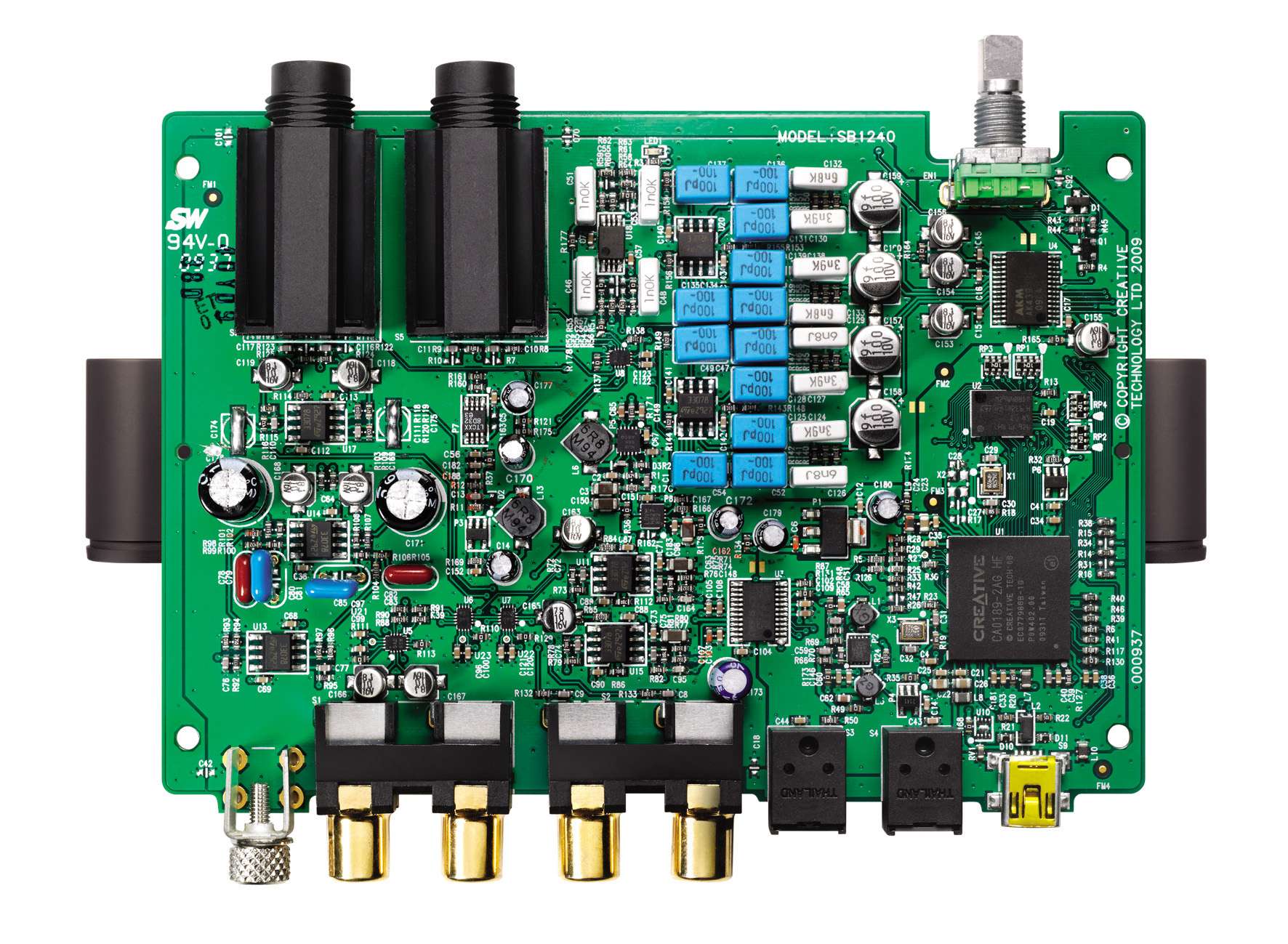
I acquired this little inexpensive gadget only because I´d found out with my then new Sennheiser HD-448 that the headphone output of my Lenovo SL-510 sucks. While this wasn´t obvious with my Superlux it became irritating soon with the very balanced Sennheiser because of missing treble and flat stageing. In the end I decided to buy another soundcard which turned out to be the X-Fi HD USB. True, I could have used my E-MU 0202 USB instead but its headphone output has a high output impedance (22 Ohms) and is pretty weak. Since the new Soundblaster was intended to be used soleley at our second appartement with one of my headphones it was of vital importance for it to contain a strong enough headphone output with low output impedance. For amplifying headphones the card uses the 4556 op-amp by JRC, this amp has been on the market for almost 30 years and it´s still a decent thing considering its price because it has a low output impedance (of just 1 Ohm) in combination with low distortions... that is if it´s treated right. For communication via USB the external card uses the CA0189 from Creative, the high quality D/A-converter is an AK4396VF from Asahi-Kasei while the CS5351 from Cirrus-Logic is responsible for A/D-conversion. But this card has something that distinguishes it from many other USB interfaces: it contains an RIAA amp, enabling you to connect your turntable to this interface directly without the need of an additional pre-amp. I thought that this particular feature might come in handy should I have the desire to capture vinyl. As it turned out during the last year I have not captured one single LP yet (except for testing); it probably has something to do with my strong dislike for this obnoxious and dreaded medium. Well, it doesn´t matter since this feature will not disappear suddenly, won´t it? To my own surprise I have instead used another aspect of this card quite extensively: its digital optical output made it possible to record music onto MiniDisc in high quality.

The inside of the Sound Blaster X-Fi HD USB. Not "audiophile" but high quality.
Copyright by Creative Labs.
I assume that you might have some reservations towards Creative cards; I´m aware that many people experienced problems with them - I myself never did though, every Creative card I´ve owned has been behaving as it should. Manufacturing quality and finish are decent considering the used materials (plastic). It posesses gold-plated connectors (it´s pointless for audio quality; it only avoids corrosion) and its outer shell feels nice to the touch. I especially love how smooth the volume button turns. But it´s very light and that could create problems: imagine plugging in a headphone - the card will simply slip if you don´t hold it in your hand. Setting up the card was easy, installing and upgrading didn´t produce any errors no matter where and on which PC I did it. BTW, I chose not to install the bloated software suite Creative offers, I picked the driver and the audio panel only. Fans of the DSPs typical for Creative (EAX 4.0, THX Studio Pro Crystalizer, Surround etc.) will be happy 'cause the card is equipped with them. Nonetheless they should be aware that all DSP functions are done in software and not in hardware like on the internal X-Fi cards which creates additional computing stress for an older PC or one of those low-power PCs. If you´re willing to experiment a bit, if you want to avoid installing issues or if you´d like to have the newest drivers (Creative is a bit lazy there) I can recommend a fully updated package conceived by the famous Daniel K.; get it here. The DSPs also provide an indication who the target audience for this card is: your average Joe with an interest in good sound quality for every day tasks or gaming, a lot of features and some toys to play around with. Music Professionals? This card lacks routing options, ASIO inputs for multitrack recording or XLR ports so it isn´t suited for professional music production. On the whole it feels like a small gadget able to be connected to your stereo system - that´s actually OK, Creative doesn´t hide this. Several people all around the web have reported that this card can be used as a DAC - I haven´t used it that way yet. Furthermore it still needs a running PC (in order to be powered). Well, it´s nice to have that feature.

Creative Labs Soundblaster X-Fi HD USB front
So far I´ve talked about its relative advantages and the features it offers. What about shortcomings, are there any? Indeed there are! Creative claims that this card offers an audiophile headphone amp. To determine if the JRC 4556 really is of audiophile quality we first have to make clear what the expression 'audiophile' actually means. If it means using anything out of the ordinary then this card isn´t audiophile because it uses readily available, not too costly parts. But as I´ve shown this isn´t an issue because something extremely well sounding can be produced using cheap and simple parts only. Should 'audiophile' mean engineering prowess, then the answer would be Yes/No. Recording and especially playback quality is very decent - but only if you use the line-in / line-out. The headphone output on the other hand seems to be a good example of botched engineering: Creative managed to turn a decent part with perfectly low output impedance into something with an output impedance too high for many headphones the card is actually suited for considering available voltage levels provided by the USB connection. The PCI-Express counterpart for this card, the Titanium HD, uses the same JRC 4556 IC and on that card it has a reported output impedance of 36 Ohms - way too much for IEMs, my HD-448 or my Superlux. I have to make it clear that this isn´t the fault of the IC itself; Creative seems to have added parts to save on engineering and it shows. To find out why that could create problems look at an example from an ancient portable player below:

Sony MZ-R 55 - headphone out with Triple.Fi 10 (copyright not with me)
The frequency reading of this exemplary unit above should ideally be a straight line - instead the high impedance of the MZ-R 55 headphone output creates severe frequency deviations with IEMs which WILL be audible. Since the PCB circuitry for the headphone amplifier looks similar on both Creative cards (according to others) we can safely assume that both will behave in a similar way, meaning that the X-Fi HD USB would have an equally high headphone output impedance creating the same or even stronger deviations like the ones pictured above. Yes, you´d have to say "Bye bye" to balanced sound quality. So in essence with the X-Fi HD USB you´ll have lovely audio quality using its line-out - but the headphone output will produce sonic crap should you be using it with low impedance cans susceptible to high impedance outputs. As a basic rule the headphone impedance should be 8 times higher than the output impedance of the amplifier the headphone is connected to. For the X-Fi HD USB you therefore would need a headphone with an impedance of at least 288 Ohms in order to reach balanced sound. Enter my Sennheiser HD-600 which boasts 300 Ohms... but wait, why is this gorgeous headphone so soft in volume? Because the X-Fi HD USB doesn´t offer enough power for such a demanding and power hungry creature (even though Creative advertises it that way). Which means that for the Creative Labs Soundblaster X-Fi HD USB you´d need a seperate headphone amp to unleash its full potential. Kind of defeats the purpose, don´t you think?

X-Fi HD USB headphone output and microphone input
The disadvantages don´t stop with the dreaded headphone out. Are you planning to play 44.1 / 88.2 kHz material with this card NOT using any resampling? Forget it then. The analogue in-/outputs only offer 48 / 96 kHz sampling rates. This card lacks a seperate crystal needed for 44.1 kHz-based samplerates even though the CA0189 used for USB communication is actually able to handle one of them (44.1). Which creates the second problem: the optical S/PDIF connectors can only process 44.1, 48 & 96 kHz - but they ignore 88.2. Why does all of this pose a problem? Because the good old CD uses a samplerate of 44.1 kHz, a standard the X-Fi HD USB cannot handle with its analogue outputs and inputs. Therefore a CD will always be resampled to 48 kHz or to 96 kHz (depending on what is configured in the Windows WASAPI control panel). Using 88.2 kHz files from for example HDTracks.com with the digital output of this Creative is not possible, at least not without resampling. Digital recording of 88.2 kHz material with its digital input? Don´t even think about it, the card won´t recognize it (I´ve tried). This 'fine' example of engineering seems to have been constructed 15 years ago when those samplerates indeed weren´t very common on PCs. Is this audiophile? I think you can now answer this question yourself.

Backside of the X-Fi HD USB
But now to measurments with RMAA. The first measurment I did for the original review was the commonly employed loopback from the output to the input of the same card via an RCA cable. Many computer magazines do this kind of measurment although it´s unsuitable for finding out if a soundcard behaves well. Using a loopback you for instance don´t know if it´s the output that´s noisy or the input because noise or distortions exhibited by the output are masking the possibly noise- or distortionfree input or vice versa. Therefore I´ve removed it for this updated article. Much more precise than the loopback are seperate testruns done seperately for the line-in and the line-out. So I connected the output of the Soundblaster to the input of the ASUS Xonar Essence ST and the other way round, both times using the same RCA cable. While a PC is inadequate for measuring a soundcard because of grounding issues I knew for certain that my ASUS behaves exceptionally well on it´s in/outputs (noise level of -115 dB for the output and -114 dB for the input, no distortions or jitter). To make it short I was fairly positive that it would be good enough for the purpose of exposing possible flaws of the X-Fi HD USB.

Recording (line in, 50 %): from ASUS to Soundblaster X-Fi HD, one year later,
using two different PCs, one on batteries

Playback (line out, 0 dB fs): from Soundblaster X-Fi HD to ASUS, one year later, 
using two different PCs, one on batteries - spectacular results

My latest article about USB cables made it clear that the playback part of this soundcard is perfectly engineered. During the tests for that article it transpired that I indeed had been measuring the effect of a ground loop a year ago. The result was that the old measurments did not show the possible performance of the Creative so I replaced them with the ones I did for the third article about USB cables. To the measurments: the DAC AK4396V is rated at having a noisefloor of -114 dB (min.) - Creative manages the feet of achieving fantastic -113 dB. Every measurment was done in 24/96 using 0 dB fs for both cards - except on the input of the Sound Blaster: its volume slider produced a perfect 0 dB fs input signal only at 50 % of the available recording level. Setting a recording level of 100 % I experienced severe distortions from an overloading input. That behaviour is caused by the line-in also used as an input for vinyl - the amplifier inside this card is always active. With vinyl records there also is a very noticeable gain of frequencies from 7.000 to 12.000 kHz, beyond those frequencies the band decreases sharply. This indicates capacity problems of the input when receiving vinyl signals but it isn´t a serious issue since 85% of commonly available RIAA amps behave exactly like that. Another thing: either the same line-in/vinyl amplifier of this card is used for the microphone input on the front - or a (possible) seperate microphone amplifier produces noise leaking into the line-in. The latter would demonstrate engineering errors:

Noise, line-in
The left channel is noisier on lower frequencies than the right channel; I assume the left stereo channel of the line-in probably doubles as the monaural microphone input. This is complaining on a high level because this noisefloor is OK for such a low-priced soundinterface. However, a few months ago I´ve stumbled upon an additional row of measurments on another site which revealed strong distortions. Since the loopback method was used I can´t tell if the input or the output distorts, I can only say that I myself haven´t witnessed distortions using the same method. EDIT 05.08.13: Hmm, that blog is now gone. My seperate testruns for recording and playback revealed that they are indeed higher for the input than for the output but non-threatening at all. My unit is practically distortion free though two different units of the same card measuring differently using a loopback might suggest poor quality control on Creatives' side, changed specs or measurments done wrong (happened to me too). Another typical flaw of cheap USB soundcards are high levels of jitter. Not with this card as you can see on the two pictures below:

Jitter, line-in, 24/96
Jitter, line-out, 24/96

The performance is excellent, playback as well as recording are virtually free of jitter. Because I was using a samplerate of 96 kHz for the Creative and 192 kHz for the ASUS I have effectively measured the jitter performance for both cards combined - even more impressive, isn´t it? It wasn´t that surprising since this soundcard employs the asynchronous USB transfer: instead of the PC pushing the data towards it the interface itself demands the data only when needed, it therefore is in complete control of the connection and its data transfer. On earlier USB interfaces the theoretically inferior synchronous or adaptive modes were used, occasionally prompting high jitter levels. I should however mention that asynchronous USB doesn´t automatically guarantees perfect audio, the engineers still need to be skilled to avoid jitter. Are you curious to find out for yourself which USB mode your own USB soundcard uses? In that case I can recommend the USB Decriptor Dumper from Thesycon.

X-Fi HD from above
Before I´ll tell you about audio quality I have to mention that I´ve used the X-Fi HD only in combination with the Audioquest Forest USB cable during the last year. I have written three articles about this and other (supposedly) High End cables: "Hot Vodoo: Audio differences between USB cables - yes, they do exist!" and "More USB cables - more differences", articles that proved to be highly controversial. The third and last article about USB cables "Vodoo continued: my final Statement on USB cables" mainly deals with the effects of a ground loop I have been measuring in the older articles. Also, please note that I´m able to apply my testing methodology only to the line-out but not the headphone output. It goes without saying that I did every single test not using any of the DSPs the card offers.

Sound with the line-out: The sound of this card is very good for playback. Compared to the reference files the Soundblaster X-Fi HD USB lacks a bit of high frequency gloss or 'air' which diminishes resolution and detail a bit. Bass is stronger than my reference files, that difference is small but noticeable. Speed and snap are marvellous over the whole frequency band, music indeed seem a bit 'faster'. Overall, the dynamics are exaggerated; they aren´t completely natural but riveting nonetheless, more importantly they never veer into strident territory. The stage is fascinating too: while it isn´t as wide as the reference it showcases more depth augmenting holographic impression. I found it very pleasing that the X-Fi HD USB borrows some of its characteristics from the excellent Sony D-335. The character of the original files is not retained completely, it´s partly replaced by something with a more forward sound. To put it bluntly: music is more fun coming from this card. In conclusion the line-out is not 100 % sonically invisible but for casual listening (or for almost anyone of its users) it´s perfectly suited. Yes, I think that many people will just love the sound the Creative creates (pun intended). Should you be using the stock USB cable the card was equipped with you will however encounter a flatter stage, its already exaggerated dynamic capabilities will turn from engaging to strident. You decide. Here are now my ratings for the line-out (Audioquest Forest used):

Sonic Balance:
Dynamics:
Resolution:
Stage / Ambiance:
Character:

Recording quality: the frequency deviation with vinyl signals is noticeable, causing hoarse sounding singers and too much 'air'. It´s also responsible for something best described as a brittle sound my two other RIAA amplifiers - which aren´t very good - lack. On the other hand playback of vinyl is not an exact science because of too many factors producing unreliable results. I can only say that for me the quality is good enough (I´d correct errors anyway). Recording usual line-in signals produces a slightly constricted sound, missing resolution and less dynamics. While this doesn´t sound it isn´t because the overall recording quality is decent. The noise signature of the left channel  revealed in my measurments above wasn´t audible.

Sound quality of the headphone output: Despite a way too high output impedance I have yet to encounter imbalanced sound quality with this card using headphones. I seem to have been lucky because my Sennheiser HD-448 and my Superlux HD-668B don´t have any problems with high output impedances, according to measurments on headphone.com they virtually aren´t susceptible to them. Compared to my FiiO E6 this card amplifies lower frequencies, creating more bass power as a result (without sounding bloated). Secondly, it presents music with more dynamics than it really has, making it a bit more aggressive and by that mirroring the sound of the the line-out. Can high impedance headphones like the Sennheiser HD-600 be used with it? Not the best idea, the card doesn´t have enough power for power hungry cans like these, the volume that can be reached might be too soft for some. Using the HD-600 in combination with the maximum volume setting creates distortions on transients; the headphone output cannot deliver what my HD-600 'demands'. Using it with a volume setting slightly below the maximum (90-95 %) these distortions are almost absent, yet the music lacks a bit 'body', meaning soloists have less chest. In short this combination sounds a bit thinner and slightly strident. I have not used IEMs or headphones sensitive to high output impedances with this card and I don´t intend to do so - in such cases I recommend to stay away from this card as far as possible.

Both the HD-448/449 & the HD-668B virtually aren´t susceptible to high output impdances

Concluding my revised article I can only say that the X-Fi HD USB is a mixture of good and bad. Creative claims that this soundcard is for audiophiles. Experience and research however reveal that this claim merely is wishful thinking of Creatives' marketing division and not grounded in reality. Simply put: the headphone output is crap. I´m sorry to say it as blunt as this, even when I consider that I haven´t had any problems at all. But I use headphones not affected by the high output impedance so I´m forced to ignore my own experience in this case. My point is that you, dear reader, probably don´t know if your headphones react to something like this; with this card you might think that the new and nifty cans you just bought don´t sound very well when in reality it is caused by a mismatch between the X-Fi HD USB and your headphone. You plan on using headphones with impedances higher than 250 Ohms to avoid this problem? Congratulations, you´ve just hit another obstacle because this card is too weak to power them sufficiently. Oh, you intend to play CDs in perfect quality with it? I´m sorry but this isn´t possible either because the lack of support for 44.1 kHz based samplerates forces the Windows audio engine to resample using its not very sophisticated interal resampler. You want to play the newest 88.2 kHz remaster of an ancient Rolling Stones album you just bought on HDTracks to feed it digitally to your very well engineered DAC? I´m very sorry, this is impossible too: Windows resampling kicks in again. 
This card is only for you if you can accept a loss in quality - or if you´re using 48 / 96 kHz exclusively, don´t use headphones vulnerable to high output impedance or weak output power and if you plan on correcting frequency errors produced by the RIAA amp needed for vinyl yourself with a high quality EQ. Should you find yourself in the latter description you will get decent manufacturing quality combined with a nifty looking exterior, very decent audio quality on the line-out and tons of DSPs to play with. One thing however is crystal clear: think carefully to which of the two groups you belong for this card is a disappointment in some regards. It took me a year to find out how badly this soundcard performs regarding certain aspects; I subsequently made the decision that this will be my final Creative product. For listening with headphones I can recommend the FiiO E07K 'Andes' warmly, it cannot record, nor does it feature digital in- and outputs, yet it´s impeccably neutral and able to power low impedance headphones competently.


Latest update: 11.01.2013
Related Posts Plugin for WordPress, Blogger...

The Socials