Showing posts with label oversampling. Show all posts

Monday, November 05, 2012

Review: Pioneer BDP-140

You´re about to read the penultimate out of nine reviews. You don´t need to read them all, just pick the unit that seems to be the most interesting to you. In the weeks to follow I´ll review the following units: Kenwood DP-5090, Pioneer DV-610, Sony CDP-470, Pioneer BDP-140, iRiver IMP-550, Sony MZ-R 55, Sony MZ-R 37, Sony NW-A 1000 and the Sansa Clip+. Stay tuned and enjoy the new review: the Pioneer BDP-140! I also implore you to read the article describing my rigorous testing methodology before you actually start reading this one.

Pioneer BDP-140 (picture copyright by Pioneer)
The Pioneer BDP-140 is my first BluRay player and the most recent of the bunch. My boyfriend bought it for me last month as a present for my birthday. Until a year ago I didn´t spend one minute on BluRay simply because the picture quality of the DV-610 was so wonderful with upscaled DVDs. At the same time I however noticed that special DVD editions were becoming less common; special or Collector's editions started to be produced for BluRays instead. Point is, I really like to put those nifty looking special editions onto our cupboards (or into drawers, the cellar... where there is available space). I´m a collector and DVD started to become extinct in regard to special editions so I concluded that I would finally need a BluRay player. In September 2012 the BDP-140 was going to be replaced by the BDP-150 (its very similar successor) and as a result it became very cheap: my boyfriend bought it for roughly 100,- Euros (compare that to the 170,- Euros for the DV-610).

Pioneer BDP-140 from inside
Its manufacturing quality is reflected by its price range: compared to the DV-610 it has been reduced somewhat. While the BDP-140 is bigger than the DV-610 it weighs roughly half, probably because everything inside is smaller, less complex with a much higher level of integration. The power supply board for the DV-610 for example is three times bigger, its PCB is twice as big and also contains more parts. When BluRay players first hit the market their cases were filled to the brink with parts, they even needed fans to cool their power hungry hardware. The BDP-140 has only one D/A-converter (a fairly recent Asahi Kasei 4430) which also seems to include the complete output stage... yes, it´s true, I can only see six additional parts for the output in the Service Manual. BUT: I might be talking bullshit here so I´d be thankful if someone could enlighten or correct me. Anyway, the DV-610 was still aimed at analogue playback, it could pass six  analogue channels for Dolby Digital, DTS, SACD and DVD-Audio through its RCA outputs while the HDMI-output felt like a fancy gimmick in comparison. The BDP-140 on the other hand has only digital interconnections in mind, achieved through its modern HDMI 1.4a output. Few people know that it´ll also allow digital output of SACD signals through its optical S/PDIF output with 24/88.2 (2.0). it´s one of only two players on the market able to do that. EDIT: The last two generations of Pioneer BluRay players apparantly have been able to do that, I became aware of it thanks to members from the AVSforum. Since everything can be done digitally the analogue output seems to serve as some kind of spare. Apart from being extremely lightweight it also doesn´t look good from the outside or the inside. The front and the mechanical parts (drive) feel like rather cheap and not well-manufactured plastic and the whole layout appears to lack sophistication and care. The impression I have is that this player is a mass-produced, off-the-shelf creation constructed without love - or so it seems.

Pioneer BDP-140: cheap looking front
BTW, Pioneer didn´t manufacture it, it was built for them by Chinese manufacturer TCL. That might be one of the reasons why several people at for example Amazon.com reported that the drive emits loud noises, that the menu of the player has faults or that the software embedded in the player crashes often - they don´t trust the Chinese even though they have been manufacturing high quality devices for years. I however have not witnessed something like this in the one month I´ve used it: for me it has been working without flaw, played every disc and every file I´ve fed it with so far. The drive is fast and doesn´t emit loud noises, the player also doesn´t get very warm. In short: since I got it it has been working very reliably.

Pioneer BDP-140 CD playback
Pioneer BDP-140 SACD playback
Pioneer BDP-140 jitter CD playback
As you can see on the RMAA charts the BDP-140 measures almost as well as the DV-610; jitter performance has been improved and I´m sure that it´s 100% inaudible. With CDs the sound through its analogue output is equally impressive: as detailed and defined as the reference it only shows a lack of power at the presence range to some extent. I assume that this somewhat laid back sound is also the reason for a recessed stage - but when I say "somewhat" I really mean that it´s hardly noticeable at all. The stage for example is as wide and deep as the reference files yet a tiny bit distant because of aforementioned reasons. The slightly diminished mids are also responsible micro dynamics losing a small part of their appeal. These are the only flaws I could find because it doesn´t have any problems with timing, snap, transients or speed. Resolution and details are top-notch, it also retains the reference files' character. I wish I could tell you that SACD sounds better, I can´t though because it sounds exactly like CD. Just like the DV-610 the BDP-140 resamples DSD to 24/88.2 - but apparently not as well. Taking other reviews I´ve read to their logical conclusion I´d like to point that even the digital output won´t reveal as much of the music as the analogue output of the DV-610. But I´m complaining on a high level... because consider this: the engineering focus wasn´t on analogue output and it still sounds that well? Above I wrote that it seems to be constructed without 'love'... as it turns out you won´t need emotions to create well sounding devices, apparently you´d 'only' need engineering skills! Congratulations, Pioneer:

CD/SACD playback

Sonic Balance:
Dynamics:
Resolution:
Stage / Ambiance:
Character:


Update 17.04.2013: Over half a year has passed since purchasing this BluRay Player. I would love to write that something dramatic has happened (no, I wouldn´t) but this player still performas as expected. Not one Disc it had to play during those seven months has malfunctioned, it didn´t matter if it was a BluRay, DVD, CD or SACD. There has been one complete crash of its system software which was caused by an error I made myself (I was trying out video encoding and created a faulty encoding). Furthermore, during those seven months I´ve come to love its remote. It feels wonderful in my hand (because of mixture of plastic/aluminum), has every button I wish for it to have and seems to have an incredibly powerful infrared light as I can point it anywhere with the player receiving every command. The result is that I can still recommend it, if you should find it anywhere go buy it.

Saturday, November 03, 2012

Review: Pioneer DV-610

You´re about to read the seventh out of nine reviews. You don´t need to read them all, just pick the unit that seems to be the most interesting to you. In the weeks to follow I´ll review the following units: Kenwood DP-5090, Pioneer DV-610, Sony CDP-470, Pioneer BDP-140, iRiver IMP-550, Sony MZ-R 55, Sony MZ-R 37, Sony NW-A 1000 and the Sansa Clip+. Stay tuned and enjoy the new review: the Pioneer DV-610! I also implore you to read the article describing my rigorous testing methodology before you actually start reading this one.

Pioneer DV-610
The Pioneer DV-610 is the first SACD player I bought. I already had collected numerous SACDs beforehand for years without being able to play them back. I knew that I would own a SACD player the moment they became affordable - which finally happened in 2009 when I bought this one for 170,- Euros. But I wanted more and this player appeared to be the device best suited to my needs: I wished to replace my ageing JVC DVD player with a technologically more advanced machine, a player that would read every medium I´d throw at it with ease (including my SACDs). I also wanted to have an HDMI output for possible future use with a modern display. Last year in July we finally bought our first flat screen and for the first time I witnessed a digitally transmitted picture having a quality I didn´t expect coming from DVD. Responsible for upscaling to 1080p is a chip manufactured by Mediatek, this chip (MT1389) also does DSD decoding, mp3 decoding, MPEG 2 / MPEG 4 decoding and whatnot. D/A conversion is achieved by three Burr Brown PCM 1742KE (released in 2005 and still in production), an up-to-date delta-sigma converter incorporating functions into only one IC for which the Kenwood DP-5090 and the Sony CDP-470 needed up to five seperate ICs. It´s also quite expensive when I consider that the Pioneer DV-610 was only a budget model. For SACD its potential is partially unused since the Mediatek chip resamples DSD from 1/2.8224 down to 24/88.2. The huge amount of parts for D/A converter and output stage present in the CDP-470 and the DP-5090 is absent, the Pioneer achieves the goal of converting and amplifying with a much simpler layout.

Responsible for good picture quality at 1080p
Manufacturing quality is ok but nothing to get mad about. The DV-610 is lightweight, its front is made out of plastic and the drive mechanism (by Orion) doesn´t feel too robust (though it still works very well, reliably and fast). It´s certainly not manufactured as well as the Kenwood DP-5090 which probably is the reason that this player and its predecessors didn´t fare too well in reviews when used as a CD/SACD player. Several audio magazines here in Germany compared it against much more expensive players (heavier, more parts, etc.) and - surprise! - they fared much better. As we all know, weight, manufacturing quality and a high price tag are all important for audio, aren´t they? To find out if that´s the truth let´s have a look at my measurments which have been done seperately for CD and SACD:

Pioneer DV-610, CD
Pioneer DV-610, SACD
Pioneer DV-610, jitter, CD
Apart from the amount of jitter the measurments are excellent throughout, noise or distortions are absent. Jitter indicates a mixture of low frequency jitter (the "spread" around the 11.025 Hz sine) and periodic high frequency jitter. However, everything is well below -110 dB so it´s probably inaudible. Measurments are slightly better when the test signal is played back on SACD - this is exactly as it should be since it offers higher resolution. The SNR and Dynamic Range show the skill with which the engineers designed the PCB layout: the DACs are rated at -106 dB, I measured -104 dB which is a fantastic result. Still, I´m slightly disappointed because 20 Bit output quality theoretically allows for a SNR of -121 dB. I know, I know, I´m complaining on an extremely high level, furthermore if someone needs to be blamed it´s Burr Brown for constructing such 'noisy' DACs in the first place.

CD playback
CD material shows dynamic capabilities close to the reference files (transients seem a tad too timid), the stage is well represented albeit a bit too compact and not particularly stable; instruments tend to change their place. Furthermore, the timing is not very good for lower frequencies: bass sounds as if it "follows" the rest of the frequency spectrum where timing and snap are impeccable. Overall EQ displays a little fondness for bloated and too thick bass while treble is diminished a bit which hampers detail and resolution to be reproduced properly. But there are advantages as well: this player won´t ever sound strident, sibilant or shrill, it also won´t sound slow or boring because apart from the bass mids and treble show a lot of speed with a particularly enjoyable amount of snap. Yes, this player really grooves. Sonic colour is the area where the player clearly surpasses the reference; it adds a nice voluptous and engagingly wet yet precise euphonic sheen to the music. This sheen naturally is artificial and not the original but it´s still jolly good fun, therefore:

Sonic Balance:
Dynamics:
Resolution:
Stage / Ambiance:
Character:


SACD playback
When playing back SACDs the Pioneer DV-610 sounds... well, it doesn´t really sound. It was extremely difficult for me to hear any difference to my reference files at all. Dynamics are almost perfect, the timing problem audible with CD material vanished upon playing SACD. Staging sounded like a carbon copy of the reference, just like resolution, level of detail and colour. Still, stage and imaging on occasion show some tiny difference, sometimes instruments seem to be placed rather strange with the left channel sounding as if coming from behind (don´t know how else to describe it). But instead of creating a euphonic colour the player now sounds perfectly neutral and completely retains the character of the recording. Any deviation I´ve just described is tiny, but I have to mention it and I will therefore substract one point for dynamics & stage. The pristine sound with SACDs leaves me with only one possible rating, the highest I´ve ever given to a player:

Sonic Balance:
Dynamics:
Resolution:
Stage / Ambiance:
Character:


Pioneer DV-610 close-up

Saturday, October 27, 2012

Review: Kenwood DP-5090

This is my first review out of nine. You don´t need to read them all, just pick the unit that seems to be the most interesting to you. In the weeks to follow I´ll review the following units: Kenwood DP-5090, Pioneer DV-610, Sony CDP-470, Pioneer BDP-140, iRiver IMP-550, Sony MZ-R 55, Sony MZ-R 37, Sony NW-A 1000 and the Sansa Clip+. Stay tuned and enjoy the first review, the Kenwood DP-5090! I also implore you to read the article describing my rigorous testing methodology before you actually start reading this one.

Kenwood DP-5090

The Kenwood DP-5090 was released in 1997 and it is one of those players released around that time that managed to reproduce 16 Bit CDs with 24 Bit accuracy... or so. Back then many players claimed to be capable of playing CDs with a resolution exceeding their technical abilities. The proprietary Kenwood D.R.I.V.E (Dynamic Resolution Intensive Vector Enhancement) filter did - according to some reviews - well enough for this player to sound sensational. I´ve read several reviews praising its wonderful sound, many magazines ended up rating it higher than many other units. But we don´t want to concentrate on reviews from the past, we want to rate the real thing.
Build quality is nice as well, the front is manufactured out of thick aluminum, the rest of the case is fairly heavy and equally well built, even the drive mechanism is protected with a thick metal plate. Actually... there seems to be a lot of conflicting information around as to which parts the DP-5090 is actually using. The chaos starts with the service manual: the DP-5090 apparently uses nothing less than three seperate D/A converters. The first is the MN35502 from Panasonic, the second is the CXD2507AQ from Sony and the third is Kenwood's own KAN05. According to the manual only the latter is in use... but the streamlined signal flow depicted in the manuals' diagrams looks so chaotic that I might be wrong. Internally the DP-5090 is pretty similar to the cheaper DP-4090 - the main difference is that the more expensive model uses a combination of several ICs for the DSP stage. I don´t exactly understood if it uses two or three seperate digital filters: the SM5843 from NPC or another filter embedded into the KAN05 itself (or maybe the Sony IC?). In any case, the Service Manual confuses me and the layout seems needlessly complicated. Sure, I´m a layman in that regard... still, todays' much more advanced converters contain all the necessary parts in only one IC. Anyway, the D/A converter (or the whole converting stage) is surrounded by an army of transistors, SMDs, ICs and condensers, the output stage required for amplifying signals once they have been converted to analogue seems equally sophisticated. The player is able to read CD-Text information, it also is equipped with two digital outputs; one can therefore connect it easily to more modern D/A converters. When new it cost 350,- which is not exactly what audiophiles consider High End but it still was one of the more expensive mainstream players. According to my boyfriend (who bought it all those years ago) the DP-5090 never was very reliable, it always had problems reading certain CD-Rs or scratched CDs. That wasn´t an issue for me since the CD-Rs I usually create are of high and flawless quality. On the other hand it is not exactly causing me to invest much trust into it.

Kenwood DP-5090 measurments

Kenwood DP-5090 jitter
As you can see above this player measures exceptionally well, noise and distortions are simply absent. Jitter won´t be audible, it´s extremely low. It´s for sure one of the best devices I´ve ever measured. The sound however wasn´t able to hold up the promise of high quality; the DP-5090 is very far away from being a neutral player. Treble is exaggerated, this creates a lot of air and resolution but it also prompts Madonna to sound hoarse, sibiliant and shrill ("Ray of Light" is actually a warm sounding album). Secondly this player presents a very tight, extremely articulated and dynamic bass response with real punch. This would be wonderful if upper bass wouldn´t be diminished; vocalists lack chest, violins sound thin and brass piercing. True, a signature like this could have its advantages because of extreme levels of dynamics, impact and speed. On the other hand staging is flat and doesn´t show any depth, it´s very audible with organ recordings which crumble apart... well, at least it presents an extremely stable, consistent flat stage. But holographic stage impression? Forget it. This is a very aggressive, dynamic and cool sounding player, it has nothing in common with the sound of the reference files. It will turn music into a fast, coloured and icy warzone, presenting it with much more details and punch than it really has. It will also replace the musics' character with its own, not convincing character. I´m probably kidding myself because I have to assume that many people would actually prefer this sound. Not everyone has perfect neutrality in mind; Pop, Rock or Funk might even sound more appealing with the DP-5090 for some people. Jazz or classical music however sounds just horrible with it so I won´t ever recommend it, except maybe as a transport using its digital outputs. Disappointing.

Sonic Balance:
Dynamics:
Resolution:
Stage / Ambiance:
Character:

Monday, January 16, 2012

Pioneer's LegatoLink, Wadia Spline - the secrets about Up- and Oversampling


Well, I won´t tell you about "secrets" - simply because there aren´t any. Up- or/and Oversampling are fairly standard in any CD player, soundcard, network player, mp3 player or similar stuff. They are not really necessary but they reduce unwanted digital artifacts... or so they teach us. I also won´t tell you in detail how oversampling or upsampling works because that´s far too technical and because I lack the knowledge of how it exactly mathematically (my boyfriend is a mathematician but he doesn´t care about this stuff).

What is oversampling? It´s a process of multiplying (for example 4fs oversampling means quadrupling the information) the data so engineers are able to use a simpler constructed (and cheaper) aliasing filter above the transition band. Aliasing artifacts are a inherited system anomaly when digital is converted back to the analogue domain (and vice versa but we´ll be looking at the playback chain only). These aliasing artifacts are nothing more then the signal from 20-22.050 Hz mirrored to higher frequencies (from 22.050 to 44.1000). Contrary to what anyone has told you or will tell you (including me) these are indeed artifacts, distortions or imaging products. They are false "signal ghosts" which in theory could become dangerous because of the possibility of creating intermodulation distortion on amplifiers which in turn destroy the loudspeakers - both are often stated mantras in engineering circles. These "artifacts from Hell" therefore have to be removed from the outputted signal. One must do this with a low pass filter, either digital or analogue - digital is more effective and less prone to introduce other unwanted distortions. On the first CD players without oversampling the analogue filters kicked in at 20.000 Hz (at the end of the passband) and because of these filters not being very good (because of a very small transition band from 20.000 to 22.050 Hz) and also because they were so very near to the audible frequency band they produced some other artifacts like phase distortions or were very hard to design.

So oversampling was devised as a simple & cheap method to move the place for the alias filter to kick in to a higher frequency so that it wouldn´t hurt the audible signal from 20-20.000 Hz. Let´s look at my exemplary quadrupling oversampling filter again: you´d end up with a samplerate of 176.400 Hz simply by multiplying the digital output (44.100 Hz) four times. When you stretch something with 4fs oversampling you create gaps and these gaps are filled with interpolated data. Result: only one out of four data points is a "real" point whereas the other three points have been guessed based on the available real data. But the effect of the transition band moved to 176.400 Hz is more advantageous then the disadvantages of the interpolation because now you just need one simple electronic part to remove unwanted aliasing effects - and you won´t even hurt the signal too much; the transition band can be much wider and less perfect. The aliasing filter doesn´t kick in at 22.050 but at 88.200. Other advantages of oversampling are higher resolution (more possible bit-depth) and less noise because quantization noise can be spreaded into a wider overall frequency band. That´s why oversampling is used today in almost any digital device - and it´s good that way. Well, there are still people (the guy from XXHighEnd for example) or companies around who prefer true multi-bit and non-oversampling D/A-converters (i.e. the classical approach) - they now look a bit ridiculous, don´t they?

Upsampling isn´t that much different because it too creates more data by increasing its amount, much the same as Oversampling (but at a later stage). Only the output is different. With oversampling the output has the same samplefrequency as the input, with upsampling (correct would be resampling) you change the output itself. Depending on how often you resample you can create any frequency you want, from 88.200 to 192.000. That´s also the reason why an ancient DAC-7 by Philips is able to output higher samplerates then  the 44.1 kHz it was initially designed for when released in the early '90s (as proven by Pro-Ject and their external DAC).

So, what do we have now? An aliasing artifact free output in both cases. BUT: other artifacts have been introduced because oversampling/upsampling still need digital filters to remove unwanted content above 22.050 Hz. These low pass filters work at precisely 22.050 Hz and depending on how wide or small (the slope) this low-pass filter is designed to work inside the transition band it will erase all frequencies up from 20.000 Hz (this was actually intended and that´s also the reason why you can often read about a frequency response of 20-20.000 Hz for CD; the 2.050 Hz are designed to be a "buffer" or a "spare".). Where was I? Ah yes, the slope. A steep slope used with the low-pass filtering stage for example creates an unwanted artifact called "ripple":

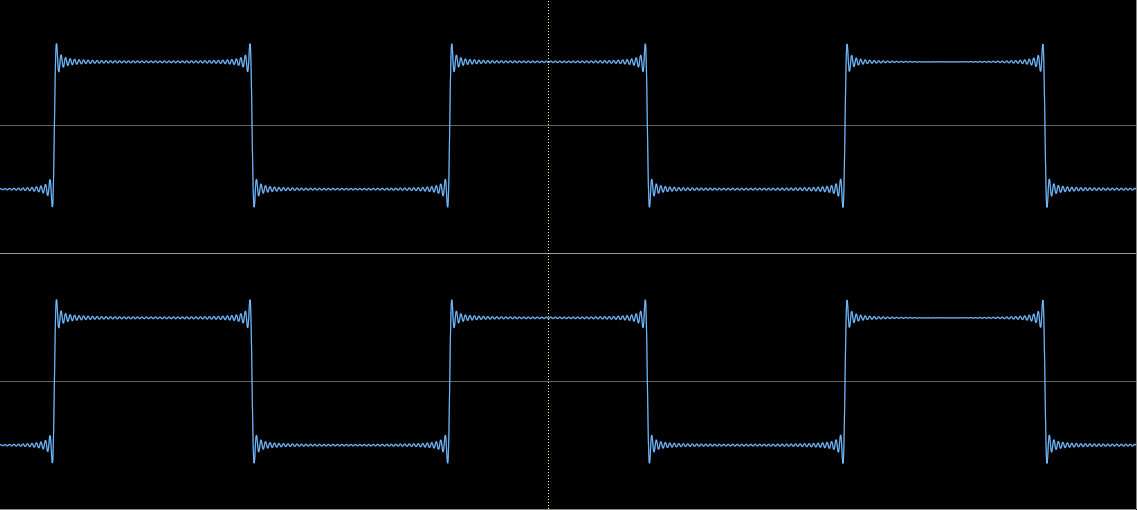
On this example using a 44.1 kHz created square wave (base frequency: 500 Hz) the signal begins to ripple
before the actual signal happens and continues to ripple after the signal stopped - this is called pre- and post echo.

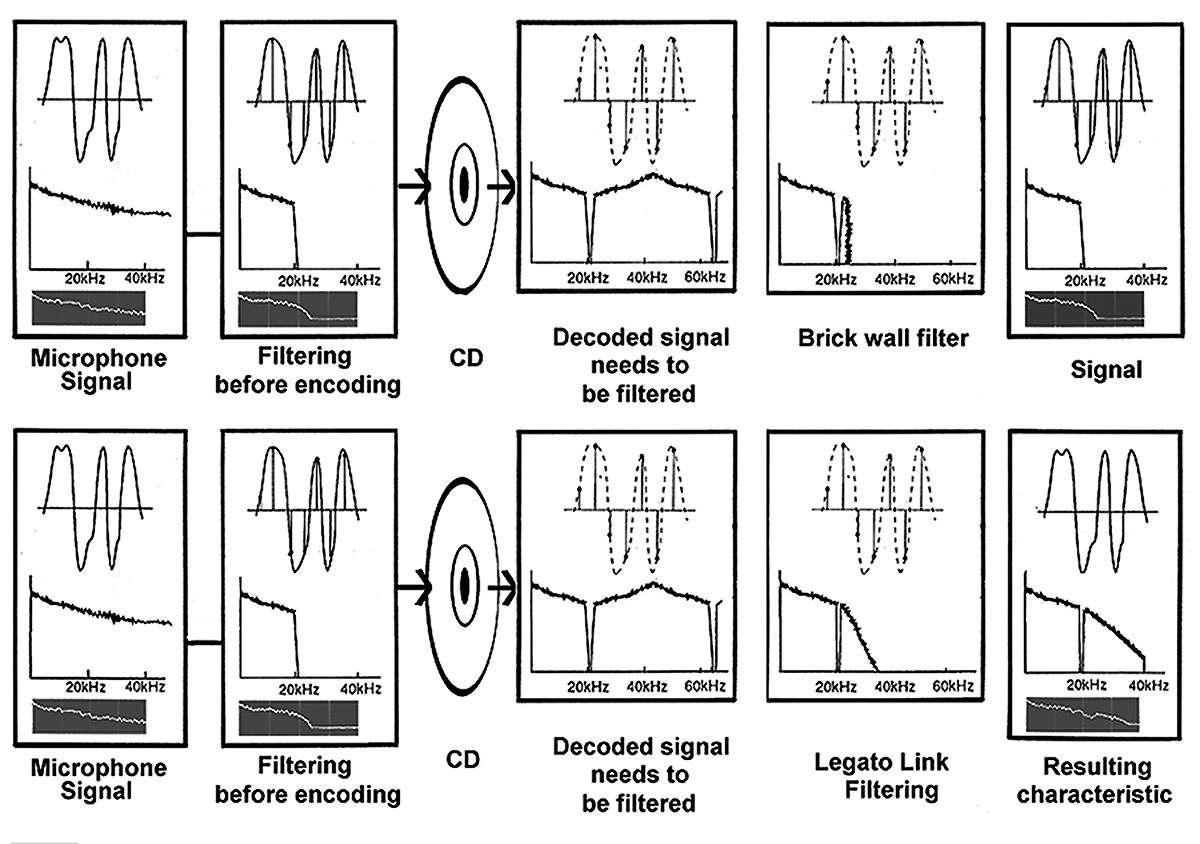
This ripple effect is another inherent necessity because of the window function used to design the low-pass filter. You can either have this or a frequency deviation that is close to the transition band. With a perfect filter you wouldn´t have any frequency deviation or ripple - it´s sad that this perfect filter doesn´t exist. Mathematically it´s possible but the computational power needed for it would be way too demanding. And who would need to use it anyway? Because every engineer will tell you that this ripple only happens at the passband area at 22.050 Hz and doesn´t bleed into lower frequencies. Well, this actually isn´t true, I´ve tested it myself. The ripple effect will be weaker the lower you go on your frequency band - but on frequencies around 2.000 Hz it´ll be still apperent. Some companies did not like this behaviour and so they started to use a different filter design. The most prominent example would be the spline algorithm by Wadia. Starting in the late '80s they began to use a design with a much less steep filtering slope, called Spline Algorithm. But these were expensive high end players so a company from Japan, Pioneer, created their own system, called "Legato Link" which did the same as the filter from Wadia. The major difference between Wadia's spline algorithm and Pioneer's Legato Link was that Pioneer intended it for high end players as well as for components aimed at regular customers. They also backed it with a huge advertising campaign and some funny looking charts:

Copyright by Pioneer.

In effect they lied a bit by shifting the attention from impulses to frequency response. They claimed that their Legato Link system recreated lost frequencies by adding new ones. These "added" frequencies were of course nothing more then aliasing artifacts (correct would be the term "imaging") that were let through in a controlled way by means of a less steep low-pass filter, very similar to the one used by Wadia before. Over the years Pioneer used it in CD players, CD recorders, DAT recorders, MD recorders and DVD players. To my knowledge they even use it today but I don´t know if it still works the way as I´ve described here. However, the measurment loving community hated it because low-pass filters with gentle slopes may get rid of pre- and post ringing artifacts but they nevertheless create frequency deviations. They were skeptical for another reason too: the Pioneer design didn´t follow the age-old mantra of forbidding any aliasing, they even ignored that no amplifier or loudspeaker connected to a digital device with Legato Link filtering exploded (as they must have been expecting) while amplifiying those components. Anyway, with their Wadia-like filter design Pioneer decreased frequencies from the analogue output as much as -3 dB at 20.000 Hz. Of course, Wadia had the same problem but where Pioneer accepted a non-standard frequency response Wadia instead tried to counter these diminished high frequency power by adding harmonious distortions created by their analogue output stage (isn´t that funny: you want to get rid of distortions by adding new ones!). Anyway, both companies were successful in their endevour of perfecting the impulses:

The same signal as above but upsampled to 96 kHz with a gentle, Wadia/Pioneer like 
filter (done with iZotope RX): look how much the ripple has been diminished.

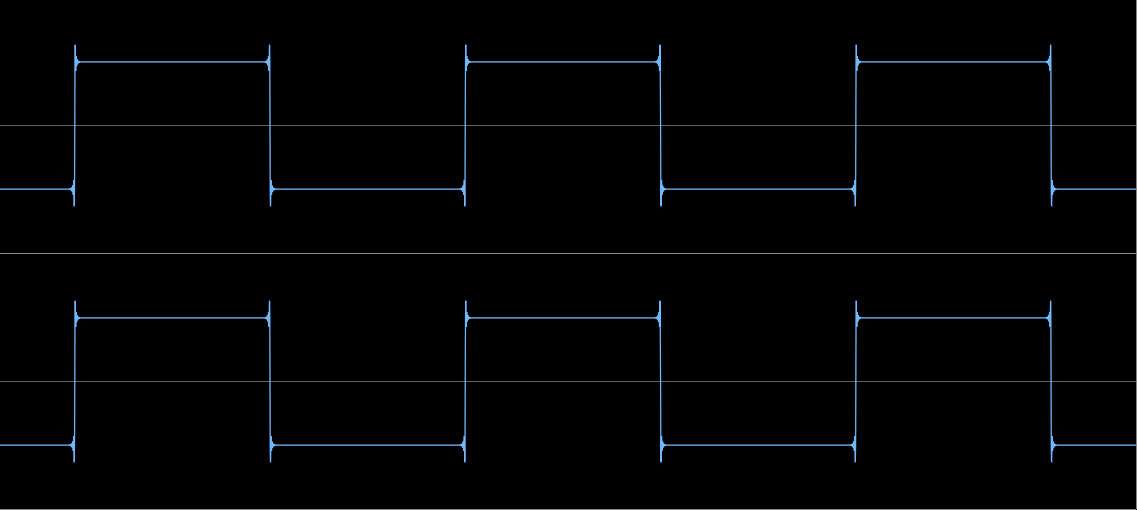
Just for comparison: the same signal - only upsampled to 96 kHz with the usually used steep filtering.
Horrible, isn´t it? Ripple has been increased which is what you get with normal upsampling.


The ripple-free example looks good, doesn´t it? The pre- and post echos have been reduced and the signal is almost free of ripple or ringing artifacts. I´d love to tell you that the Pioneer players were the best in existence but sadly I cannot: I once owned a Pioneer PD-S 802 myself - complete with Legato Link and their famous Stable Platter drive (an unreliable thing) and I can assure you that it sounded like crap. I bought it because in every test I´ve read it was supposed to sound much better then my older Technics SL-XP 300 (which wasn´t equipped with all those nifty techniques). But it did not and I was very disappointed. I have to admit, it probably sounded that bad because the effect of nice impulses was much smaller then the effects of the electronic parts surrounding the D/A-converters or the parts responsible for amplifying the RCA outputs. However, my next CD player was a Sony CDP-XB 920 which had a switchable filter design (you were able to switch between standard, spline and analogue filter designs). Yet, the Sony sounded best with the standard filter. Maybe it sounded that well because it didn´t upsample at all, the Sony "only" oversampled, or because of the parts used at the output stage, whatever the reasons were, I don´t know.
BTW: this is a native 96 kHz created square wave that hasn´t been upsampled: Almost pristine impulses.

So the Sony sounded slightly better with the ripple-as-hell filter design. The example of my Sony shows two things: 1. Impulses are not that important 2. the circuit design is much more important for sound. To change the design of the low pass filter is only really necessary if you strive to finetune the output of a digital component, it certainly hasn´t the world saving effect Wadia or Pioneer have been claiming over the years. If you´re curious and want to review the effects of impulses for yourself you can do so: you´ll have to buy a neat and wonderful program, iZotope RX Advanced. This program has a resampler that can be configured to your needs, you can for example use the standard filter for upsampling or a more gentle approach. Before I forget: you should never ever use the gentle approach when downsampling signals! If you´d do a serious error like that you would mirror aliased signals back into the signal - and that would be like inviting evil into your digital house because these aliasing distortions are permanent, cannot be removed once they are there and they tend to be quite audible. I say that because iZotope RX Advanced allows you to do just that, you have to be careful how to use it and you have to know what you´re doing. This isn´t for Noobs! Following that warning now a little advertising: besides having one of the best resamplers out there this program offers a ton of high quality DSPs for repairing destroyed audio material, in short it´s worth all its money. Oh, I forgot to mention: my approximation for the gentle low-pass spline filtering looks like this:

My standard setting for upsampling 44.1 or 48 kHz material.

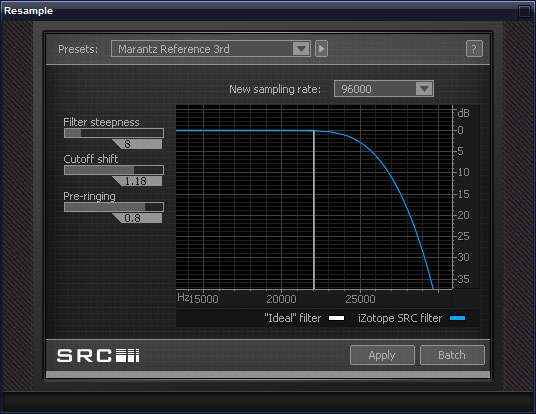
I used a different preset for quite some time that was supposed to sound close to original 24/96 stuff and was modeled after a High End player from Marantz, for completists I will post it here too but please be aware that I discarded it some time ago. For one, I correct frequency errors introduced by my gentle filter with an EQ and secondly because of better hardware I now own. My "Marantz Preset" was created using a combination of double blind and sighted listening tests with my old Sounblaster Live! 24 Bit External; with that hardware it sounded close to original 24/96 material but when I got my revealing ASUS Xonar Essence ST three years ago I realized that it actually sounded a bit wrong and not at all close to original 24/96 material, probably because of the Cutoff shift moved to 1.18. Additionally, by moving the pre-ringing I also created slight phase distortions - I was aware of this back then but I accepted them as inevitable for my goal to reach sonic perfection. So here it is but be advised that you´ll introduce other types of flaws or distortions into your material permanently:

My old configuration. Don´t use it.

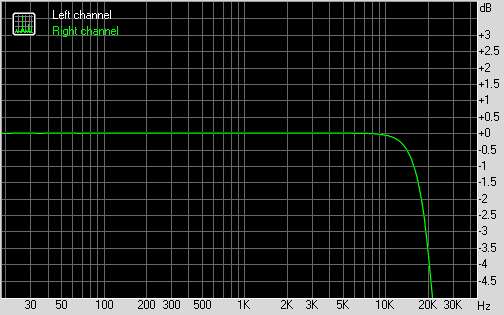
Attention, fellow readers: both configurations I´ve shown to you destroy the material integrity you´re working with! Just remember that it´ll run through a low-pass filter for a second time the moment you convert it back to analogue at playback. The effects won´t be that severe because the passband will be far away from audible frequency bands and because modern, 96 kHz capable D/A converters are using a gentle slope at high sampling frequencies - but still: every processing step you do will further diminish the quality of your material. You can circumvent some ill effect by using the highest bit-depth within iZotope RX Advanced of 32 Bit floating point and by saving your work with this bit-depth (or at least dither when you decrease bit depth to 24 Bit). Furthermore, be advised that you´ll create a frequency error with in the end much more worse effects compared to the ripple effects you rather wanted to erase:

With the gentle spline filter you´ll get this frequency response.
No pre- and post echoes but a frequency error.

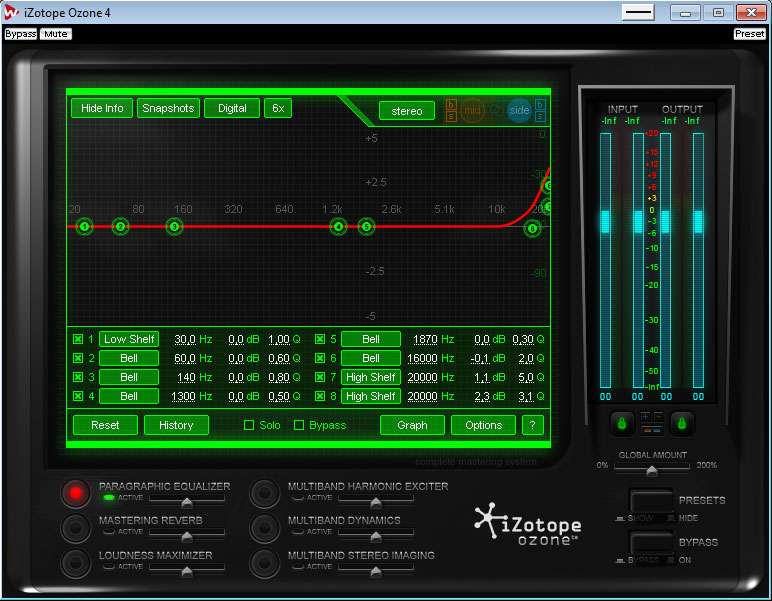
The frequency error can be countered to a certain extent with an EQ.

Of course, by using a digital EQ you´ll introduce another DSP into your processing chain, in effect diminishing the signal quality further. If you use 32 Bit floating point dithering before decreasing to 24 Bit you can avoid some ill effects - even if it´s still an additional DSP. I myself use this method on every music I listen to but I´m fully aware that I´m destroying the signal integrity. Why am I doing this? Because the music I listen to probably was processed with a multitude of effect signal processors with not much naturalness left anyway (except some very good, natural recordings that I don´t upsample at all). Anyway, there´s still one thing you don´t have to pay attention to: you´re not going to destroy your loudspeakers, it just won´t happen - and you could have this impression by reading some comments about this on hydrogenaudio. My general warning however remains and is still valid: I´m replacing one ill effect with another. You´ll also have to be aware that you won´t (and never will be) creating true 24/96 material! What once was lost cannot be recovered or re-engineered. The material I´m listening to most of the time is nothing more then a pleasant sounding fake that pleases my ears but that shouldn´t be looked at from a data integrity or measurment standpoint. In the end you´ll have to decide what you´ll be doing for yourself, I wish you much fun and luck!


Related Posts Plugin for WordPress, Blogger...

The Socials