

Introduction
The following Article concerns itself with a piece of software called an Equalizer. Removing certain frequencies with this EQ enables the ATRAC codec necessary for any MiniDisc recorder to encode any piece of music in a superior way. Substantial proof will be offered by means of measurements as well as musical examples.
A warning: if you are lazy or if PC-based audio is a complete mystery to you this article isn´t for you. You also won´t be happy if you think that an equalizer is one of the devil's minions (an opinion clearly not based upon facts). Furthermore, the significant sound improvements described here require you to spend some time with your music, it means work. If you can´t afford the necessary time, you probably aren´t interested in good audio quality coming from MiniDisc at all. Or are you? ;)
A warning: if you are lazy or if PC-based audio is a complete mystery to you this article isn´t for you. You also won´t be happy if you think that an equalizer is one of the devil's minions (an opinion clearly not based upon facts). Furthermore, the significant sound improvements described here require you to spend some time with your music, it means work. If you can´t afford the necessary time, you probably aren´t interested in good audio quality coming from MiniDisc at all. Or are you? ;)
Basics of lossy encoding
Lossy (or perceptual) codecs were developed for only one thing: making audio smaller without you, dear constant reader, noticing it. Using a datarate of, say, 128 kBit/s you´ll receive a file the size of only 5 megabytes (before: 50 megabytes). Every lossy codec available on the market performs this 'shrinking', it doesn´t matter if it´s ATRAC, MP3, AAC, OGG or WMA. How do these codecs achieve this? They 'erase' or 'alter' parts of any musical material, getting rid off things our ear cannot perceive anyway. Erasing certain parts of any object reduces its size which is most convenient for portable players not having terabytes of available space; they can store more music that way. In the article that follows I will compare ATRAC (necessary for MiniDisc) to MP3. Both codecs are equally old (20 years), yet MP3 is still in development. ATRAC however was declared dead in 2004 with the introduction of Hi-MD, since then it hasn´t been improved. ATRAC is effectively one of the worst codecs around, it doesn´t help that its datarate is comparably high (292 kBit/s). It could have been more effective if Sony would have decided to fuck their desire for power constraints (a superior ATRAC IC would have drained battery power faster). Well, we have to work with what we´ve got and how we are able to improve it. Anyway, the following chapters will show you the most important basic instrument any perceptual (lossy) codec employs to fool your ear... or more precisely, your brain (Fig. I):
 |
| Fig. I: Equal-loudness contour, logarithmic scale (copyright: Wikipedia) |
 |
| Fig. II: Multitone signal, -6 dB, .WAV, 24/44.1 (linear scale, Hanning) |
 |
| Fig. III: Multitone signal, -6 dB, MP3 (Lame, 256 kBit/s), 24/44.1 (linear scale, Hanning) |
Disadvantages of ATRAC compared to MP3
 |
| Fig. IV: Multitone signal, -6 dB, ATRAC 4.0, 24/44.1 (linear scale, Hanning) |
Advantages of ATRAC compared to MP3
 |
| Fig. V: 1 kHz sine, MP3 (Lame, 256 kBit/s), 24/44.1 (logarithmic scale, Hanning) |
 |
| Fig. VI: 1 kHz sine, ATRAC 4.0, 24/44.1 (logarithmic scale, Hanning) |
Sonic differences between ATRAC & MP3
Ask 'normal' people (not audiophiles) how they perceive the sound of MP3 and you´ll most likely receive the answer that it sounds slightly warmer to them, that is, if they can hear any difference at all. Yet your basic audiophile will call its sound 'cold' and 'digital' when in reality nothing could be further from the truth (their reasoning: it must sound that way because it uses lossy compression). Listen, all you audiophiles out there: MP3 encoded music sounds a tiny bit warmer compared to the original. The reason is not that it removes any frequency content above 16 kHz (also stated by audiophiles), the one and only true reason is that it fails at encoding short transients responsible for dynamics, attack and precision. When ATRAC still was used regularly it too was described as sounding 'cold' (for example in German STEREOPLAY magazine 15 years ago). Again, this isn´t true. At least not for ATRAC 4.0 and ATRAC 4.5. Both sound significantly more pleasant and warmer than the original (ATRAC DSP Type-R changed the situation somewhat). Responsible for this mellow signature isn´t a too short window size. These shortcomings are caused by the ATRAC codec attempting to encode signals up to 20 kHz. All those years ago, magazines and audiophiles alike (the german STEREO magazine paramount among them) constantly pressed Sony to improve rendering of high frequencies. They believed that if you could retain frequencies from 16 to 22.05 kHz it would yield true audiophile sound. Bullshit! ATRAC would have profited extremely if they wouldn´t have listened to audiophiles, I will show you how.
Tweaking ATRAC
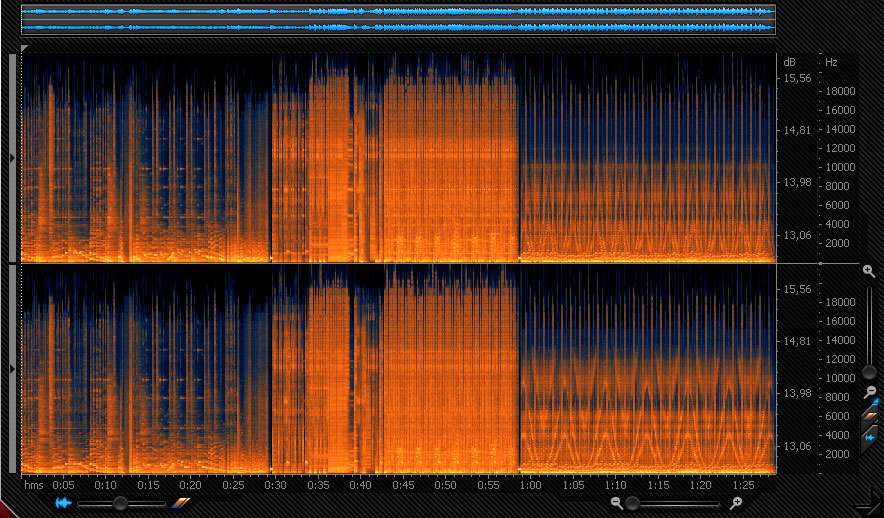 |
| Fig. VII: ATRAC standard encoding (24/44.1, linear scale) |
 |
| Fig. VIII: Multitone signal, -6 dB, ATRAC 4.0, STANDARD ENCODING, 24/44.1 (linear scale, Hanning) |
 |
| Fig. IX: Multitone signal, -6 dB, ATRAC 4.0, 15.5 kHz CUTOFF, 24/44.1 (linear scale, Hanning) |
Look at Fig. IX and compare it to Fig. VIII by clicking on one of them with the left mouse button and scrolling through both of them. Quantization noise floor has been lowered by roughly 5 dB - and only because frequencies beyond 15,500 Hz have been removed. Stunning result, isn´t it?
 |
| Fig. X: RMAA frequency response, ATRAC 4.0 STANDARD ENCODING, four passes |
 |
| Fig. XI: RMAA frequency response, ATRAC 4.0, 15.5 kHz CUTOFF, four passes |
Even RMAA recognizes the effect. Fig. X & XI depict that the hole around 4,000 Hz, typical for any ATRAC version, has almost disappeared along with the odd response at subsonic frequencies (20 Hz). Increasing levels from 10,000 to 15,000 Hz on Fig. XI are caused by my equalizer setting (see below at 'Equalizing ATRAC (costly option)').
Equalizing ATRAC (free option)
I told you that this tweak is free, I therefore searched, found and measured a suitable equalizer. This was difficult, not many free equalizers around are able to process with high quality. I will however also tell you about costly alternatives, namely SoundForge and iZotope Ozone. SoundForge is the VST-host while Ozone is the equalizer I work with in that case. I will talk about them because they are yield slightly superior quality. Never, I repeat, NEVER use built-in equalizers (SoundForge, WaveLab, Adobe Audition, foobar2000, Winamp). I´ve measured them and they create so many errors that it´s shocking. Anyway, to achieve the tweak without paying any money while still retaining high quality you´ll need these things:
- foobar2000 (get it here)or
- a VST-wrapper (get it here)
- the equalizer EngineersFilter from RS-MET (get it here)
- Audacity (get it here)
- the equalizer EngineersFilter from RS-Met
 |
| Fig. XII: RS-MET EngineersFilter setting for ATRAC Cutoff |
Fig. XII reveals my configuration for the cutoff filter. The EngineersFilter offers several other filtering methods but I decided to keep it simple in order for less tech-savy people to use it as well. Regarding installation/setup of foobar2000, its VST-Wrapper and the EngineersFilter I cannot help you however, you need to figure that out for yourself, the same goes for Audacity. Other recommendations are: keep the signal at 32 bit floating-point, regardless if you´re working with foobar2000, SoundForge or any other digital audio editor. As you know, the MiniDisc is capable of working with high resolution material so if you´re recording from a PC just keep it at that high resolution. If you don´t want to use a PC I´d recommend a CD-RW (which can be erased and rewritten). In that case, decrease bit-depth to 16 bit without using noise-shaped dither (the shaped and dithered quantization noise would otherwise confuse ATRAC again) and burn the results to CD-RW.
Equalizing ATRAC (costly option)
 |
| Fig. XIII: iZotope Ozone 4.0 settings for ATRAC cutoff |
 |
| Fig. XIV: iZotope Ozone 4.0 general setup (-> click 'Option') |
First of all you´ll need a digital audio editor like SoundForge, WaveLab, Adobe Audition or Audacity. With these you´ll be able to load iZotope Ozone (in my case, version 4.0) which you will configure to the specifications pictured in Figs. XIII & XIV. The 1.5 dB amplification of frequencies at 20,000 kHz is optional and used by me to fool my ear into not recognizing that certain frequencies are alltogether absent. Why would you even use the iZotope Ozone EQ? Because it´s in my experience the best equalizer on the market, it doesn´t create phase distortions nor other distortions or errors and generally performs perfectly. Have a look:
 |
| Fig. XV: iZotope Ozone, phase response |
 |
| Fig. XVI: EngineersFilter, phase response |
The phase response sadly is very underrepresented when it comes to sonic differences between DSPs or units playing audio material. In this case it´s evident that iZotope Ozone has superior phase performance (Fig. XV) compared to the EngineersFilter (Fig. XVI), yet it is debatable if this is audible at all. Let´s be fair: the EngineersFilter EQ performs admirably compared to all the other free EQs I´ve tested. Impulses play a role too:
 |
| Fig. XVII: iZotope Ozone, impulse response |
 |
| Fig. XVIII: EngineersFilter, impulse response |
Fig. XVII depicts a perfectly symmetrical impulse response for iZotope Ozone. A high steepness of the cutoff filter produces better frequency resolution at the expense of perfect impulse response. The same is true for the EngineersFilter, although here the impulse response (Fig. XVIII) is modeled after the first CD players with analogue anti-aliasing filtering. In the end you have to decide, I´ve written it years ago that the effects of impulses are overrated. BTW, the settings I´ve described yield the following measurable results:
As you can see on both examples above which were created by RMAA I´ve achieved the desired effect - without frequency deviations created by crappy equalizers and, almost (for the EngineersFilter) without phase distortions. The graph depicting the zoomed-in frequency response (Fig. XX) reveals a not too steep cutoff, yet it´s precise enough to get rid of frequencies beyond 15.5 kHz. The result of my procedure is evidenced by Fig. XXI: the picture shows a spectogram derived from an ATRAC encoded/decoded recording (compare to Fig. VII). The precise 15.5 kHz cutoff is clearly visible.
 |
| Fig. XIX: frequency response, ATRAC 4.0, 15.5 kHz cutoff (logarithmic scale) |
 |
| Fig. XX: frequency response detail, ATRAC 4.0, 15.5 kHz cutoff |
 |
| Fig. XXI: ATRAC encoding with 15.5 kHz cutoff (24/44.1, linear scale) |
The sound
When I first heard the results I couldn´t believe my ears, the sound had improved by such a margin that I was wondering how I had been able to listen to it before. Precision, attack, stability and holographic impression of the stage were sounding so much better now... But listen for yourself. The following files were recorded digitally with the Sony MZ-R 55 featuring A) the standard full-frequency and B) the 15.5 kHz cutoff discovered by me. In both cases, the original files were at 24/44.1. After recording I played them back using the Kenwood DM-5090 (also digitally) and recorded its output with the optical input of my Creative Labs Soundblaster X-Fi HD USB. After that I merged three 30-seconds examples and uploaded them to soundcloud. INSTEAD OF LISTENING TO THEM ONLINE, DOWNLOAD THEM! Reason: both are ATRAC-encoded/decoded PCM-files, encoded again with MP3 by soundcloud (at 128 kBit/s). Should you just press 'play' you´d only hear a transcoded file, revealing compression artifacts clouding possible differences. Downloading them however you´ll be able to listen to the pure, ATRAC-encoded/decoded, Kenwood-derived, digital files in pristine 24 bit quality without further influence from soundcloud. You would even be able, should you desire, to perform a DBT listening test; these two examples were edited with sample precision.
Three ATRAC 4.0 encoded samples, standard encoding
Three ATRAC 4.0 encoded samples, encoded using my 15.5 kHz cutoff filter
Epilogue
And? What do you say? I feel that the result speaks for itself. I admit that this tweak requires some effort but I think that it´s worth it. I now can use ATRAC 4.0 again! Oh yes, I almost forgot... why didn´t I use a more recent ATRAC version? While the effects will be superior using ATRAC 4.5 or higher, the ATRAC 4.0 equipped recorders I own (MZ-R 30, MZ-R 50, MZ-R 35, MZ-R 37, MZ-R 55) have high quality drives, producing MiniDiscs running without flaw on any other MD recorder / player. Later units (MZ-R 900, MZ-R 909) featuring superior ATRAC ICs fail to do this. With the exception of the Sony MZ-N 510 they all record with unreliable results. I also admit that it isn´t very convenient to use MiniDisc these days. The reason to use them, for me at least, isn´t their sound. Every other lossy codec employed today around the world is superior. I´m sorry, but it´s a fact. Still, I love those little discs. The players/recorders are of high build quality, sound well enough (in some cases more than well) and you get the joy of bringing some amount of 'slowness' into your musical life by occupying yourself with media you can actually touch. Let´s face it, I´m an idiot. An idiot... just like people still listening to vinyl. Like them I believe in an ancient and deceased format. But have I mentionend yet, that it´s pure joy? Oh, I did? Never mind! Anyway, with my tweak you´re able to prolong the lifetime of MiniDisc before it´s completely replaced by superior codecs and playback devices. And while you´re at it, use it in combination with the FiiO E07K, it´ll sound even better this way. Use this chance well and enjoy the results!

Last update: 06.09.2013
